CNC Router Meaning: A Plain-Language Guide to What the Term Means and What the Machine Does
Three letters and a common word that together describe one of the most practically useful machines a small shop, maker space, or fabricator can own. CNC router comes up in conversation constantly, but it is also a term people use without always being sure they are using it correctly. Is it the same as a CNC mill? Is it a laser cutter? Is a desktop hobby machine “really” a CNC router? This guide unpacks the meaning properly, not with jargon, but with the actual substance behind each word.
A CNC router is a computer-controlled machine that uses a rotating cutting tool to carve, cut, and profile material by moving that tool precisely across multiple axes according to a digital program. CNC stands for Computer Numerical Control. Router refers to the type of material-removal tool: a spinning bit that cuts on its sides and tip, the same principle as a handheld woodworking router but mounted on a gantry and driven by a machine.
Short answer: CNC tells you how the machine is controlled (a computer translates coordinates into precise motor movements), and router tells you how it cuts (a spinning bit removes material). Together, a CNC router is a spinning-bit cutting machine whose movements are commanded by a computer program.
What each word in “CNC router” actually means
CNC: Computer Numerical Control. The computer sends numerical coordinates to the machine’s motors, which move the tool to those positions precisely. “Numerical” is the key word: instead of a person guiding the tool by feel or by following a template, a series of numbers defines every position in the cut. The program that provides those numbers is called G-code, and it is generated by CAM (Computer-Aided Manufacturing) software from a design file.
Router. In woodworking, a router is a handheld power tool with a spinning bit that cuts profiles, rabbets, dadoes, and decorative edges. The bit spins fast and cuts on contact. A CNC router uses the same cutting principle, a high-speed spinning bit, but instead of being handheld and guided by a person, it is mounted on a motor-driven gantry that the computer moves with precision. The word “router” distinguishes it from a CNC mill, which operates on harder materials with lower spindle speeds and different tool geometries, and from a laser cutter, which uses a beam rather than a spinning tool.
What the machine physically looks like and how it works
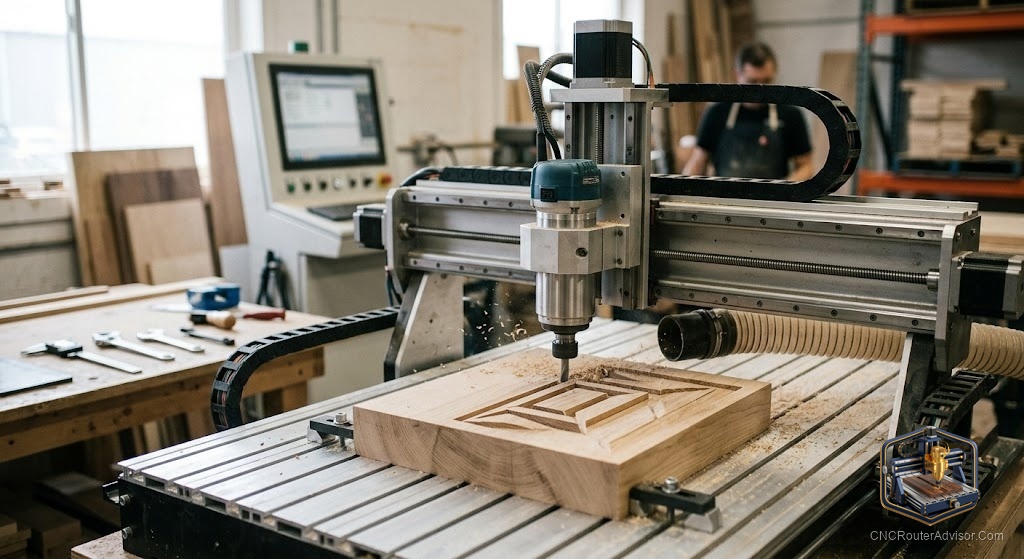
A CNC router has a flat table (the bed) where the material is held, a bridge-like structure (the gantry) that moves the cutting head across the material, and the cutting head itself that moves up and down. The computer controls all three directions: X (left and right), Y (front and back), and Z (up and down). By combining movements across all three axes, the tool can reach any point in the work area and cut to any programmed depth.
The operator creates or imports a design in software, converts it to toolpaths in CAM software, loads the file on the machine, secures the material, and runs the program. The machine does the cutting; the operator monitors the job.
What a CNC router is not
Understanding the meaning fully includes understanding what the term excludes.
A CNC mill is a different machine, built for hard metals at lower speeds and with more rigid construction. The boundary is blurry at the edges, but a router is typically faster, larger in work area, and optimised for softer materials like wood, MDF, plastic, and non-ferrous metal.
A laser cutter uses a concentrated beam of light rather than a spinning bit. No contact with the material, no chips, different physics entirely. Some machines combine a router and a laser head on the same gantry, but each tool and method is distinct.
A 3D printer builds material up; a CNC router removes it. Both are computer-controlled, but the process is the opposite.
The range of machines the term covers
One clarification worth making: “CNC router” covers machines from a desktop hobby unit cutting 180mm by 300mm of acrylic all the way to a full-sheet production machine processing 4-by-8-foot plywood panels. Both are CNC routers in the correct meaning of the term. The scale, the spindle power, the motion system, and the control software differ enormously, but the definition, a computer-controlled spinning-bit cutting machine, applies to all of them.
The verdict
The meaning of CNC router is straightforward once you take the term apart: a spinning-bit cutting machine whose movements are commanded by a computer via numerical coordinates. It is not a laser cutter, not a CNC mill, and not a 3D printer, though it is in the same family of computer-controlled fabrication tools. Knowing this precisely makes every other conversation about the machine, buying decisions, software choices, material compatibility, more grounded.
Three things to remember:
- CNC means Computer Numerical Control: a computer converts coordinates into precise motor movements, removing human hand-guidance.
- Router means a spinning bit that cuts on contact, the same principle as a handheld woodworking router but computer-driven and mounted on a gantry.
- The term covers a huge range of machine sizes and prices; a desktop hobby unit and a production full-sheet machine are both correctly called CNC routers.
FAQ
What does CNC router mean? A computer-controlled machine that uses a spinning bit to cut, carve, and profile material. CNC stands for Computer Numerical Control (the computer commands movement via numerical coordinates), and router describes the spinning-bit cutting method.
What does CNC stand for? Computer Numerical Control. It describes the method of control: a computer sends numerical coordinates to the machine’s motors, which move the tool precisely without human hand guidance.
Is a CNC router the same as a CNC mill? No. A CNC router is optimised for wood, plastic, and soft metals at high speed over a large area. A CNC mill is built for hard metals at lower speeds with more rigid construction. The cutting principle is similar but the machines serve different applications.
Is a CNC router a laser cutter? No. A laser cutter uses a focused beam of light; a CNC router uses a spinning bit. Different physics, different materials, different results, though some machines can accept both a router head and a laser module on the same gantry.
What does a CNC router cut? Wood, MDF, plywood, acrylic and other plastics, foam, and soft non-ferrous metals like aluminium and brass with the right tooling. Hard metals like steel are outside the typical range.
What is G-code, and why does it matter? G-code is the numerical instruction set that tells the CNC machine where to move and how fast. CAM software generates it from your design file. It is what the “numerical control” in CNC actually refers to.
Does “CNC router” apply to small hobby machines too? Yes. The term covers machines of all sizes, from desktop units cutting small hobby projects to industrial full-sheet production machines. The definition is about how the machine is controlled and how it cuts, not about its size.
References
- CNC Router Info, How to Choose a CNC Router (machine fundamentals): https://cncrouterinfo.com/guides/how-to-choose-a-cnc-router/
- 731 Woodworks, CNC Machines for Small Woodworking Shops: https://www.731woodworks.com/731-blog/best-cnc-machines-for-small-woodworking-shops-in-2025-beginner-to-pro-picks