
CNC Router Gantry Guide: Features, Specifications, and Buying Considerations
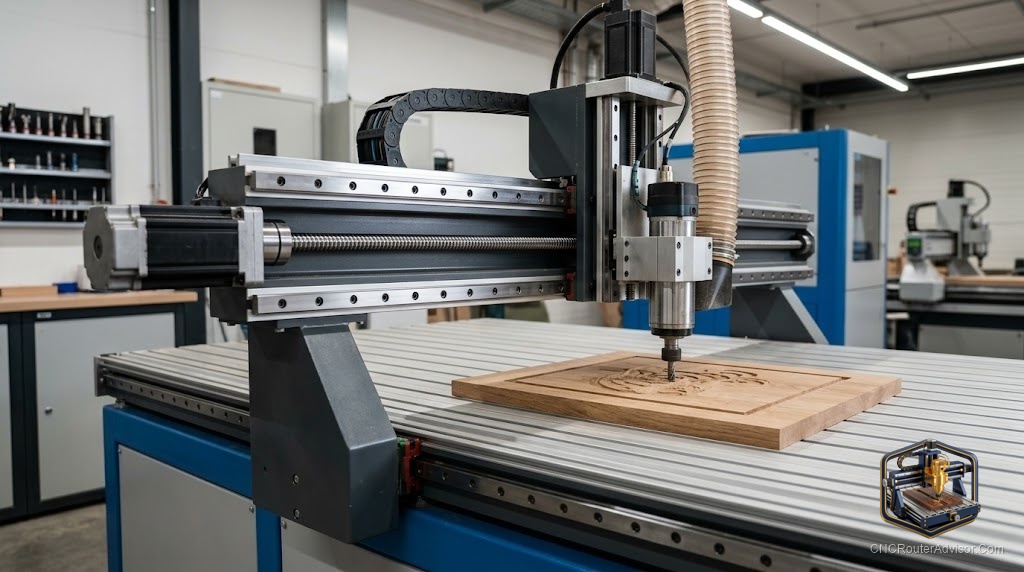
Everything the CNC router cuts flows through the gantry. It is the bridge that carries the spindle across the work area, and its rigidity, its span, and the quality of its motion system determine whether the machine cuts accurately across a full sheet or loses precision mid-table. Most buyers spend their attention on work area and spindle specs, but experienced operators will tell you the gantry is the component that separates machines of the same stated size from each other.
The gantry on a CNC router is the structural bridge that spans the bed and carries the Z-axis assembly across the work area. It travels along the Y-axis while the Z-axis moves the cutting head up and down. The quality of the gantry determines positional accuracy, resistance to flex under cutting force, and the consistency of cuts across the full travel distance.
Short answer: a heavier, stiffer gantry on a well-supported rail system produces better cuts, especially at the far ends of the travel where flex is worst on weaker designs. When comparing machines of similar work area, gantry construction is the most revealing indicator of real-world performance difference.
What the gantry has to do
The gantry has two jobs that work against each other. It must be rigid enough to resist deflection under cutting forces, and it must travel smoothly and precisely along its full length, which means it also needs to be as light as practical so the drive system can move it accurately. On small machines those two goals are easy to balance. On large machines, flex at the ends of a long gantry span becomes the dominant limit on cut quality.
A gantry that flexes under load lets the spindle wander off the programmed path, producing chatter, varying depth of cut across a sheet, and parts that do not match from one end to the other.
Gantry materials and construction
Steel tube or plate is the most rigid material and is standard on production and industrial machines. Aluminium extrusion is lighter and widely used on hobby and prosumer machines with good results at shorter spans. Composite or polymer-filled profiles on budget machines trade rigidity for cost and are a red flag at any substantial span.
Beyond material, connection points matter. A gantry well-bolted to well-machined bearing carriages stays square and true; one with loose or imprecise connections introduces slop that shows up in cuts.
Gantry height and Z clearance
Gantry height determines vertical clearance between the bed and the spindle, setting the maximum material thickness and the maximum tool stick-out you can use. For most sheet work, 100 to 150mm of Z clearance is practical. Confirm Z clearance against your typical material thickness before buying.
Fixed versus moving gantry
Most hobby and prosumer routers use a moving gantry, where the gantry travels along the machine while the work surface stays fixed. This is compact and works well at most hobby scales. On larger production machines, a fixed-gantry design where the table moves can be very rigid at large spans but requires a longer machine footprint.
Drive system on the gantry
Rack and pinion is the common choice at larger spans because it handles the forces without belt stretch or flex. On smaller machines, lead screws and ball screws are precise and backlash-free. Belts are used on the smallest hobby machines where cost is the priority and the span is short enough that stretch does not materially affect accuracy.
The verdict
When comparing CNC routers of similar work area, spend time on the gantry. Look for heavy construction, well-supported rail carriages, and a drive system suited to the span. A stiffer, heavier gantry means better cuts across the full table, more durable results in harder materials, and a machine that stays accurate longer.
Three things to remember:
- The gantry’s rigidity sets the ceiling on cut accuracy and consistency across the full work area.
- Material and connection quality matter as much as stated specs; flex at the ends of the gantry travel is the most common performance gap.
- Match the drive system to the span: rack and pinion for large machines, screws for mid-range, belts only for short-span hobby use.
FAQ
What is a gantry on a CNC router? The structural bridge that spans the bed and carries the cutting head across the work area, traveling along one axis while the Z-axis assembly moves the spindle up and down.
Why does gantry rigidity matter so much? A flexible gantry deflects under cutting forces, letting the spindle wander off its programmed path and causing chatter, depth variation, and parts that do not match across the sheet.
What is a good gantry material? Steel is the most rigid and is used on production machines. Thick aluminium extrusion is widely used on hobby and prosumer machines with good results. Composite profiles at any substantial span are a cost compromise worth avoiding.
Fixed gantry or moving gantry? Moving gantry is compact and effective for most hobby and prosumer use. Fixed gantry can be very rigid at large spans but requires a longer footprint.
How much Z clearance do I need? For most sheet work, 100 to 150mm is practical. For carving into thick stock, more is useful.
How do I check gantry quality before buying? Push the gantry sideways with moderate hand pressure. Obvious flex is real flex that shows in cuts. Check rail carriages for precise fit and solid mounting.
Does a heavy gantry slow the machine down? At very high rapid speeds it can, but for woodworking and metalworking feeds the difference is negligible. The rigidity benefit outweighs any modest speed trade-off.
References
- Avid CNC, PRO4896 CNC Router (gantry construction and specifications): https://www.avidcnc.com/pro4896-4-x-8-cnc-router-machine-p-1337.html
- ShopSabre, Best CNC Routers for Small Businesses: https://www.shopsabre.com/cnc-routers-for-small-business/
- CNC Router Info, How to Choose a CNC Router: https://cncrouterinfo.com/guides/how-to-choose-a-cnc-router/