
CNC Router Parts: What Every Component Does
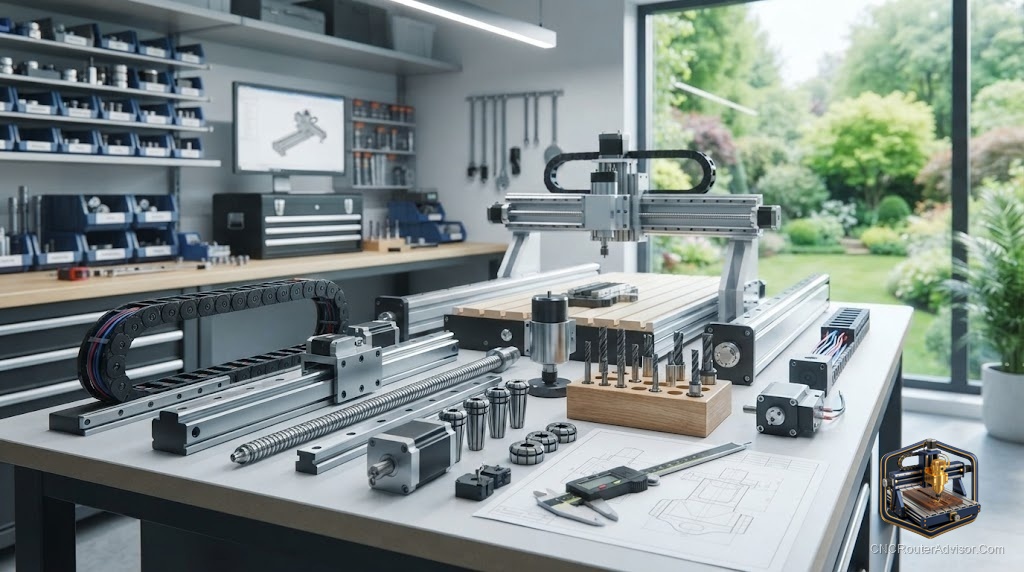
A CNC router that produces inconsistent cuts is usually a machine with a compromised part. It is never obvious which part until you understand what each one does. The gantry that racks slightly produces diagonal error. The V-wheel with a flat spot produces periodic position error. The collet that is under-tightened allows bit pull-out mid-cut. Understanding the parts prevents these failures.
CNC router parts are the mechanical, electrical, and structural components that work together to move a rotating bit through programmed toolpaths.
Structural Parts
Frame: Aluminum extrusion (2040/4080 profile on hobby machines) or welded steel on production machines. Sets the maximum rigidity the machine can achieve. All other adjustments work within the frame’s rigidity limit.
Gantry: The bridge structure that moves along the Y-axis carrying the X and Z assemblies. Must be perpendicular to the Y travel and square to the table.
Spoilboard: Sacrificial MDF surface under the workpiece. Must be surfaced flat to the machine’s Z travel plane.
Motion Parts
Stepper motors: NEMA 23 standard for hobby X, Y, Z drives. Open-loop: no feedback. Loss of steps = lost position.
Lead screws / ball screws: Convert motor rotation to linear motion. Lead screws: adequate, some backlash. Ball screws: less backlash, higher accuracy.
Linear rails / V-wheels: Guide axis travel. Linear rails (MGN12, HGR20) are smoother and require less maintenance. V-wheels wear and need periodic adjustment.
Spindle Parts
Trim router: Makita RT0701C or DeWalt DWP611. Brushed motor. Manual speed. Community standard.
Collet: Holds the bit shank. 1/4-inch native. 1/8-inch reduction collet. Must be torqued correctly.
Controller Parts
GRBL board: Interprets G-code, drives stepper drivers. Arduino + CNC shield or dedicated boards.
Limit switches: Define machine home position. Crucial for repeatable job setups.
FAQ
What is the most important CNC router part to maintain? The collet. Under-torqued collets allow bit pull-out. Worn collets allow runout. Inspect and replace on schedule.
How often should V-wheels be replaced? When flat spots or groove wear are visible, or when axis play is detectable. Typically every 100-500 hours depending on cutting conditions.
What causes stepper motor step loss? Acceleration too high for the motor, acceleration ramps too aggressive, or cutting forces exceeding motor torque. Reduce feed rate or acceleration first.
References
- Sienci Labs. Machine components. resources.sienci.com
- Carbide 3D. Machine documentation. carbide3d.com