
Baileigh CNC Router Guide: Features, Specifications, and Buying Considerations
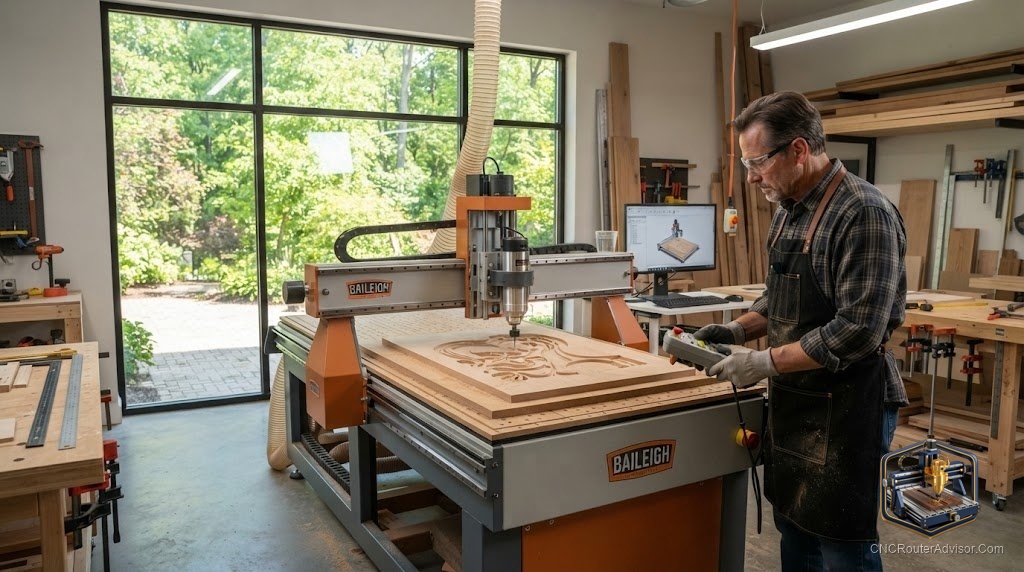
Baileigh Industrial is a known name in metalworking and woodworking machinery, and its CNC routers sit toward the professional and industrial end of the market rather than the hobby bench. When you are looking at a machine from an established machinery brand, the evaluation is less about whether it can carve at all and more about whether its capability, support, and price fit a working shop. This guide explains the features and specifications to expect from a professional-class router like a Baileigh, and the buying considerations that should drive the decision, so you can judge it on substance.
With an established machinery brand, the questions shift to build quality, support, and production fit, so the goal is a framework for evaluating a professional router on the factors that matter.
A Baileigh CNC router is a professional and industrial-class router from an established machinery manufacturer, built for woodworking, sign making, and production work with an emphasis on rigid construction, capable spindles, and dealer support. Evaluating one means checking the fundamentals, work area, frame rigidity and motion system, spindle power and type, and Z clearance, alongside the professional-level factors that matter at this tier: build quality and reliability, control and software, available support and spare parts, and shop requirements such as power and space. Because professional machines are a substantial investment, weigh total cost of ownership and the strength of support against your production needs, and confirm specifications with the manufacturer or dealer.
Judge a professional router on fundamentals plus build quality, support, and production fit, and confirm the details with the dealer.
Features to expect
Professional-class routers like Baileigh’s typically emphasize:
- Rigid construction: heavier steel or reinforced frames that resist deflection for clean, accurate cuts in demanding materials.
- Capable spindles: more powerful spindles (often VFD-controlled) than hobby machines, suited to production cutting.
- Solid motion systems: linear rails and ball or lead screws for precision and durability under load.
- Larger work areas: beds sized for real production parts and sheet goods.
- Dealer support: access to support, spare parts, and often training, a key advantage of buying from an established brand.
These features aim at reliability and throughput rather than the compact convenience of desktop machines.
Specifications to check
Work area. Confirm the X, Y, and Z travel fits your production parts and sheet sizes, with sensible headroom.
Frame and rigidity. Look at frame material and construction, since rigidity sets cut quality and material capability. Professional machines should be notably stiffer than hobby routers.
Spindle power and type. Match spindle power and RPM range to your materials and production cutting. A VFD spindle offers variable speed and durability.
Motion system. Linear rails with ball or lead screws indicate a precise, durable machine built for sustained use.
Control and software. Confirm the controller and CAD/CAM compatibility fit your workflow, including any production features you need.
Shop requirements. Check power (single or three-phase), floor space, and dust extraction needs before buying.
Buying considerations
Match capability to production needs. Buy for the work area, spindle power, and throughput your shop actually requires, with headroom, rather than over- or under-buying.
Prioritize reliability and support. For a professional machine, uptime matters. Weigh build quality, reputation for reliability, and the strength of dealer support and spare-parts availability.
Weigh total cost of ownership. Look beyond purchase price to installation, tooling, maintenance, and support over the machine’s life.
Confirm the specifications. Verify work area, spindle, rigidity, and control details with the manufacturer or dealer, and where possible seek feedback from current users, rather than relying on marketing.
Plan the install. Confirm your shop’s power, space, and dust extraction can host the machine before purchase.
The verdict
A Baileigh CNC router is a professional and industrial-class machine from an established manufacturer, built for woodworking, sign making, and production with rigid construction, capable spindles, and dealer support. Evaluate it on the fundamentals, work area, rigidity, spindle, and Z clearance, plus the professional factors that decide value at this tier: build quality and reliability, control and software, support and spare parts, and shop requirements. Because it is a substantial investment, weigh total cost of ownership and support strength against your production needs, and confirm the specifications with the manufacturer or dealer. Judged that way, you will know whether it fits your shop.
Three things to take with you:
- A Baileigh router is professional and industrial-class, emphasizing rigid construction, capable spindles, solid motion systems, and dealer support over compact convenience.
- Check the fundamentals (work area, rigidity, spindle, motion system, control) and the professional factors (reliability, support, spare parts, shop requirements) together.
- Weigh total cost of ownership and support strength against your production needs, confirm specifications with the dealer, and plan power, space, and extraction before buying.
FAQ
What class of machine is a Baileigh CNC router? Professional and industrial-class, from an established machinery manufacturer, built for woodworking, sign making, and production work rather than the hobby bench. Expect rigid construction, capable spindles, solid motion systems, larger work areas, and dealer support.
What should I check when buying a professional CNC router? The fundamentals, work area, frame rigidity, spindle power and type, motion system, and Z clearance, plus professional factors: build quality and reliability, control and software, support and spare-parts availability, and shop requirements like power and space. Confirm details with the dealer.
Do Baileigh routers need three-phase power? It depends on the specific model and spindle. Larger professional machines often use three-phase power, while some may run single-phase. Confirm the power requirement with the manufacturer or dealer before purchase and plan any electrical work accordingly.
Why does dealer support matter for a professional router? Because uptime matters in production, and a professional machine is a long-term investment. Accessible support, available spare parts, and often training determine how quickly you recover from problems, which can be worth more day to day than a small specification advantage.
How do I judge if a professional router is worth the price? Weigh total cost of ownership, purchase, installation, tooling, maintenance, and support, against your production needs and the value of reliability and support. Match capability to the work you actually do, with headroom, rather than over- or under-buying.
What shop requirements should I plan for? Adequate power (single or three-phase depending on the model), sufficient floor space with a solid, level floor, and dust extraction sized for production cutting. Confirm these before purchase, since retrofitting power, space, and extraction after delivery is costly and slow.
References
- Wikipedia, CNC router overview: https://en.wikipedia.org/wiki/CNC_router
- Baileigh Industrial, CNC routers (manufacturer): https://www.baileigh.com