
5-Axis CNC Router Guide: What It Does, Applications, and Buying Factors
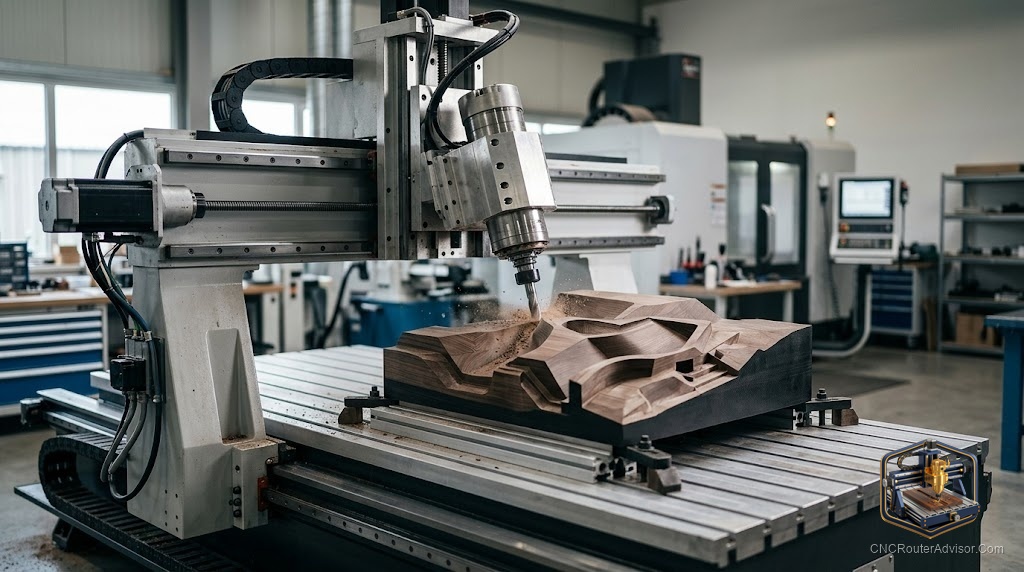
A 5-axis CNC router represents the top tier of routing capability, a machine that can tilt and rotate the tool relative to the work so it approaches from nearly any angle, cutting geometry that flatter machines simply cannot reach. If you have seen a complex curved mold, an ornate carved column, or an aerospace pattern come off a router in a single setup, you have seen what five axes make possible. That capability sits at the far end of a spectrum of cost, complexity, and skill, and understanding both the power and the price is the key to deciding whether a 5-axis router belongs in your shop or is far more than your work needs. This guide covers what a 5-axis router does, where it is used, and the factors to weigh.
The number of axes defines the geometry a machine can produce, and five axes is the most capable and most demanding tier. Knowing precisely what the extra axes add, and what they cost in money and complexity, is essential before considering one, because for most shops the honest answer is that three axes are enough.
A 5-axis CNC router moves the tool along three linear axes (X, Y, Z) and adds two rotary axes, so it can orient the tool to approach the workpiece from almost any angle instead of only from above. This lets it machine complex curved and sculptural surfaces, reach undercuts, and cut multiple faces of a part in a single setup, geometry a 3-axis machine cannot achieve without extensive re-fixturing. Its applications are advanced and high-value: molds and patterns, aerospace and automotive parts, sculptural and architectural work, and complex 3D components. The trade-offs are major: high cost, substantial complexity in the machine, control, and CAM programming, and a steep learning curve. Buying factors include whether your work truly needs 5-axis geometry, CAM software capability, machine rigidity and quality, and support and training. For most woodworking and sign shops, a 3-axis router is sufficient.
A 5-axis router is a specialized tool for genuinely three-dimensional, high-value work; match it to that work or choose 3-axis and save enormously.
What a 5-axis router does
A standard 3-axis router moves the tool in X, Y, and Z, always approaching from directly above. A 5-axis router adds two rotary axes, tilting and rotating the tool, the table, or both, so the tool can approach from nearly any direction. That capability delivers:
- Complex curved and sculptural surfaces cut cleanly from the ideal angle rather than approximated from above.
- Undercuts: features beneath overhangs that a 3-axis tool cannot reach.
- Multi-face machining in one setup: several faces of a part cut without manual re-fixturing, improving accuracy and reducing setups.
- Optimal tool orientation to the surface, improving finish and efficiency on 3D work.
This is a real expansion of what geometry is possible, the reason 5-axis exists.
Applications
Five-axis routers serve demanding, high-value work where the geometry justifies the investment:
- Molds and patterns: complex mold cavities and foundry patterns with curved surfaces and undercuts.
- Aerospace and automotive: structural and aerodynamic parts, patterns, and tooling.
- Sculptural and architectural work: statues, ornate columns, and freeform architectural elements.
- Complex 3D components in composites, marine, and advanced prototyping.
Each of these involves geometry that a 3-axis machine cannot produce well, or at all. Where your work lacks that, the fifth and fourth axes go unused, and a 3-axis machine would serve better for far less.
The trade-offs
Cost. Five-axis machines, controls, and CAM software cost dramatically more than 3-axis equipment, which by itself rules them out for most shops.
Complexity. The machine, its control, and above all the CAM programming are far more complex. Programming 5-axis toolpaths and avoiding collisions between tool, holder, and part from every angle is a demanding discipline.
Learning curve. Using a 5-axis router well takes real training and experience for both operators and programmers; it is not quickly mastered.
CAM software. True 5-axis work depends on capable (and expensive) CAM software and the skill to drive it, making the software as central as the machine.
Buying factors
Confirm you genuinely need 5-axis geometry. This is the decisive question. Buy 5-axis only if your parts require multi-angle machining, undercuts, complex curved surfaces, or multi-face single-setup work that a 3-axis machine (with occasional re-fixturing) cannot deliver. Unused 5-axis capability is an expensive mistake.
CAM software and skill. Because 5-axis success depends on programming, prioritize capable CAM software with collision avoidance and the training to use it. Confirm it supports your parts.
Machine rigidity and quality. Rigidity and build quality set cut quality and precision, which matter greatly at 5-axis price and capability levels.
Support and training. Given the complexity, strong manufacturer support, training, and well-integrated control and CAM are essential, part of the true cost of ownership.
The verdict
A 5-axis CNC router is the most capable tier of routing, orienting the tool to approach from almost any angle to machine complex curved surfaces, undercuts, and multiple faces in a single setup. That power serves specialized, high-value work, molds, aerospace, sculpture, complex 3D, and comes with major cost, complexity, and a steep learning curve, with CAM software as central as the machine itself. For the great majority of woodworking and sign shops, a 3-axis router is sufficient and far more sensible. Reserve 5-axis for work that genuinely requires multi-angle machining, and when you do buy, prioritize CAM capability, machine quality, and strong support and training.
Three things to take with you:
- A 5-axis router adds two rotary axes to the three linear ones, so the tool approaches from almost any angle, enabling complex curved surfaces, undercuts, and multi-face single-setup machining.
- It serves specialized, high-value work and demands major cost, complexity, and skill, with capable CAM software and training as central as the machine.
- Most shops are well served by 3-axis; buy 5-axis only when your parts genuinely require multi-angle geometry, then prioritize CAM capability, machine quality, and support.
FAQ
What is a 5-axis CNC router? A router that moves the tool along three linear axes (X, Y, Z) and adds two rotary axes, so it can orient the tool to approach the workpiece from almost any angle. This enables complex curved surfaces, undercuts, and machining multiple faces of a part in a single setup.
What can a 5-axis router make that a 3-axis cannot? Complex curved and sculptural surfaces cut from the ideal angle, undercuts (features beneath overhangs), and multiple faces of a part in one setup without re-fixturing. A 3-axis machine, which approaches only from above, cannot achieve these without extensive re-fixturing, if at all.
What is a 5-axis router used for? High-value 3D work: molds and patterns, aerospace and automotive parts, sculptural and architectural pieces, and complex 3D components in composites and marine applications. The common thread is genuinely three-dimensional geometry beyond a 3-axis machine’s reach.
Why are 5-axis routers so expensive? The machine, control, and CAM software are far more complex than 3-axis, and true 5-axis work requires capable, costly CAM software and skilled programming with collision avoidance. Hardware, software, and training together make the total investment dramatically higher.
Do most shops need a 5-axis router? No. For the vast majority of woodworking and sign work, a 3-axis router is sufficient. Five-axis is a specialized tool for parts that genuinely require multi-angle machining; buying it without that need wastes significant money on unused capability.
What matters most when buying a 5-axis router? First, confirm your work truly needs 5-axis geometry. Then prioritize capable CAM software (with collision avoidance) and the skill to use it, machine rigidity and build quality, and strong manufacturer support and training, all central to getting value from the machine.
References
- Wikipedia, five-axis machining overview: https://en.wikipedia.org/wiki/Five-axis_machining
- CNCzone, multi-axis CNC router discussions: https://www.cnczone.com