
4 x 8 CNC Router Machine Guide: Work Area, Machine Size, and Buying Factors
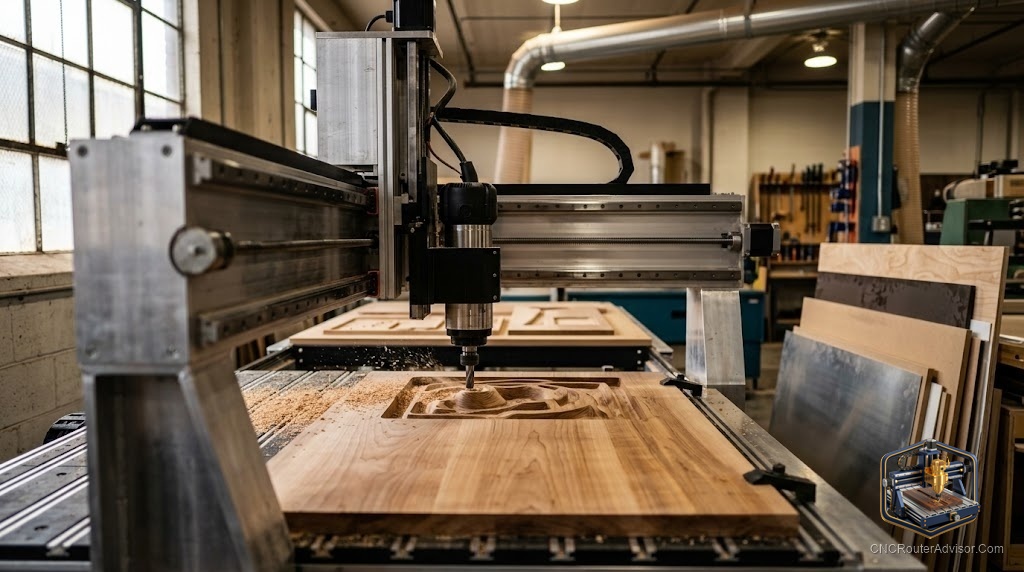
The 4 by 8 CNC router is the machine that turns a hobby or side business into a production operation, because it cuts a full sheet of plywood, MDF, or plastic in one setup. That single fact, full-sheet capacity, changes everything about throughput, and it is why 4 by 8 is the workhorse size for cabinet shops, sign makers, and anyone processing sheet goods at volume. It is also a big, heavy, power-hungry machine that demands real space and infrastructure, so buying one is a bigger commitment than a benchtop router. This guide explains what the 4 by 8 size gives you, what it demands in return, and the factors that should drive the purchase.
Choosing this size is about matching full-sheet capacity to genuine production needs while planning for the space, power, and dust the machine requires. Understanding both sides prevents both underbuying (and re-cutting sheets) and overbuying (a machine your shop cannot house or feed).
A 4 by 8 CNC router machine has a work area of roughly 48 by 96 inches (about 1220 by 2440 mm), sized to cut a full 4 by 8 sheet of plywood, MDF, plastic, or similar in one setup. It is the workhorse size for cabinet shops, sign makers, and sheet-goods production, prized for throughput and eliminating the need to break sheets down first. Buying factors include the substantial space it needs (its footprint exceeds the work area), power requirements (often three-phase, and a serious dust collection setup), rigidity and drive system (usually rack-and-pinion for the long axis, with a strong steel frame), spindle power (typically a larger VFD spindle), workholding (commonly a vacuum table for sheets), and whether your production volume justifies the machine. It is the right choice for full-sheet production; it is oversized and demanding for occasional or small-part work.
If you process full sheets in volume, a 4 by 8 transforms throughput; if you cut occasional or small parts, a smaller machine fits far better.
What full-sheet capacity gives you
The defining benefit is cutting a full 4 by 8 sheet in one setup:
- No breaking sheets down first, saving a whole handling step and preserving accuracy.
- Nesting many parts on one sheet, cutting a full run of cabinet or sign parts in a single job.
- Throughput that suits production, load a sheet, run the program, unload finished parts, repeat.
- Larger single parts, full-size signs, panels, and long components, that smaller machines cannot cut whole.
For sheet-goods production, this capacity is the whole point, and it is why the 4 by 8 is the standard professional size.
What the machine demands
That capability comes with real requirements:
- Space: the footprint exceeds the 4 by 8 work area substantially, since the gantry travel, frame, and material handling area extend well beyond it. Plan room to load and unload sheets on at least one side, plus access around the machine. This is a shop-floor machine, not a benchtop one.
- Power: larger 4 by 8 machines often need three-phase power for the spindle and drives; confirm your shop supplies it or budget for a converter. The spindle alone is a substantial electrical load.
- Dust collection: cutting full sheets produces a lot of chips and dust, so a serious dust collector and dust shoe are essential, not optional.
- Material handling: full sheets are heavy and awkward; plan how you will load and unload them, and where sheets and finished parts will stage.
Underestimating space, power, and dust is the most common regret of first-time 4 by 8 buyers.
Buying factors
Confirm your volume justifies it. A 4 by 8 pays off when you process full sheets regularly. If your work is occasional or small-part, a 2 by 2, 4 by 4, or benchtop machine fits your space and budget far better. Match the machine to genuine production need.
Rigidity and drive system. At this size, the long X axis is usually driven by rack-and-pinion (fast and practical over long spans), and a strong steel frame provides the rigidity to cut cleanly across a full sheet. Judge the frame and motion system, since they set cut quality and accuracy over the large span.
Spindle power. Production sheet work wants a substantial VFD spindle for fast, clean cutting through the day. Match the spindle to your materials and duty cycle.
Workholding. For full sheets, a vacuum table is the common and productive choice, holding whole sheets flat and clearing clamps from the surface. Confirm the workholding suits your materials and volume, and factor the vacuum pump into space and power.
Controller, software, and support. A production machine needs a capable controller, good CAM for nesting, and available support and parts. Downtime on a production machine is costly, so support matters.
Space and infrastructure, planned in advance. Before buying, confirm the floor space, power, dust collection, and material handling. These are part of the true cost and must be ready.
The verdict
A 4 by 8 CNC router is the workhorse of sheet-goods production, cutting a full sheet in one setup to deliver the throughput that cabinet shops, sign makers, and volume producers need. That capability demands real space (well beyond the work area), often three-phase power, serious dust collection, and material handling, so it is a shop-floor commitment, not a benchtop purchase. Confirm your production volume justifies it, judge rigidity and the drive system for cut quality over the long span, match the spindle and workholding to your materials, and plan the infrastructure in advance. For full-sheet production, nothing smaller compares; for occasional work, it is more machine than you need.
Three things to take with you:
- A 4 by 8 (roughly 48 by 96 inches) cuts a full sheet in one setup, the defining benefit that makes it the workhorse size for cabinet, sign, and sheet-goods production.
- It demands real infrastructure, space well beyond the work area, often three-phase power, serious dust collection, and material handling, which first-time buyers commonly underestimate.
- Buy it only when your production volume justifies it; then judge rigidity and drive system, spindle power, and workholding (often a vacuum table), and plan the space and power in advance.
FAQ
What is the work area of a 4 by 8 CNC router? Roughly 48 by 96 inches (about 1220 by 2440 mm), sized to cut a full 4 by 8 sheet of plywood, MDF, plastic, or similar in one setup. Its physical footprint is substantially larger than the work area.
Why buy a 4 by 8 CNC router? For full-sheet capacity: cutting a whole sheet in one setup eliminates breaking sheets down, allows nesting many parts per sheet, and delivers the throughput that cabinet shops, sign makers, and sheet-goods producers need. It also cuts larger single parts than smaller machines.
How much space does a 4 by 8 CNC router need? Significantly more than its 48 by 96 inch work area, since the gantry travel, frame, and material handling area extend well beyond it. Plan room to load and unload sheets on at least one side, plus access around the machine and space for dust collection.
Does a 4 by 8 CNC router need three-phase power? Often yes. Larger 4 by 8 machines commonly need three-phase power for the spindle and drives. Confirm your shop supplies it or budget for a phase converter, and account for the spindle’s substantial electrical load.
What workholding do 4 by 8 CNC routers use? A vacuum table is the common and productive choice for full sheets, holding them flat and clearing clamps from the surface for fast loading. Mechanical clamps and T-track are also used for specific parts. Factor the vacuum pump into space and power planning.
Is a 4 by 8 CNC router worth it for a small shop? Only if you process full sheets regularly. Its throughput transforms sheet-goods production, but if your work is occasional or small-part, the space, power, and dust demands make a 2 by 2, 4 by 4, or benchtop machine a far better fit for the money and shop.
References
- All3DP, CNC router size and production guide: https://all3dp.com
- CNCzone, full-sheet CNC router setup and infrastructure discussions: https://www.cnczone.com