
2 x 2 CNC Router Guide: Work Area, Machine Size, and Buying Factors
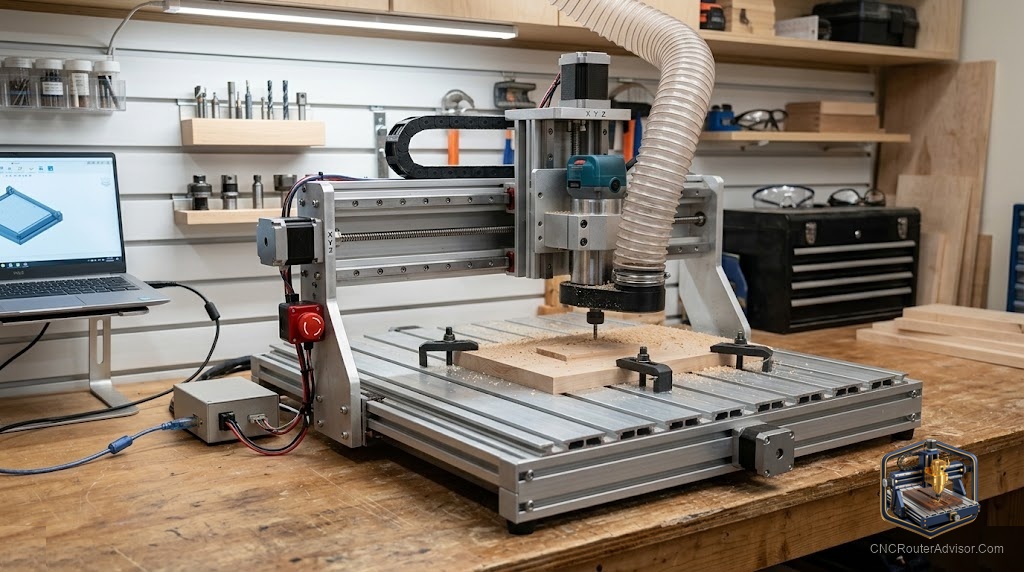
A 2 by 2 CNC router occupies a useful middle ground that a lot of buyers overlook. It is bigger than the tiny 3018-class desktop machines, so it cuts real project parts, yet far smaller than a full 4 by 8 sheet machine, so it fits a normal shop or even a large bench and does not demand industrial space or power. For the maker who has outgrown a mini machine but does not need to cut full sheets, a 2 by 2 can be the sweet spot. This guide explains what work area that number really gives you, how much space and machine you are actually buying, and the factors that should drive the decision.
Choosing a machine size is really about matching the work area to your projects while respecting the space, power, and budget you have. A 2 by 2 makes a specific set of trade-offs, and understanding them prevents both overbuying and outgrowing the machine too soon.
A 2 by 2 CNC router has a work area of roughly 24 by 24 inches (about 610 by 610 mm), placing it between compact desktop machines and large sheet-format routers. It suits medium projects, signs, plaques, small furniture parts, trays, and 3D carvings, without needing the floor space or power of a full-size machine. Buying factors include the real usable work area (slightly less than the nominal size after workholding), rigidity and drive system (which set cut quality and material capability), spindle power (matched to your hardest material), Z clearance (for workpiece thickness), and whether 2 by 2 genuinely fits your projects or you should size up or down. It is an excellent balance of capability and footprint for makers who have outgrown a mini machine but do not cut full sheets.
The right size is the one that covers your projects with modest margin; 2 by 2 hits that mark for a broad range of medium work.
What a 2 by 2 work area gives you
At roughly 24 by 24 inches, a 2 by 2 comfortably handles:
- Signs and plaques up to a genuinely useful size.
- Small furniture parts, brackets, and joinery components.
- Trays, boxes, and decorative panels.
- 3D carvings and reliefs of medium size.
What it does not do is cut full or half sheets in one go; a 4 by 8 sheet must be broken down first, and even a 2 by 4 half-sheet exceeds it. For makers whose parts fit within about two feet square, that is rarely a limitation, and the compact size buys real benefits in space and cost. Remember the usable area is a little smaller than the nominal figure once workholding (clamps or the spoilboard edge) is accounted for.
Machine size and space
A 2 by 2 machine’s physical footprint is larger than its work area, since the frame, gantry travel, and often the controller and drag chains extend beyond the cutting envelope. Still, it is compact enough to sit on a sturdy bench or a modest stand and fit a home shop, garage, or corner of a workshop. Points to plan for:
- Bench or stand: it needs a solid, flat, stable surface; a wobbly bench undoes the machine’s accuracy.
- Clearance around it: allow room for material overhang, access to all sides, and dust collection.
- Power: most 2 by 2 machines run on standard single-phase household power, a real advantage over large three-phase machines.
- Noise and dust: plan dust collection and, if indoors, consider noise; a compact enclosure is easier to build at this size.
Buying factors
Confirm the work area truly fits your projects. Measure your typical and largest parts. If they fit within about 24 by 24 inches with margin, a 2 by 2 is well matched. If you regularly need larger, size up to a 2 by 4 or 4 by 4 rather than fighting the limit; if your work is small, a cheaper desktop machine may suffice.
Prioritize rigidity and the drive system. Cut quality and material capability come from rigidity: an aluminum (or steel) frame, linear rails over V-wheels, and lead or ball screws over belts. For clean hardwood cutting this matters more than a slightly larger work area on a flexible machine.
Match the spindle to your material. A modest spindle suits soft materials and engraving; hardwood and heavier cutting want more power or a VFD spindle. Favor a machine with a spindle upgrade path so you can add power later.
Check Z clearance. The vertical clearance and Z travel determine how thick a workpiece and how long a tool you can use. If you carve thick stock, confirm the Z suits it.
Value software and community. A GRBL-based machine with a large community means easy support, abundant tutorials, and available parts and upgrades, which matters more for most buyers than a spec-sheet edge.
The verdict
A 2 by 2 CNC router is an excellent balance of capability and footprint for makers who have outgrown a mini machine but do not need to cut full sheets. Its roughly 24 by 24 inch work area handles medium signs, furniture parts, trays, and carvings, while fitting a normal shop and running on standard power. Confirm the size truly fits your projects, prioritize rigidity and the drive system for cut quality, match the spindle to your material with an upgrade path, check Z clearance, and favor a well-supported GRBL machine. Sized to your work, a 2 by 2 is a versatile, practical choice.
Three things to take with you:
- A 2 by 2 (roughly 24 by 24 inches) sits between desktop and sheet-format machines, ideal for medium signs, furniture parts, trays, and carvings without full-sheet capacity.
- Prioritize rigidity and the drive system (frame, linear rails, lead or ball screws) for cut quality, and match the spindle to your hardest material with an upgrade path.
- Confirm the work area fits your projects with margin, check Z clearance for thickness, and favor a well-supported GRBL machine; it runs on standard power and fits a normal shop.
FAQ
What is the work area of a 2 by 2 CNC router? Roughly 24 by 24 inches (about 610 by 610 mm), with slightly less usable area once workholding is accounted for. It suits medium projects but cannot cut full or half sheets in one go.
What can a 2 by 2 CNC router make? Signs and plaques, small furniture parts and joinery, trays, boxes, decorative panels, and medium 3D carvings, anything that fits within about two feet square. It is well matched to makers who have outgrown a mini machine but do not cut full sheets.
Does a 2 by 2 CNC router need special power? Usually no. Most 2 by 2 machines run on standard single-phase household power, unlike large three-phase industrial machines. Confirm the specific machine’s requirement, especially if it has a larger VFD spindle.
Is a 2 by 2 CNC router big enough for a business? For small products, signs, engraved gifts, small furniture parts, a rigid, well-tooled 2 by 2 can support a business. For full-sheet furniture or high-volume production you will eventually want a larger machine, but many small operations run well on this size.
How much space does a 2 by 2 CNC router need? More than its 24 by 24 inch work area, since the frame, gantry travel, and controller extend beyond the cutting envelope. Plan a solid bench or stand, clearance on all sides for material and access, and room for dust collection.
Can a 2 by 2 CNC router cut hardwood? Yes, if it is rigid enough and has adequate spindle power. Prioritize an aluminum or steel frame with linear rails and lead or ball screws, and a spindle matched to hardwood or a VFD upgrade. A flexible, underpowered machine struggles with hardwood finish.
References
- All3DP, CNC router size and buyer’s guide: https://all3dp.com
- OpenBuilds, CNC router build and specification reference: https://openbuilds.com