How to Make Money with a CNC Router: An Honest Look at What Actually Works
The fantasy is seductive: buy a CNC router, let it run while you sleep, wake up to finished products and a full order queue. The reality is that a CNC router is a tool that makes production faster, not a business that runs itself. The people who make real money with a CNC router are running a business that happens to use one, and the ones who lose money bought a machine hoping it would become the business. Understanding that distinction before you spend anything is the single most valuable thing this guide can give you.
That said, people genuinely do make money with these machines, some as a full living and many more as a meaningful side income. The ones who succeed tend to share a pattern: they picked a product niche with real demand, they priced for profit rather than for activity, and they treated the machine as one input in a business that also required marketing, customer service, and consistent quality. This guide walks through what actually works and what to be realistic about.
Making money with a CNC router means using the machine to produce goods or services you sell at a profit, whether that is finished products (signs, furniture, decor, custom parts), production services for other businesses (cutting parts to spec), or digital products (design files that others cut). The machine’s value is repeatability and speed: it produces consistent results at volume, which is what turns craft into a business.
The honest headline: the machine is the easy part. Finding a profitable niche, pricing correctly, and marketing consistently are the parts that determine whether you make money, and none of them are automated by the router.
The realistic ways to make money
Custom and personalized products
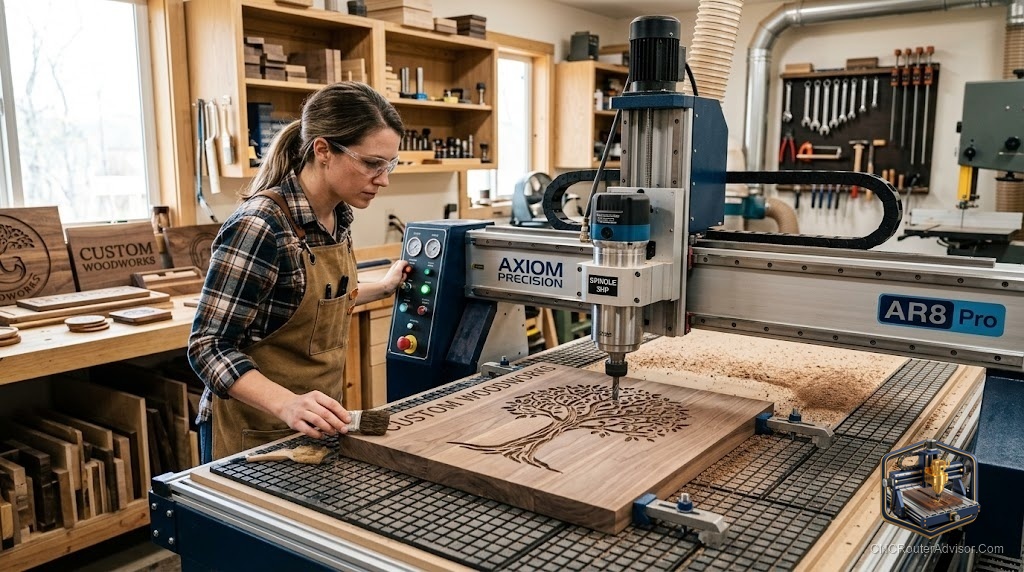
Personalization is where small CNC operations compete best, because it is exactly what mass manufacturers cannot do cheaply. Custom signs, engraved cutting boards, wedding and event decor, personalized gifts, house numbers, and business signage all command a premium precisely because they are one-of-a-kind. The margin on a personalized item is higher than on a commodity item, and the CNC router’s ability to run a unique design as easily as a repeat one is a genuine advantage.
The catch: personalized work is design-and-communication intensive. Each order involves customer interaction, proofing, and setup. This is a real business with real customer service, not a passive one.
Production runs for other businesses
Many businesses need parts cut and do not own a router. Cabinet shops that outsource door fronts, sign companies that subcontract overflow, furniture makers who need consistent components, and product companies that need short-run parts are all potential recurring customers. B2B production work is less glamorous than selling finished decor, but it is often more stable, higher volume, and less marketing-intensive once you have a few steady accounts.
The catch: B2B customers expect reliability, consistent quality, and on-time delivery. This rewards a well-run operation and punishes an inconsistent one.
Selling at markets, online, and to retailers
Finished products sold through Etsy, local craft markets, farmers markets, and wholesale to local retailers is the classic path. Home decor, seasonal items, games, organizers, and giftware all sell through these channels. The CNC router lets you produce enough inventory to make a market booth or an online shop viable.
The catch: this is a retail business with all that entails: inventory management, platform fees, photography, listings, and the reality that many product categories are crowded. Differentiation and quality matter enormously.
Digital products (design files)
Selling the design files rather than the physical product is the closest thing to passive income in this space. Create a design once, sell it many times to other CNC owners through Etsy, Design Bundles, or your own site. No material cost, no shipping, no inventory.
The catch: it requires genuine design skill, the market for files is competitive, and file piracy is real. The best file sellers have a distinctive style and a catalog large enough to generate volume.
Pricing: where most CNC businesses fail
The most common reason a CNC side business does not make money is pricing that covers materials and nothing else. Profitable pricing accounts for:
- Material cost, including waste and consumables (bits wear out).
- Machine time, valued at a real hourly rate that accounts for the machine’s cost, maintenance, and electricity.
- Your labor, including design, setup, finishing, packaging, and customer communication, at a rate you would actually work for.
- Overhead, including software subscriptions, platform fees, shop space, and marketing.
- Profit margin on top of all of that, because covering your costs is breaking even, not making money.
Many makers price by looking at what others charge and undercutting, which starts a race to the bottom that nobody wins. Price for profit, differentiate on quality and service, and accept that some customers are not your customers.
What to be realistic about
The learning curve is real. Producing sellable quality consistently takes months of practice with the machine, the software, tooling, and finishing. Budget for a ramp-up period before the business generates meaningful income.
Marketing is the actual job. For product businesses, finding customers is harder and more time-consuming than making the products. The router does not market itself.
Finishing and post-processing take time. A cut part is not a finished product. Sanding, finishing, assembly, and packaging often take longer than the cutting, and they are not automated.
Machine downtime happens. Bits break, spindles need maintenance, jobs fail. A business dependent on one machine has single-point-of-failure risk; factor maintenance and the occasional lost job into your expectations.
The verdict
Making money with a CNC router is real and achievable, but it is a business, not a machine that prints money. Pick a niche with genuine demand and margin (personalization and B2B production are the most reliable), price for actual profit rather than activity, and accept that marketing, customer service, and finishing are the real work. The router is the easy part; the business around it is where the money is made or lost.
Three things to take with you:
- Personalized products and B2B production runs are the most reliable profit paths; design-file sales are the closest to passive but require real design skill.
- Price for profit by accounting for material, machine time, your labor, overhead, and a real margin, not by undercutting competitors.
- The machine is the easy part; niche selection, pricing, marketing, and consistent quality determine whether you make money.
FAQ
Can you actually make money with a CNC router? Yes, both as a full living and as a side income. Success depends on choosing a profitable niche, pricing for profit, and treating it as a business with marketing and customer service, not as a machine that generates income passively.
What is the most profitable thing to make with a CNC router? Personalized and custom products (signs, engraved gifts, event decor) tend to have the highest margins because they command a premium mass manufacturers cannot match. B2B production runs for other businesses offer more stable recurring revenue.
How do I price CNC router products for profit? Account for material cost including waste, machine time at a real hourly rate, your labor for design and finishing, overhead like software and platform fees, and a profit margin on top. Covering material cost alone is breaking even, not profit.
Is selling CNC design files a good way to make money? It is the closest thing to passive income in this space, with no material or shipping cost. It requires genuine design skill and a distinctive style, and the market is competitive with real file-piracy risk.
How long before a CNC router business becomes profitable? Budget for a ramp-up period of several months to learn the machine, software, and finishing well enough to produce consistent sellable quality, and to build the marketing and customer base. It is not immediate.
What is the biggest mistake people make trying to profit from a CNC router? Underpricing, usually by covering material cost and ignoring machine time, labor, and overhead. The second biggest is expecting the machine to be the business rather than one tool within a business that also requires marketing and customer service.
References
- CNC Cookbook, “How to Make Money with a CNC Router”: https://www.cnccookbook.com
- Etsy Seller Handbook (pricing and product business fundamentals): https://www.etsy.com/seller-handbook