Haas CNC Router: What the Brand Is, What It Builds, and Who It Is For
Haas Automation is not a brand that competes on signs and coasters. If you are searching “Haas CNC router” expecting a desktop machine to put in a hobbyist workshop, this article will save you some time and redirect you to the right category. If you are a production shop, a sign manufacturer, a woodworking operation running serious volume, or a machinist who grew up on Haas mills and wants to know whether the company’s machining center approach translates to routing applications, then there is a real story here.
Haas built its reputation on CNC machining centers: vertical mills, turning centers, and horizontal machining centers that compete at the quality-to-value intersection of the industrial machine tool market. That reputation is grounded in consistent build quality, broad dealer support, and a control system that machinists recognize from training to production floor. Whether that same approach carries into routing is the substance of what follows.
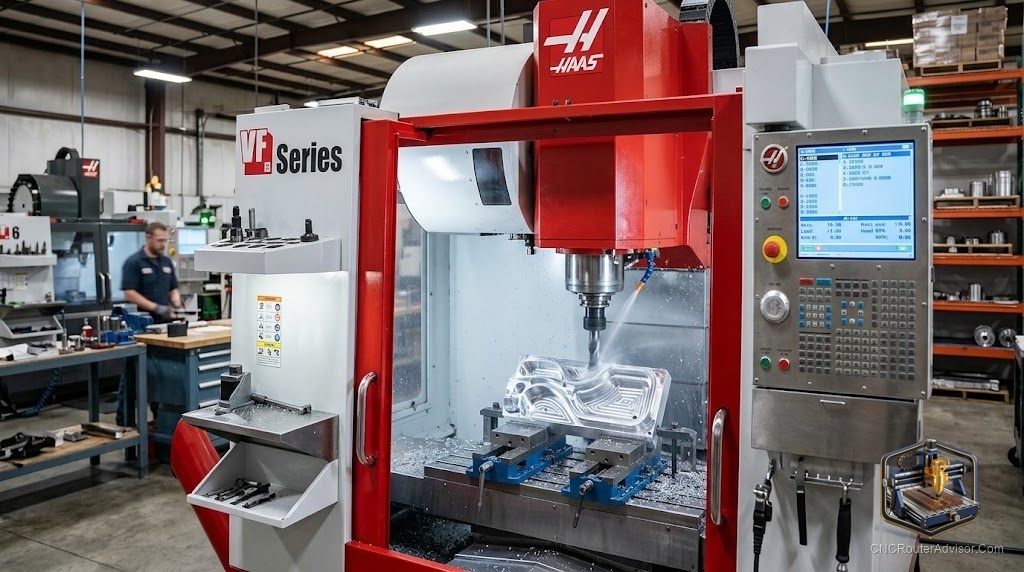
Haas Automation is an American CNC machine tool manufacturer based in Oxnard, California, producing machining centers, turning centers, and multi-axis machines. When “Haas CNC router” appears in industrial conversations, it typically refers either to using a Haas vertical machining center (VF series or similar) for routing applications on metals, composites, and harder materials, or to the Router (GR) series that Haas produced for large-format routing applications including woodworking, sign making, and composite panel work.
For production environments that need industrial reliability, domestic manufacturer support, and integration with a machining floor that already runs Haas controls, the brand represents a serious option. For hobby or small-shop routing, Haas is almost certainly the wrong conversation.
The Haas brand in context
Haas is the largest machine tool builder in the Western world by unit volume, a position it earned through consistent pricing, reliable construction, and a broad dealer and service network across North America. The Haas control system, found on essentially every Haas machine, is respected for its consistency and the fact that operators trained on one Haas machine can work on any other without relearning the interface.
Haas machines are sold through a network of Haas Factory Outlets (HFOs), not through general retail or online channels. This is relevant because it means pricing, configuration, and acquisition involve dealer relationships rather than catalogue ordering, and support is geographically tied to the HFO network.
Routing applications on Haas machining centers
Many production environments use Haas vertical machining centers for routing-adjacent work: trimming composite aircraft parts, machining aluminum panels, routing foam and polymer tooling forms, and similar applications where a machining center’s rigidity and the Haas control system’s capability are assets rather than overspecification.
For work that is technically routing (removing material with a rotating tool across a flat or three-dimensional workpiece) but requires tighter tolerances, harder materials, or larger workpieces than a dedicated router handles, a Haas VMC is a real solution. The machine’s rigidity, toolchanger, and probing capability exceed what any dedicated wood router provides. The trade is cost, footprint, and the reality that a Haas VMC is a precision milling machine configured for routing, not a router.
The GR (Gantry Router) series
Haas produced a Router series, designated GR, specifically for large-format routing applications including woodworking, sign fabrication, and composite panel cutting. These machines applied Haas’s machining center design philosophy to a gantry router format: servo drives, the Haas control, solid construction, and dealer support to the same standard as the rest of the Haas line.
The GR series targeted production shops that wanted a router with the reliability and support infrastructure of a machining center rather than a purpose-built woodworking router from a sign-industry supplier. The machines were larger-footprint, higher-investment options suited to shops that prioritized serviceability and control consistency over initial cost.
For current availability and specific configurations, contacting a Haas Factory Outlet is the appropriate next step, as product lines in this category evolve and local HFO inventory and configuration options vary.
Who should consider Haas for routing applications
A Haas makes sense for: a production facility that already runs Haas machining centers and wants consistent control interface and support across its routing work, a composite fabrication shop that needs machining-center rigidity for trimming and routing structural components, or a sign and display manufacturer whose volume justifies the industrial investment and wants the domestic support network.
Who should not consider Haas: any shop where budget, footprint, or production volume puts the Haas investment outside return-on-investment range. For commercial sign work, Multicam, ShopBot, Thermwood, and SCM all offer purpose-built production routers with their own dealer and support networks. For hobby or small-shop work, Haas is a category mismatch.
The verdict
Haas brings to routing what it brings to machining: consistent construction, a control system operators recognize, and a dealer network that supports the machine after the sale. The question is whether that package matches the application and investment profile. For production industrial routing with Haas fleet integration, the answer is often yes. For general commercial woodworking and sign routing at smaller scale, purpose-built routing brands compete more directly on value.
Three things to take with you:
- Haas machines are industrial, dealer-sold tools, not available through retail or online channels; acquisition involves the HFO dealer network.
- For routing applications on composites, aerospace materials, and precision work, a Haas VMC is a legitimate solution where machining-center rigidity is the requirement.
- For commercial woodworking and sign routing, purpose-built routing brands at the same investment level often provide better value-to-application fit.
FAQ
Does Haas make a CNC router? Haas produced a GR (Gantry Router) series for large-format routing applications. They also make vertical machining centers (VF series) frequently used for routing-adjacent work in composite and metal fabrication. For current configurations, contact a Haas Factory Outlet.
Where are Haas machines sold? Through the Haas Factory Outlet (HFO) dealer network. Haas machines are not sold through retail or online catalogue channels.
Is a Haas machine appropriate for woodworking? For high-volume production woodworking or composite work where machining-center reliability and the Haas control system are priorities, yes. For most commercial and small-shop woodworking, purpose-built routing brands provide better application fit at lower investment.
What control system does Haas use? All Haas machines use the Haas control (FANUC-influenced, Haas-proprietary), which is consistent across the product line. Operators familiar with one Haas machine can work on any other without control retraining.
How does Haas compare to dedicated routing brands like Multicam or ShopBot? Haas brings machining-center rigidity, the Haas control, and a national service network. Dedicated routing brands like Multicam, ShopBot, and Thermwood offer purpose-built routing configurations, routing-optimized software integration, and routing-specific application support. Which is better depends on the application and shop context.
Can I use a Haas VMC to route wood or MDF? Technically yes, with appropriate tooling and speeds. Practically, a Haas VMC is overspecified in rigidity, tooling cost, and footprint for routine wood routing. It is the right tool for composite trimming or precision routing in metals, not for production cabinet work.
References
- Haas Automation, official site: https://www.haascnc.com
- Haas Factory Outlet directory: https://www.haascnc.com/dealer-locator.html