
Gantry CNC Router Explained: Configuration, Capability, and Choosing the Right Type
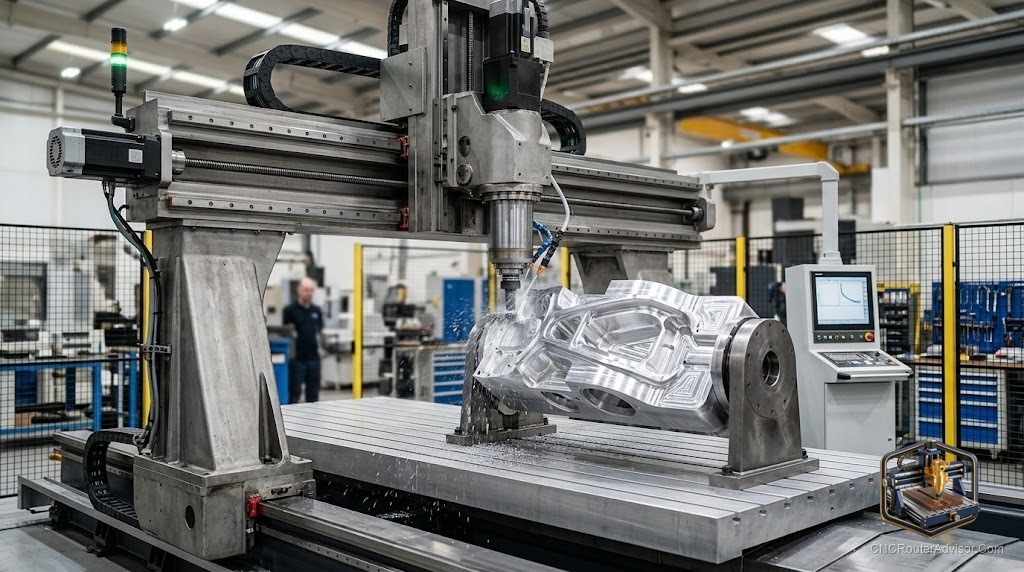
Every CNC router has a gantry, whether the marketing calls it that or not. The gantry is the bridge structure that carries the spindle over the work area: a horizontal beam mounted on two vertical supports that ride left and right while the spindle moves front to back and up and down. Understand the gantry and you understand why different machines cut differently, hold tolerances differently, and cost what they cost.
The term matters more specifically when buyers encounter “gantry router” as a product category. In that context, it usually means a machine with a large, fixed-table gantry design: the table stays still, and the entire gantry structure moves over it. That configuration has implications for rigidity, work area, and what the machine is suited for that this guide explains directly.
A gantry CNC router uses a bridge structure spanning the width of the work area to carry the spindle. The gantry can be configured in two main ways: moving gantry, where the bridge moves along the length of the fixed table, or fixed gantry with a moving table, where the bridge stays still and the table moves beneath it. Most desktop and mid-range CNC routers use a moving-gantry design. Industrial sign and cabinet production machines span both types.
For most buyers, the key question is not gantry type, it is gantry mass and rigidity. A heavier, stiffer gantry deflects less under cutting loads, which translates to better dimensional accuracy, less vibration, and cleaner edge quality at higher feed rates.
Moving gantry versus moving table: the real difference
In a moving-gantry machine, the heavy bridge structure accelerates and decelerates along the length of the table. The inertia of that moving mass limits how fast the machine can accelerate without positional error. On a small machine cutting slowly, this rarely matters. On a large machine running at production feed rates, gantry mass is a design constraint, which is why production machines invest heavily in lightweight gantry materials (aluminum extrusion, carbon fiber, welded steel tubing) or accept the inertia and use servo drives powerful enough to manage it.
In a moving-table machine, the gantry is fixed and only the table moves under it. The table is typically lighter than a gantry, so acceleration is faster and positioning can be more precise at speed. The constraint is that the work area is limited by the range of table travel, and the machine footprint is roughly twice the work area length. Moving-table designs are most common on precision engravers, desktop mills, and some niche CNC router configurations.
For most routing applications on machines above desktop scale, the moving-gantry design dominates because it accommodates large work areas in a smaller footprint.
Gantry rigidity: the metric that explains performance differences
Gantry rigidity is the most important mechanical factor in a CNC router’s performance after the spindle. A gantry that deflects under cutting loads produces parts that are not the shape the file says they should be. A gantry that does not deflect produces parts that match the file.
Rigidity comes from three sources: material selection (steel is stiffer than aluminum extrusion, which is stiffer than plastic), cross-section geometry (a deep I-beam profile resists bending better than a shallow square tube), and the interface between the gantry and its linear guides (wider spacing between the guide rails reduces the moment arm of cutting forces on the structure).
For buyers comparing machines, a published specification for gantry material and construction is more informative than a published specification for work area. Two machines with identical work areas can differ dramatically in gantry rigidity, and that difference shows entirely in cut quality at real feed rates.
Common gantry configurations by machine class
Desktop hobby routers (Shapeoko, Onefinity, Longmill): Aluminum extrusion gantry, moving-gantry design, usually with a single or dual-supported span. These machines run well at moderate feeds in wood, MDF, and plastics. The gantry mass is low enough that servo or stepper drives can accelerate it adequately. The rigidity limit shows when cutting harder materials at aggressive feeds.
Mid-range semi-pro routers (ShopSabre, Laguna, CAMaster desktop): Steel-weld or thick-profile aluminum gantry, moving-gantry with dual linear rails on both sides, rack-and-pinion or ball-screw drive on the gantry motion. Rigidity is substantially higher than the desktop class, and these machines maintain accuracy in hardwood and aluminum routing at production feeds.
Industrial production routers (Biesse, SCM, Multicam, Thermwood): Heavy welded steel or cast-iron gantry, servo-driven, designed for continuous production shifts. These machines are sized for full-sheet 4-by-8 or larger processing with minimal downtime and high accuracy maintained over many cycles.
What to look at when comparing gantry routers
Four things determine whether a gantry router is appropriate for your work:
- Gantry material and construction. Welded steel or heavy-profile aluminum is more rigid than light extrusion. Ask or look for photos of the gantry cross-section.
- Dual-rail versus single-rail gantry. A gantry supported by a single rail on each side has more deflection under lateral cutting loads than a dual-rail gantry. Dual-rail is standard on serious production machines.
- Drive system on the gantry axis. Rack-and-pinion and ball-screw drives maintain accuracy under load better than belt drives on large machines.
- Gantry clearance (Z height). Clearance between the table and the underside of the gantry determines the maximum workpiece height. For furniture-scale work with 3D carving on thick slabs, this is a real constraint.
The verdict
The gantry is the structural heart of a CNC router. Understanding its configuration, mass, and rigidity explains the performance difference between machines far better than work area and spindle specs do. For most buyers, the right question is not just gantry type but gantry construction: how stiff is it, how is it supported, and can it hold its position under the cutting loads your material and speed demand?
Three things to take with you:
- Gantry rigidity, not work area, is the primary predictor of cut quality at real feed rates in hard materials.
- Moving-gantry designs dominate mid-range and industrial machines because they deliver large work areas in a smaller machine footprint.
- Dual-rail gantry support and ball-screw or rack-and-pinion drives are the step-up indicators that separate serious production machines from hobby-class equipment.
FAQ
What is a gantry on a CNC router? The gantry is the bridge structure that carries the spindle over the work area. It spans the width of the table and moves along the table’s length in a moving-gantry configuration, or stays fixed while the table moves beneath it.
What is the difference between a moving gantry and a moving table CNC router? In a moving-gantry machine, the bridge structure travels over a fixed table, which is standard on most routing machines. In a moving-table machine, the gantry is fixed and the table moves under it, enabling faster table acceleration at smaller footprints.
Why does gantry rigidity matter for CNC routing? A gantry that deflects under cutting loads produces parts that do not match the design. A stiffer gantry holds its position under load, which produces parts that match the file at real feed rates in hard materials.
What is a dual-rail gantry? A gantry supported by two linear rails on each side, which provides more resistance to deflection from lateral cutting forces than a single-rail design. Dual-rail support is standard on mid-range and production-class machines.
What drive systems are used on CNC router gantries? Belt drives are common on hobby machines. Rack-and-pinion is standard on mid-range and industrial machines for the long-axis gantry travel. Ball screws are used where very high accuracy is required.
Does gantry clearance affect what I can cut? Yes. The clearance between the table and the underside of the gantry determines the maximum workpiece height. For thick slabs, raised fixtures, or workpieces with significant 3D relief, confirm gantry clearance before buying.
References
- ShopSabre CNC, “How to Buy a CNC Router” (machine construction overview): https://www.shopsabre.com/how-to-buy-a-cnc-router/
- IDC Woodcraft, “CNC Router Buying Guide: Understanding Gantry Construction”: https://idcwoodcraft.com/blogs/news/cnc-router-buying-guide