
CNC Stone Router: What It Is, What It Can Do, and What It Demands
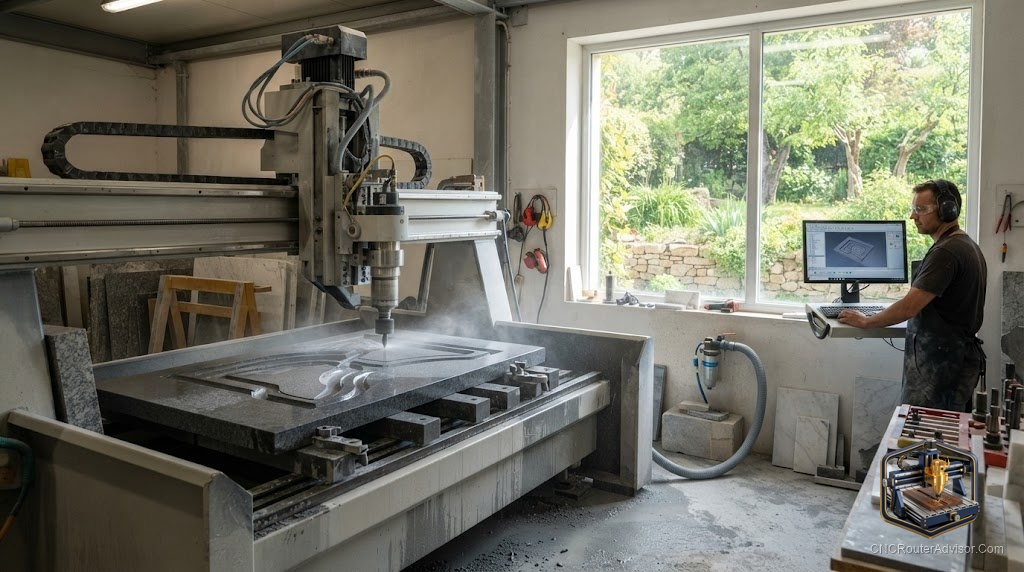
Granite holds a straight edge in a way wood never will. It also fights the machine every step of the way, and if the machine is not built to absorb that fight, the machine loses. CNC stone routing is a real and productive application of router technology, but the gap between a wood router and a machine that cuts stone is not just a different bit. It is a different class of equipment, a different approach to tooling, and a completely different set of expectations about speed, noise, mess, and maintenance.
If you are looking at stone routing because you want to engrave a granite countertop, cut a slate sign, or machine an architectural stone panel, this is the guide that tells you what the work actually requires, where the capability lives, and who genuinely should skip this and outsource instead.
A CNC stone router is a computer-controlled machine designed or adapted to cut, carve, engrave, or profile natural and engineered stone. It uses diamond or carbide tooling rather than the standard router bits suited to wood and plastics. The machine must be rigid enough to handle the vibration and cutting forces stone generates, and the setup almost always requires a water or misting system to cool the tooling, suppress silica dust, and extend bit life.
The short answer on whether you should cut stone with your existing CNC router: maybe, for soft stone and shallow engraving only, with the right tooling and a lot of caution. For serious production stone work, a machine built or specified for stone is the practical reality.
What stone routing is actually used for
The applications divide into two main categories: engraving and shallow relief, and profiling and cutting.
Engraving and shallow relief covers granite memorial markers and headstones, slate signs and plaques, marble decorative panels, and stone tile inlays. The machine traces a path at shallow depth, removing material with a diamond engraving bit or a small ball nose. Depths are modest, forces are manageable, and a rigid hobby machine with the right tooling can do this work, especially in softer stones like slate.
Profiling and cutting means shaping stone edges, cutting holes or cutouts in countertops, routing curved profiles in slab edges, or cutting tile to complex shapes. This is a different level of force and rigidity requirement. Countertop edge profiling in granite at production rates requires a machine built for stone, with high-torque water-cooled spindles, heavy gantries, full water flood systems, and diamond profile tooling that costs significantly more than wood router bits.
Why stone demands more from the machine
Wood is soft, forgiving, and absorbs some vibration. Stone is hard, unforgiving, and transmits every vibration directly to the tooling and the machine frame. A lightweight machine that runs fine on MDF will chatter and flex under stone cutting forces, which shows up as chipped edges, broken bits, and surface finish that looks like the machine was fighting itself, because it was.
Rigidity is the non-negotiable. Heavy steel or cast-iron construction, substantial linear guides, and a gantry that does not deflect under lateral cutting loads are the baseline for any machine expected to cut stone consistently. Entry-level aluminum-frame hobby routers are not that machine.
The spindle also matters differently. Wood routing tolerates high-RPM routers running at 20,000 to 25,000 RPM with moderate torque. Diamond tooling for stone often runs at much lower RPM, 3,000 to 8,000 for most engraving and profiling applications, with the specific range depending on tool diameter and material hardness. A spindle with a variable RPM range and enough torque at low speed is necessary.
Tooling: diamond is not optional
Diamond-tipped or PCD (polycrystalline diamond) tooling is the standard for stone CNC work. Carbide bits can make initial cuts in softer stones but wear quickly and produce poor edges in hard stone. For granite and hard marble, diamond tooling is not a recommendation, it is a requirement for any sustained work.
Diamond bits for CNC stone routing include straight diamond core bits for hole cutting, diamond profile bits for edge shaping, and electroplated diamond engraving bits for V-carving and lettering. Tooling costs more than wood router bits and wears in a different way: diamond tooling has a finite diamond layer that erodes over time rather than dulling the way a carbide edge does.
Cooling and dust control
Silica dust from stone cutting is a serious respiratory hazard. It is not the kind of dust you manage with a shop vac and a face mask. OSHA regulates respirable silica exposure because silicosis, the lung disease it causes, is irreversible and progressive. Any production stone routing operation needs either wet cutting, which traps dust in water, or a seriously capable industrial dust extraction system designed for silica capture.
For hobby and light engraving work in good ventilation with an N95 respirator minimum, risk is manageable. For production stone work, a flood coolant system is both a tooling requirement (it extends bit life enormously) and a safety system. Set it up before the first cut.
Who should buy a CNC stone router and who should outsource
A dedicated stone routing machine makes sense for a monument and memorial shop, a countertop fabrication business, an architectural stone supplier, or a specialty sign shop that has made stone work a product line. The equipment investment, the tooling cost, the wet cutting infrastructure, and the dust control system all pencil out when stone work is steady and billable.
A woodworker or maker who wants to cut an occasional stone piece should outsource it. Local monument shops and tile fabricators often have stone CNC capability and will do custom work. Online stone cutting services exist for simpler shapes. The cost of doing it yourself, in equipment, tooling, and setup, overwhelms the value for occasional use.
Who should try their existing machine on stone: someone with a rigid hobby machine who wants to engrave slate or soapstone, using proper diamond engraving bits, at shallow depth, wet, with dust control. These are the conditions where a careful experiment makes sense. Granite countertop profiling on a hobby router is not that experiment.
The verdict
CNC stone routing is real, productive, and builds a genuine product line for the right business. It is not an extension of wood routing on the same machine at the same speeds with a different bit. It demands rigidity, slow RPM, diamond tooling, water cooling, and serious dust control. For occasional use, outsourcing to a stone fabricator is the honest and practical call.
Three things to take with you:
- Rigid, heavy machine construction and diamond tooling are both non-negotiable for consistent stone results.
- Wet cutting is simultaneously a tooling requirement and a silica dust control measure; set it up properly.
- For occasional stone work, outsource; the infrastructure cost only pencils out for dedicated production.
FAQ
Can I use my wood CNC router to cut stone? For soft stones (slate, soapstone) at shallow engraving depth, a rigid hobby machine with diamond engraving bits and wet cutting can work as an occasional experiment. For granite, marble, or any profiling and cutting work, a machine built or specified for stone is needed.
What kind of bits do you use to cut stone on a CNC? Diamond-tipped or PCD (polycrystalline diamond) tooling. Electroplated diamond bits for engraving, diamond core bits for holes, and diamond profile bits for edge shaping. Carbide dulls quickly in hard stone.
Why does CNC stone routing require water? Water cooling extends diamond tool life, prevents heat buildup that can crack stone or damage tooling, and suppresses silica dust, which is a serious inhalation hazard. Wet cutting is both a tooling requirement and a safety system.
What spindle RPM is needed for stone routing? Lower than wood: typically 3,000 to 8,000 RPM for most engraving and profiling applications, depending on tool diameter and stone hardness. A spindle with variable speed and adequate torque at low RPM is required.
What stones can a CNC router engrave? Slate, soapstone, and soft limestone are accessible for lighter machines. Granite, marble, travertine, and engineered stone require purpose-built or heavy-duty machines with appropriate diamond tooling.
Is silica dust from stone routing hazardous? Yes, seriously so. Respirable silica causes silicosis, which is irreversible. Wet cutting and industrial dust extraction designed for silica are the correct controls. An N95 respirator minimum for any dry stone work.
References
- OSHA, “Silica: Construction Industry” (silica dust hazards and controls): https://www.osha.gov/silica-crystalline/construction
- JLC Online, “CNC Routing Stone Countertops”: https://www.jlconline.com/how-to/tools-and-equipment/cnc-routing-stone-countertops