
Shaper Origin Handheld CNC Router: What Makes It Different
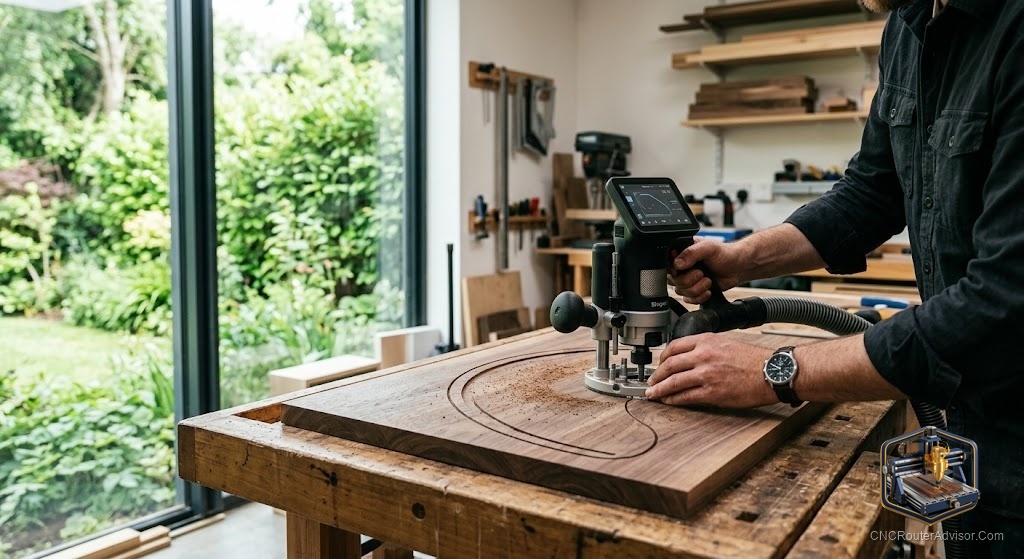
The Shaper Origin answers a question most CNC routers never ask: what if the machine moved through the shop instead of the workpiece moving through the machine? Full-sheet cabinet carcasses, assembled furniture in place, and custom architectural millwork do not fit on any hobby CNC table. The Origin cuts them where they are.
The Shaper Origin is a handheld CNC router that uses optical tracking to guide a compact router along a digital toolpath, cutting precise shapes in oversized workpieces without a fixed machine table.
How It Works
The Origin reads a self-adhesive ShaperTape grid placed on the workpiece with a built-in camera. The operator moves the tool manually along the rough path while the Origin’s internal drive system makes real-time micro-corrections to keep the bit exactly on the digital toolpath. Designs are imported via USB in SVG format. The built-in screen shows the toolpath and current position in real time.
What It Does Well
Oversized workpieces: Cuts pieces of any size that can be laid flat. Panels too large for any table-based CNC machine.
On-site work: Locksmiths, cabinetmakers, and installers use it for precision hardware cutouts on already-installed components.
Portability: Weighs about 9.5 lbs. Runs on 110V. Carries in a case.
Honest Limitations
Not a table machine replacement for production work. Slower for repeat parts than table-based cutting. ShaperTape required on every workpiece. Investment significantly above desktop CNC machines. Small workpieces are awkward due to insufficient tape grid coverage.
Bits for the Origin
Standard 1/4-inch shank CNC bits work in the Origin. Whiteside RU2100 handles most Origin applications.
FAQ
Is the Shaper Origin better than a table CNC router? For different use cases. Origin wins for oversized workpieces and on-site work. Table machines win for repeat production and high-volume throughput.
What materials does the Shaper Origin cut? Wood, MDF, plywood, acrylic, and soft metals with appropriate tooling.
How accurate is the Shaper Origin? Most users report plus or minus 0.005-0.010 inches on flat, well-prepared surfaces.
References
- Shaper Tools. Origin product documentation. shapertools.com