Router CNC ATC: What an Automatic Tool Changer Does and Whether You Need One
Every multi-tool CNC job has the same dead time: you stop the program, loosen the collet, swap bits, retighten, re-probe the Z height, and restart. For a one-off project that takes fifteen minutes, it barely registers. For a production shop running dozens of parts per day, that manual pause happens constantly, and the accumulation of idle machine time and operator attention is a real drag on throughput. An automatic tool changer eliminates that pause entirely.
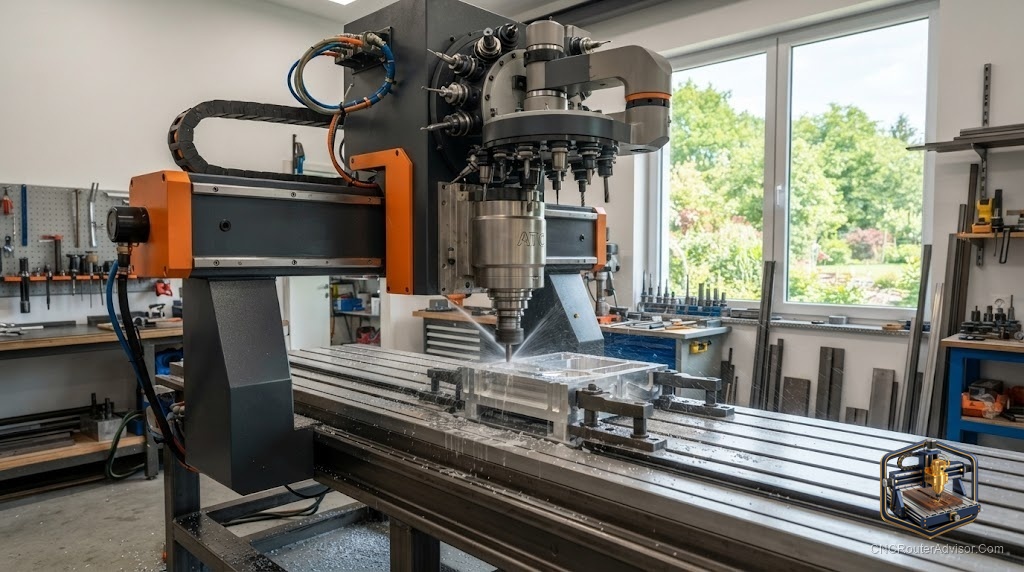
A router CNC with an ATC (automatic tool changer) is a CNC routing machine whose spindle can eject the current cutting tool and retrieve a new one from a magazine or tool rack automatically, mid-program, without stopping for a human to intervene. ATC systems are a standard feature on industrial CNC routers and increasingly available as add-ons or built-in options on prosumer machines.
The short answer on whether you need one: an ATC makes sense when your standard jobs use multiple tools and the manual changeovers noticeably hurt throughput, when you want unattended running, or when you are cutting operations that require sequential tools (drilling, V-carving, profile cuts) in a single program. It is overkill for simple single-tool jobs and adds cost and mechanical complexity. But for the shops that need it, it is transformative.
How an ATC CNC router works
The mechanics vary by system type, but the core principle is the same: the spindle is designed to automatically release and grip tool holders, and a magazine or rack holds the pre-loaded tools ready for pickup.
- Gripping-type ATC (fixed rack). The spindle moves to a static tool holder on a fixed linear rail or carousel. The spindle executes the change by engaging and disengaging the tool holder, often using pneumatic or spring-loaded gripping. Onefinity’s EazyATC by RapidChange, which holds up to four tools on a fixed rail, operates this way. This is among the most affordable and accessible ways to add ATC capability to a mid-range machine.
- Magazine ATC (rotating carousel). A carousel or linear magazine holds more tools (six, eight, ten, or more) and rotates to present the next tool to the spindle. Standard on production industrial routers. Faster and higher-capacity but more complex and expensive.
- Umbrella and side-mount ATC. Variations on magazine systems, common on larger industrial machines where tool capacity of twelve or more is needed for complex multi-operation programs.
In all cases, the ATC spindle uses a standardized tool holder (typically ISO or HSK taper) so tools seat and release repeatably and accurately. The CNC controller orchestrates the change, including automatic Z probe after pickup to confirm tool length.
The real benefits of an ATC
- Unattended operation. A program using five tools runs start to finish without anyone watching the machine. Load the stock, press start, come back to finished parts.
- Increased accuracy. Manual tool changes introduce variation, especially in Z height re-probing. Automatic changes with a standardized taper and auto-probe are more consistent.
- Reduced downtime and total production time. ShopSabre notes this as the core benefit: tool exchange happens in seconds rather than minutes, compounding across a full shift.
- Increased safety. No operator hands near the spindle area during changes.
- Machine versatility. A machine with eight or more tools loaded can run complex sign-making, cabinet, and joinery programs that mix V-carving, drilling, profiling, and finishing in a single uninterrupted program.
ATC options for prosumer machines
ATC is no longer exclusive to high-end industrial routers. Onefinity’s collet spindle ATC (EazyATC, up to four tools) is an example of an accessible path to automation on a prosumer machine. Avid CNC has offered ATC spindle options on mid-range machines. And ATC spindle upgrades (ISO 20 and BT30 tapers) are sold separately for machines that accept a compatible spindle, allowing a retrofit rather than a whole machine replacement.
Who needs an ATC and who does not
You need an ATC if your shop runs multi-tool programs repeatedly, wants unattended machine time, or pays a person to stand at the CNC waiting for bit changes all day. A cabinet shop running nested base programs with a drill bank, a profiling bit, and a V-bit in every job is a natural ATC customer. A sign maker who mostly runs single-tool V-carving jobs probably does not need one yet. And a hobbyist with a small machine doing occasional projects should invest the money elsewhere.
The verdict
ATC adds real, measurable value in the right context. For shops running multi-tool programs at production volume, the improvement in throughput, accuracy, and operator freedom is significant. The entry point has dropped: prosumer options like Onefinity’s EazyATC show that you do not need a full industrial machine to access the capability. Evaluate it by counting your current manual tool changes per shift and multiplying by the time cost. If the number is painful, an ATC will fix it.
Three takeaways: an ATC eliminates manual tool changes and enables unattended multi-tool programs; gripping-type fixed-rack systems are the accessible entry point for prosumer machines; and the investment pays off when your jobs regularly require multiple tools and manual changeovers are costing real time.
FAQ
What is an ATC on a CNC router? ATC stands for automatic tool changer. It is a system that lets the CNC spindle swap cutting tools automatically, mid-program, without stopping for a human to change bits.
How does an ATC CNC router work? The spindle releases the current tool into a holder or rack and retrieves a new one automatically, using pneumatic or mechanical gripping and a standardized tool holder taper (ISO, HSK, BT). The controller handles the sequence and auto-probes Z after each change.
How many tools can an ATC CNC router hold? Small prosumer systems hold four tools (Onefinity EazyATC). Industrial carousels hold six to ten or more. Large production routers can hold twelve or more tools.
Can I add an ATC to my existing CNC router? Sometimes. Some machines accept ATC spindle upgrades with a compatible tool holder taper. Onefinity and some other prosumer brands offer ATC as an add-on option for existing machines.
Do I need an ATC for sign making? Not necessarily. If your sign programs use mainly one tool (a V-bit or end mill), an ATC adds complexity without much benefit. It becomes valuable when you regularly run multi-tool programs mixing V-carving, drilling, and profiling.
What is the difference between a gripping-type ATC and a magazine ATC? A gripping-type ATC moves the spindle to a fixed rack of tools; the spindle grips and releases each holder. A magazine ATC uses a rotating carousel that presents tools to the spindle. Magazines are faster and higher-capacity; fixed-rack systems are more affordable.
Does an ATC improve part accuracy? Yes, in practice. Automatic tool changes with a standardized taper and auto-probe are more repeatable than manual changes, where Z height re-probing introduces variation.
References
- Onefinity CNC, What is an Automatic Tool Changer (ATC types explained): https://www.onefinitycnc.com/post/what-is-an-automatic-tool-changer
- ShopSabre CNC, Benefits of an Automatic Tool Changer and How It Works: https://www.shopsabre.com/benefits-of-an-automatic-tool-changer-and-how-it-works/
- GMN USA, Tips for Choosing the Right Automatic Tool Change Spindle: https://gmnusa.com/tips-for-choosing-the-right-automatic-tool-change-spindle/
- AccTek CNC, How Does an ATC CNC Router Work: https://acctekcnc.com/how-does-an-atc-cnc-router-work/
- Elephant CNC, ATC CNC Router vs Multi Head CNC Router: https://www.elephant-cnc.com/blog/725-atc-cnc-router-vs-multi-head-cnc-router/