
Modular CNC Router: Expandable Machines for Shops That Want to Grow
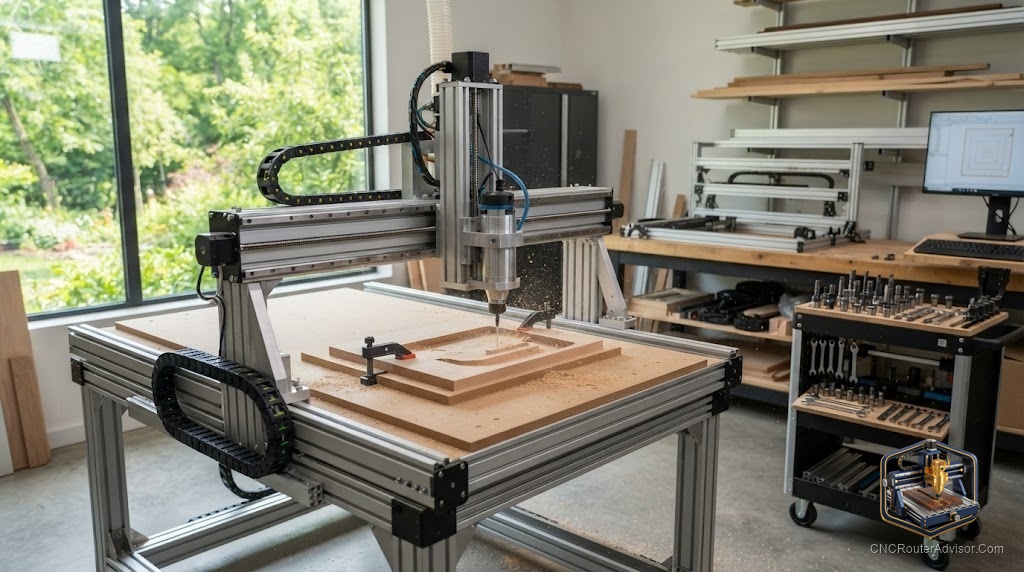
Buying a CNC router that fits your shop today is straightforward. The harder question is whether it will still fit what your shop becomes in two years. A modular CNC router answers that question differently from a fixed-frame machine: instead of buying a new machine when you outgrow the old one, you extend what you have. Rails, gantry sections, and table panels can be added, swapped, or upgraded rather than replaced wholesale, which changes the economics of growing a CNC-equipped shop significantly.
A modular CNC router is a CNC routing machine built from interchangeable, expandable structural components, typically aluminum extrusion profiles, linear rails, and bolt-together gantry and table sections, that can be reconfigured to change the cutting area, add axes, or upgrade drivetrain components without replacing the entire machine. The modular philosophy also describes machines where the controller, spindle, and motion system are designed as discrete, upgradeable units.
The short answer: modular routers are best for shops that expect to grow, for builders who want to start small and scale, and for anyone who wants to avoid the sunk-cost of buying large capacity they do not yet need. The tradeoff versus a fixed industrial machine is rigidity: bolt-together systems are generally less stiff than welded or machined frames, which affects feed rates and finish quality on demanding cuts.
What modular means in practice
The concept covers two overlapping ideas:
-
Expandable cutting area. Some machines are designed explicitly for this. STVCNC’s STVR8, for example, is described as a robust industrial-grade modular router table with a 4 by 8 foot cutting envelope. Community discussions on r/hobbycnc confirm the appeal, with users asking specifically for machines where the Y or X axis can be lengthened without a ground-up rebuild.
-
Modular component systems. OpenBuilds-style extrusion builds and commercial kit machines (V-slot, C-beam, linear rail systems) treat every axis and component as a distinct module. You can swap from a belt drive to a lead screw, add a longer rail pair to extend travel, or replace the Z-axis carriage with a more rigid design without disturbing the rest of the machine. FoxAlien’s linear rails upgrade kit for the XE-PRO, for example, replaces the motion system components while the rest of the machine stays in place.
The advantages over fixed-frame machines
- Scalable investment. Start with a 2 by 3 foot machine and expand to 4 by 4 or beyond when the work justifies it, rather than buying maximum capacity from day one.
- Repair and upgrade flexibility. Individual components can be replaced or upgraded without scrapping the machine. A worn lead screw, a damaged rail, or a controller upgrade is a module swap.
- Builder community. Modular and extrusion-based CNC builds have a large online community (OpenBuilds, V1 Engineering, DIY forums) sharing designs, upgrades, and troubleshooting.
The honest tradeoffs
Modular is not always better. Bolt-together joints introduce compliance, meaning the machine can flex slightly at connection points under cutting forces. For precise, aggressive cuts in hardwood or aluminum, a welded-steel industrial frame holds tolerance better. Machine builders and owners note that as cutting area grows, unsupported or lightly supported extrusion rails can flex, affecting finish quality and accuracy at the edges of the work envelope. The solution is well-supported linear rails (supported round rails or square profile rails), proper spacing, and conservative feeds until the machine proves its rigidity.
Who a modular CNC router is right for
Makers and small shops who want to buy into CNC incrementally, builders who enjoy designing and upgrading their machines, and shops whose work requirements are still evolving are the natural modular router audience. For a shop that already knows it needs 4 by 8 foot production capacity every day, a rigid industrial fixed-frame machine with a vacuum table is usually a better fit than a modular system assembled to that size.
The verdict
A modular CNC router is a smart platform for growth-oriented shops and hands-on builders who want expandability over raw industrial stiffness. Start with the cutting area you need now, use an extrusion or linear-rail based system with proper support, and plan upgrades in modules rather than machine purchases. Understand the rigidity tradeoff versus a welded frame and design for it with well-supported rails and sensible feeds.
Three takeaways: modular routers let you expand cutting area and upgrade components without replacing the whole machine; bolt-together systems trade some rigidity for flexibility, so use well-supported rails; and they suit growth-oriented small shops and builders better than fixed-capacity production environments.
FAQ
What is a modular CNC router? A CNC machine built from interchangeable, expandable components, typically aluminum extrusion or linear rail systems, that can be reconfigured to change cutting area or upgrade the motion system without replacing the whole machine.
Can you really extend a CNC router’s cutting area? Yes, on machines designed for it. Some commercial and kit-based machines use rail and table sections that can be added to extend the Y or X axis, and community discussions confirm users actively doing this.
What are the drawbacks of a modular CNC router? Bolt-together joints are less stiff than welded frames. As the machine scales larger, unsupported rails can flex, affecting precision on demanding cuts. Proper rail support and conservative feeds mitigate this.
What is the best build system for a modular CNC? Aluminum extrusion (V-slot, C-beam) is widely used for smaller modular builds. For more rigidity, linear rail kits (square profile rails with carriages) are preferred, especially on larger machines.
Are modular CNC routers good for production work? For light to moderate production, yes. For heavy daily production requiring industrial tolerances and all-day runs, a welded-steel fixed-frame machine is a better choice.
What brands make modular CNC router tables? STVCNC makes an explicitly modular 4 by 8 router table. OpenBuilds and various extrusion-kit builders offer highly configurable modular platforms. FoxAlien offers upgrade kits for their own machines.
Can I upgrade a modular CNC’s drivetrain? Yes. Swapping from belts to lead screws or to rack-and-pinion, or replacing the motion system with linear rails, is a core advantage of modular platforms. FoxAlien, for instance, sells a drop-in linear rails kit for specific machines.
References
- STVCNC, STVR8 Router Table 4x8 Modular Router Table: https://stvcnc.com/product/stvcnc-stvr8-cnc-router-table/
- Reddit r/hobbycnc, Modular/Extendable CNC Machines discussion: https://www.reddit.com/r/hobbycnc/comments/1bgfloj/modularextendable_cnc_machines/
- FoxAlien, Linear Rails Upgrade Kit for CNC Machine XE-PRO: https://www.foxalien.com/products/linear-rails-upgrade-kit-for-cnc-machine-xe-pro
- OpenBuilds, CNC Router Builds (extrusion-based modular builds): https://builds.openbuilds.com/?id=286
- StyleCNC, Round Guide Rails vs Square Guide Rails for CNC Routers: https://www.stylecnc.com/user-manual/round-square-guide-rails-cnc-routers.html