
Maslow CNC Router: Large Format on a Tight Footprint
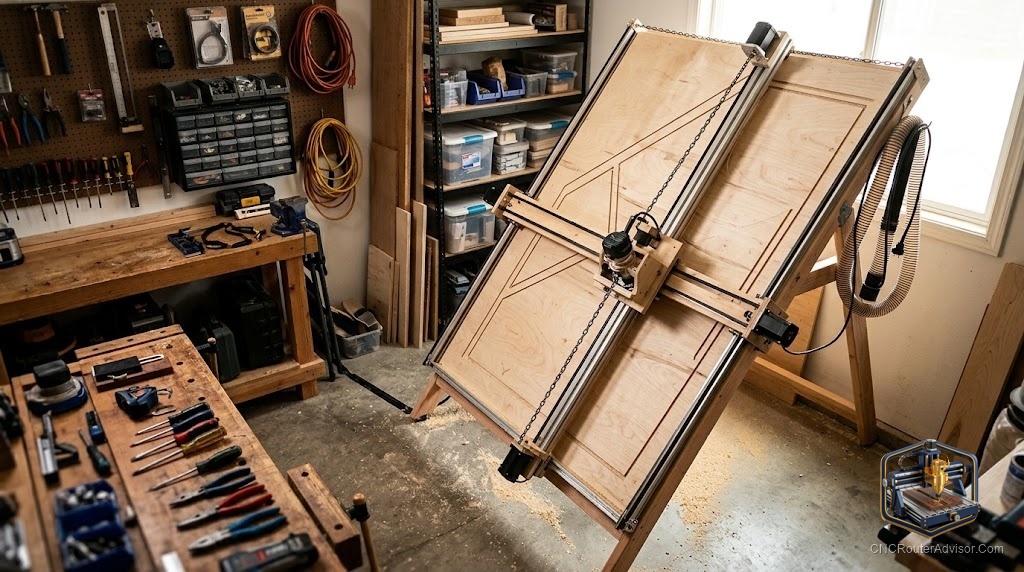
Most CNC routers that cut a full 4 by 8 foot sheet of plywood need a 4 by 8 foot machine, which means a significant chunk of workshop floor that most people do not have. The Maslow CNC solves that with an unusual approach: the sled and its router travel across the sheet in front of a vertical or flat frame, driven by cables attached at anchor points, calibrating itself automatically so you can mount it to a shop floor, a wall, or a workbench. The result is a full-sheet-capable router that stores flat and starts under the kind of money most CNC machines charge for the controller alone.
The Maslow CNC router is a large-format, open-source CNC routing machine built around a sled and cable-drive system, designed to cut full 4 by 8 foot (1220 by 2440mm) sheets of material. Currently at the Maslow 4 and Maslow 4.1 versions, it is sold as a kit, controlled via WiFi through any browser, and actively developed by an open-source community. It does not include the router spindle, which is sourced separately.
The short answer on who it is for: the Maslow is ideal for makers, furniture builders, and large-project enthusiasts who need full-sheet routing on a genuine shoestring, are comfortable with a community-supported machine, and have a flat surface to mount it to. It is not a production machine, and it requires more patience than a conventional table-based router. Within its sweet spot, it is remarkable value.
What makes the Maslow different from every other CNC router
Conventional table-based CNC routers move a gantry over a fixed table. The Maslow moves a sled across a frame, pulled and positioned by belts attached to motors at anchor points. Maslow 4 and 4.1 use four stepper-driven reels. The machine calibrates itself by pulling each belt taut in sequence, measuring tension via current feedback, and running an algorithm to calculate precise anchor positions automatically. No manual measurement required.
Key Maslow 4.1 specifications:
- Work area: 4 by 8 feet (1220 by 2440mm).
- Kit complete for: approximately the listed kit price; router and flat surface to attach to not included. The recommended router is the DeWALT DW611, with the Makita RT0701C also widely used.
- Storage: the sled packs to about 350 by 280mm (14 by 11 inches). No permanent dedicated frame required.
- Control: connects via WiFi to any browser on any device. No software to install. Compatible with standard G-code from Fusion 360, FreeCAD, Illustrator, and other CAD/CAM tools.
- Community: one of the most active open-source CNC communities, with an ongoing forum, shared project libraries, and ongoing firmware development.
The Maslow 4.1 raised over $458,000 on Kickstarter in a 30-day campaign (against a $16,000 goal), confirming its community strength.
What it cuts well and where it has limits
The Maslow community has produced furniture, signs, boats, architectural panels, and public art on these machines, and the results are genuinely impressive for the system’s accessibility. Maslow 4 claims up to 10 times faster cutting speed compared to the M2, combining faster speeds with deeper passes.
The honest limits are also real:
- It is not a production machine. For high-volume nested-based manufacturing, a conventional vacuum-table router is faster and more consistent.
- Community support is part of the deal. The Maslow is actively developed but requires engagement with the forums when things go wrong. It is not a call-the-vendor experience.
- Flat, rigid mounting surface required. You supply and prep the surface it attaches to.
- Tolerances. The Maslow is capable and well-regarded for woodworking, furniture, and signs, but tight machining tolerances seen in industrial machines require more care and calibration.
The verdict
The Maslow CNC is one of the most compelling large-format routers in the world if you accept its terms: open-source, community-supported, kit-built, and oriented toward accessible full-sheet routing rather than production throughput. The Maslow 4.1’s self-calibrating cable system, WiFi browser control, no-install software workflow, and compact storage address the original Maslow’s biggest friction points. For a furniture builder, maker, or project-oriented workshop that wants full-sheet capacity without a full-size machine, it is hard to argue with.
Three takeaways: the Maslow 4.1 cuts full 4 by 8 foot sheets and stores flat with no permanent frame; self-calibration and WiFi browser control remove most of the setup complexity; and it rewards makers who engage with the community and accept it is a capable DIY platform, not a production CNC.
FAQ
What is the Maslow CNC router? An open-source, large-format CNC kit that cuts full 4 by 8 foot sheets using a cable-driven sled. Currently at version 4.1, it self-calibrates, connects via WiFi, and is controlled from any browser.
Does the Maslow CNC kit include a router? No. The kit includes everything except the router spindle and mounting surface. The DeWALT DW611 and Makita RT0701C are the most recommended routers.
How accurate is the Maslow CNC? For furniture, signs, and structural woodworking it is well-regarded. It is not an industrial CNC with sub-millimeter production tolerances, but careful calibration delivers good results for its intended applications.
Is the Maslow CNC hard to set up? Less so on the 4.1 than earlier versions. Self-calibration removes manual measurement, WiFi browser control needs no software install, and the community documentation is thorough.
Can I mount the Maslow CNC anywhere? The machine attaches to any flat, rigid surface: a shop floor, wall, or large workbench. No permanent dedicated frame is required, and the sled packs small for storage.
What software does the Maslow CNC use? It accepts standard G-code compatible with Fusion 360, FreeCAD, OnShape, Illustrator, and most CAD/CAM tools. No proprietary software installation is needed; control is via WiFi browser interface.
Is the Maslow CNC good for beginners? It is accessible but requires genuine engagement with the community for troubleshooting and optimization. It suits a motivated beginner willing to learn, but is not a plug-and-cut box.
References
- Maslow CNC, About Maslow 4: https://www.maslowcnc.com/about-maslow4
- GizmoCrowd, Maslow 4.1 CNC Review (work area, calibration, storage, software compatibility): https://www.gizmocrowd.com/post/maslow-4-1-cnc-review
- Maslow CNC, User Guide (WiFi control and browser interface): https://www.maslowcnc.com/user-guide
- Kickstarter, Maslow 4.1 campaign ($458,405 raised): https://www.kickstarter.com/projects/maslow4/maslow41-accessible-large-format-cnc-router
- CNC Router Info, Maslow 4 specs and score: https://cncrouterinfo.com/routers/maslow-4/