
Drag Knife for CNC Router: Cut Vinyl, Leather, and Cardboard Without Buying a Second Machine
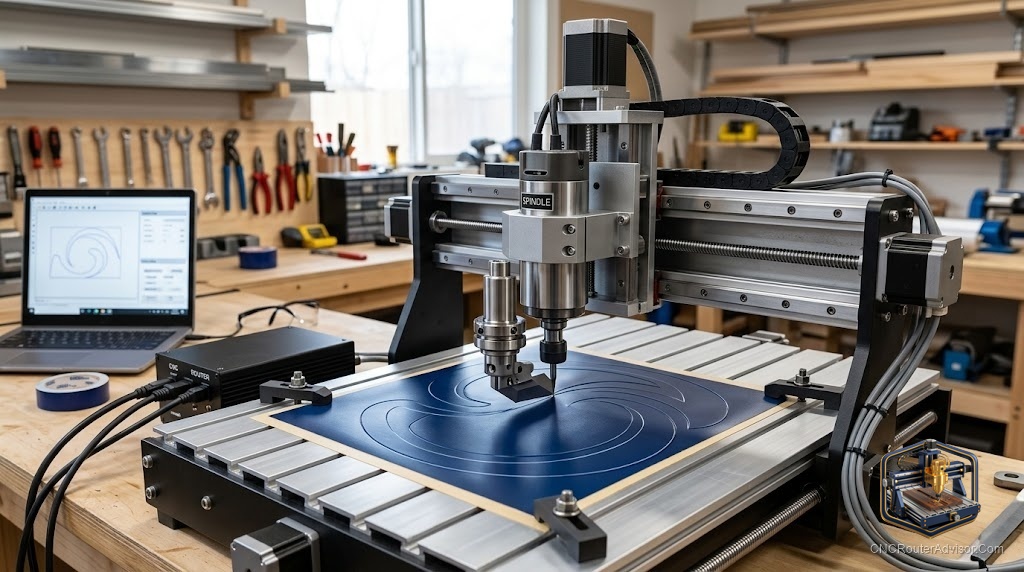
Here is a small revelation that saves woodworkers a lot of money: your CNC router can cut vinyl, cardboard, leather, gasket material, and thin plastics as precisely as a dedicated vinyl cutter. You just swap the spinning bit for a drag knife. It is one of the most useful accessories you can drop into your collet, and it turns a wood-focused machine into a surprisingly versatile cutting tool.
A drag knife for a CNC router is a tool holder with a freely pivoting blade that fits into your router’s collet like a bit. Instead of spinning, the blade trails behind the tool’s center as the machine moves, steering itself through curves and corners to slice thin materials cleanly, exactly the way a utility knife would, but with CNC precision and repeatability.
The short answer on which to get: Donek Tools makes the original and most widely used drag knives, and the model you want depends on material thickness and your collet size. The D3 fits a 1/4 inch collet and excels at detailed cuts in thin material; the D2 and D4 handle thicker stock up to 1/4 inch; and a dedicated 1/2 inch model cuts material up to 1/2 inch thick.
How a drag knife actually works
The key idea is that the blade is offset behind the axis of rotation, so it drags. As the toolpath turns, the trailing blade naturally aligns with the direction of travel, tracing exact curves and sharp corners. Because it does not spin, there is no dust, no burning, and no melting, which is why it shines on materials that a router bit would tear or a laser would scorch.
The blade itself is usually a standard utility-knife blade (a specific type), which keeps consumables cheap and easy to replace. Setup happens in your existing CAM software; Donek provides guidance for programs like Vectric Aspire, including how to handle the blade offset so corners come out crisp.
What a drag knife can cut
Drag knives are used by hobbyists and industry alike for a wide range of thin, flexible materials:
- Vinyl and adhesive films for signage, decals, and stencils.
- Cardboard and chipboard for custom packaging, boxes, and prototypes.
- Leather for goods, patterns, and inlays.
- Gasket material for custom seals.
- Wood veneer for marquetry and inlay artwork.
- Thin plastics and carbon-fiber pre-preg for aerospace, automotive, and hobby parts.
If you can cut it with a utility knife, you can generally cut it faster and more precisely with a drag knife in your CNC.
Choosing the right Donek model
Match the tool to your material and machine:
- D1 and D3 (thin, detailed work). Depth of cut from about 0.010 to 0.0625 inch (1/16 inch), with curved cuts as tight as a 1/16 inch radius. The D1 fits a 1/2 inch collet; the D3 fits a 1/4 inch collet.
- D2 and D4 (thicker material). Handle roughly 0.010 up to 0.250 inch (1/4 inch) thick, with curves down to a 1/8 inch radius. The D2 fits 1/2 inch and the D4 fits 1/4 inch collets.
- 1/2 inch model (thickest stock). Cuts material from 0.010 up to 0.50 inch (1/2 inch) thick, though minimum curve radius grows substantially, so it is best for larger shapes.
Because the Donek knife fits any standard collet, it is a near-universal accessory for almost any CNC router or spindle. The D3, the popular 1/4 inch choice, is available directly from Donek and through retailers, including on Amazon.
Setup tips and honest limitations
A drag knife is not magic. Sharp corners need a small “swivel” or corner action in the toolpath so the blade can reorient, which good CAM guidance handles. Thick or dense material may require multiple passes rather than one deep cut. And the blade offset must be set correctly in software, or curves will be slightly off. None of this is hard, but skipping it leads to rounded corners and frustration. Keep spare blades on hand, since a dull blade drags poorly and tears material.
The verdict
A drag knife is one of the highest-value accessories for a CNC router, turning a single machine into a precise cutter for vinyl, cardboard, leather, gaskets, and veneer. Donek Tools makes the standard, and choosing between the D1, D2, D3, D4, and 1/2 inch models comes down to your material thickness and collet size. For most woodworkers on a 1/4 inch collet doing detailed work, the D3 is the natural starting point. Set the blade offset correctly, keep sharp blades, and it will pay for itself the first time you skip buying a separate vinyl cutter.
Three takeaways: a drag knife trails a non-spinning blade to slice thin materials cleanly; pick the Donek model by material thickness and collet size (the D3 suits most 1/4 inch detailed work); and set the blade offset in CAM so corners and curves come out crisp.
FAQ
What is a drag knife for a CNC router? It is a collet-mounted tool with a freely pivoting, non-spinning blade that trails behind the tool center to cut thin materials like vinyl, cardboard, and leather with CNC precision.
What can a CNC drag knife cut? Vinyl, adhesive film, cardboard, leather, gasket material, wood veneer, thin plastics, and even carbon-fiber pre-preg. Essentially anything you could cut with a utility knife.
Which Donek drag knife should I buy? Match it to material thickness and collet size. The D3 (1/4 inch collet) suits thin, detailed work; the D2 and D4 handle up to 1/4 inch thick; and the 1/2 inch model cuts up to 1/2 inch thick stock.
Will a drag knife fit my CNC router? Almost certainly. Donek knives fit standard 1/4 inch and 1/2 inch collets, making them compatible with nearly any CNC router or spindle.
Do I need special software for a drag knife? You use your existing CAM software, but you must set the blade offset and enable corner or swivel actions so curves and sharp corners cut accurately. Donek provides setup guidance for programs like Vectric Aspire.
Does a drag knife use special blades? It uses a specific type of standard utility-knife blade, which keeps replacement blades inexpensive and easy to source. Keep spares, since dull blades tear material.
Can a drag knife cut thick material in one pass? Often no. Thicker or denser materials usually need multiple passes at increasing depth rather than a single deep cut for clean results.
References
- Donek Tools, Where Can I Buy a Drag Knife (D1 to D4 and 1/2 inch model specs): https://donektools.com/where-can-i-buy-a-drag-knife/
- Donek Tools, D3 Drag Knife product page: https://donektools.com/product/d3-drag-knife/
- Donek Tools, FAQ (materials and universal collet fit): https://donektools.com/donek-tools-faq/
- Ooznest, D3 Donek Drag Knife (materials cut): https://ooznest.co.uk/product/d3-donek-drag-knife/
- Donek Tools D3 on Amazon: Check on Amazon