
CNC Router Shop: Setting Up Your Space, Your Machines, and Your Workflow for Real Production
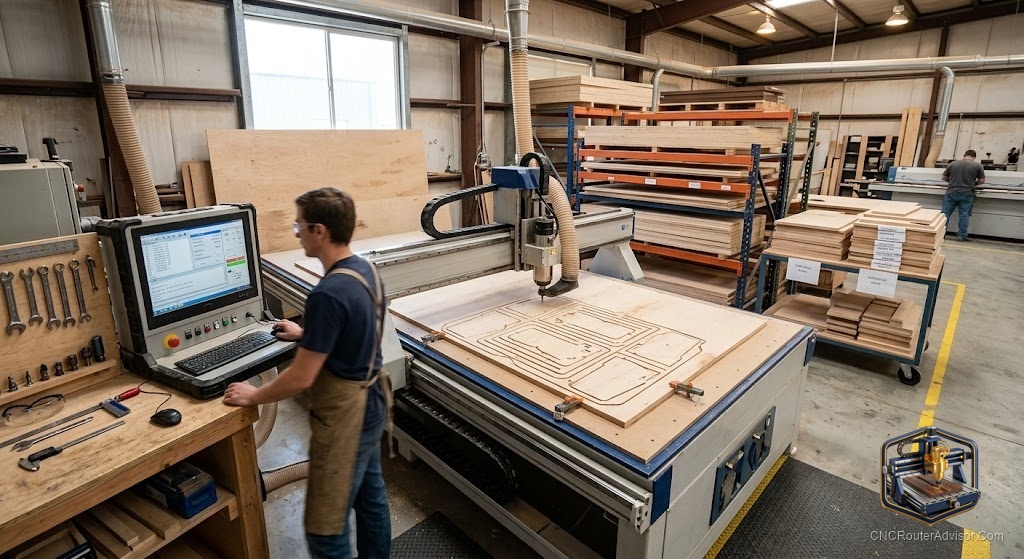
A CNC router shop is more than a machine in a room. It is a space organized so the machine, the material flow, the dust management, and the finishing workflow all work together without creating obstacles and waste at each step. The difference between a shop that produces efficiently and one that is constantly fighting logistics is usually not the machine; it is how the space around it is set up. Whether you are equipping a single dedicated room or a corner of a garage, the principles for a productive CNC shop are the same.
A CNC router shop is a dedicated workspace equipped and organized for CNC router production, comprising the machine, material storage and staging, workholding equipment, dust collection, computer and software workstation, bit storage and maintenance tools, and a finishing area, all arranged so material flows from storage through machining to finishing without unnecessary movement or hazard.
Here is the direct framing: a productive CNC router shop starts with the machine matched to the work, then builds the supporting infrastructure in order of production impact: dust collection first, workholding second, material flow third, bit storage and maintenance fourth. Two verified machine picks are noted below. The sections cover the setup priorities and how they connect.
The machine at the center
Every shop decision supports the machine, so choosing the right machine for the work is the first decision. For a shop doing signs, custom gifts, and light woodwork, a compact-to-mid machine like the Genmitsu PROVerXL 4030 V2 provides a practical work area and solid rigidity on a bench that fits most shop layouts. For shops doing larger signs, cabinet components, and a higher production rate, the FoxAlien Masuter Pro offers more work area and a sturdier build. Both are practical bench machines for a real shop rather than machines that require industrial infrastructure.
Dust collection: first priority
A CNC router produces significant fine dust from MDF and wood, and that dust is both a health and fire risk if not managed. Dust collection is the first infrastructure investment a shop should make, ahead of upgrades and accessories. A shop vacuum connected to a dust shoe at the spindle captures the chips at the source; a larger dedicated dust collector handles higher production volumes. Whatever the system, the goal is to capture chips at the spindle rather than letting them settle on every surface in the shop.
Workholding: second priority
A shop that fights workholding on every job wastes significant time. A T-track spoilboard with a set of clamps is the practical standard for most small shops, giving flexible hold-down without rebuilding the setup for each material size. Consistent workholding hardware that lives near the machine means less setup time and more cutting time.
Material flow and bench layout
Material should travel in one direction: from storage or staging, to the machine, to a finishing or sanding area, to packing or assembly. Any layout that requires material to travel backwards, be set down on the machine table while waiting, or compete with the computer workstation for surface space is an obstacle that costs time on every job. Even in a small shop, a clear material staging surface adjacent to the machine and a separate finishing area makes production noticeably smoother.
Bit storage and maintenance station
Bits stored loose in a drawer develop micro-chips from contact with each other. A simple bit organizer board or case with individual positions keeps bits clean and identifiable by type, and a maintenance station (collet wrench, torque wrench, cleaning solvent, and a flat surface for inspection) takes minutes to set up and saves the frustration of hunting for the right tool when the job is already loaded.
For the full range of machines available for a shop setup, see our guide to CNC router machines for sale.
Final verdict
A productive CNC router shop is organized around machine, dust, workholding, material flow, and bit maintenance in that order of setup priority. Match the machine to the work first; build dust collection before anything else; standardize workholding so setup is fast; arrange material flow so it moves in one direction; and keep bits organized and tools at hand. Done in that order, the shop supports the machine rather than fighting it, and production runs cleanly from the first job to the hundredth.
FAQ
What do I need to set up a CNC router shop? The machine, dust collection, workholding (T-track spoilboard and clamps), a computer workstation for CAM, material staging space, bit storage, and a finishing area. Build in that priority order.
What is the most important infrastructure for a CNC shop? Dust collection, ahead of any accessory or upgrade. CNC routing produces significant fine dust that is both a health hazard and a fire risk if not captured at the source.
How should I organize material flow in a CNC shop? In one direction: storage to machine to finishing. Avoid layouts that require backtracking or using the machine table as staging. Even a small staging surface adjacent to the machine improves production flow.
How do I store CNC router bits in a shop? In individual positions in a bit organizer board or case, not loose in a drawer. Individual storage prevents micro-chipping from contact and makes bit identification fast.
Can I run a CNC router shop from a garage? Yes. Many small shops operate from garages with a bench-mounted machine, a shop vacuum for dust, and a compact spoilboard setup. The same layout principles apply at any scale.
How much space do I need for a CNC router shop? A minimum practical layout for a single bench machine needs roughly 3x3 meters, including machine clearance, material staging, and a computer workstation. More is better for material flow and finishing.
References
- SainSmart Genmitsu, shop setup and machine documentation: https://www.sainsmart.com/blogs/news
- FoxAlien, machine documentation: https://www.foxalien.com
- OSHA, woodworking dust and safety reference: https://www.osha.gov