Build a CNC Router: The Decision, the Paths, and What Makes a Build Succeed
The decision to build a CNC router rather than buy one is a reasonable one for a lot of people, and the reasons behind it matter more than the decision itself. Building for cost savings alone is often a mistake; building for understanding, customization, and the satisfaction of a machine you made and fully own is usually the right reason. The build that succeeds is the one driven by the right motivation with realistic expectations about the time, research, and iteration it requires.
To build a CNC router means to assemble a working CNC machine from components, whether via a matched kit, a proven set of plans, or individually sourced parts, resulting in a machine tailored to your materials, work area, and needs, at the cost of time and assembly effort rather than a higher upfront purchase price.
Here is the direct guidance: the build paths range from kit assembly (lowest risk, most support) to proven plans (more customization, community-backed) to full scratch sourcing (maximum control, maximum risk). The fundamentals that make any build succeed are a rigid frame, a matched motion system, standard electronics, and realistic time expectations. The sections below cover the paths, the fundamentals, and the honest realities of building.
The three build paths
Kit assembly is the most structured path: matched parts and instructions lower the risk of wrong components and simplify the build. Kits span from small desktop machines to mid-size builds and usually include the frame, motion system, and electronics. Proven plans, such as those from V1 Engineering or PrintNC, provide tested designs with community support and documentation; you source the parts yourself but follow a design that is known to work. Full scratch design and sourcing offers maximum customization and the deepest learning, but demands significant research and carries the highest risk of component mismatch. Most first-time builders succeed with a kit or proven plans.
The fundamentals every build needs
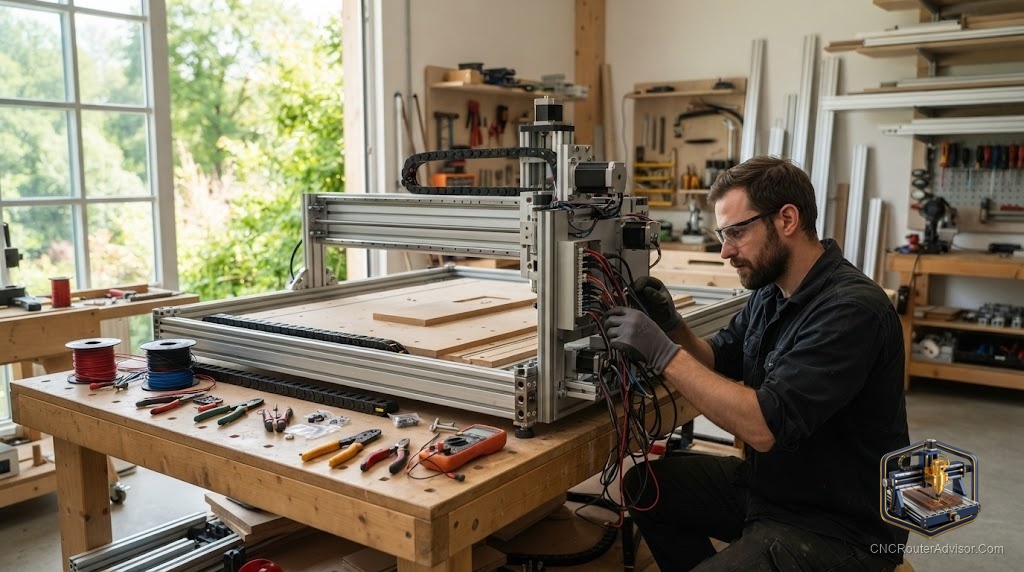
Rigidity is the non-negotiable: the frame must hold the spindle steady against cutting forces, and you cannot add rigidity later, so err toward stiff and heavy rather than light and cheap. The motion system must match the materials: belts for light wood, lead or ball screws with linear rails for harder wood and metal. Electronics should be standard, typically GRBL-based with free sender software, to benefit from the largest community and documentation. And time: a realistic build takes more of it than the parts list suggests, with squaring, tramming, wiring, and tuning all requiring patient iteration.
What the build teaches and gives you
The build teaches how every part of the machine works, which makes you far better at running, maintaining, and improving it. It gives you a machine customized to your needs and your shop. And it can save money, though the gap with assembled machines narrows once you account for all the parts, tools, and time. The strongest case for building is not cost; it is ownership and understanding.
Who should buy instead of build
If speed matters, buying assembled gets you cutting in a day rather than weeks. If you dislike troubleshooting, an assembled machine with support removes the ambiguity that building introduces. If your skills are in what you will make rather than how machines work, buying lets you focus on output rather than process. Build if you want the process; buy if you want the result.
For the wood-specific version of this build decision, see our guide to build a CNC wood router.
Final verdict
Building a CNC router is the right choice if you value understanding your machine, customizing it to your needs, and are willing to trade time for those gains. The kit path is the most reliable start; proven plans offer more customization with community support; scratch builds suit the experienced and patient. Whatever the path, a rigid frame, a matched motion system, and standard electronics are the fundamentals that determine whether the build succeeds. Approach it with realistic expectations and you finish with a machine you understand thoroughly and a set of skills that permanently improve your CNC work.
FAQ
Is it cheaper to build a CNC router than to buy one? Often somewhat, but the gap narrows once you account for all parts, tools, and time. The stronger case for building is the understanding, customization, and ownership it provides rather than pure cost savings.
What is the easiest way to build a CNC router? Building from a kit, which provides matched parts and instructions and has the highest success rate. Proven plans with community support are the next step up in complexity and customization.
What are the most important parts of a CNC router build? The frame (rigidity is the most critical factor), the motion system matched to your materials, and standard GRBL-based electronics that benefit from the largest community and documentation.
How long does it take to build a CNC router? Depends on the path and experience, but expect significantly more time than the assembly instructions suggest. Squaring, tramming, wiring, and software tuning add hours that beginners rarely plan for.
What open-source CNC router designs are available? V1 Engineering’s MPCNC and LowRider, PrintNC, and various community designs are well-documented with active communities. These provide proven plans rather than requiring design from scratch.
Should I build my first CNC router or buy one? Buy if you want to cut quickly and dislike troubleshooting. Build if you want to understand your machine deeply and are comfortable with the iteration that assembly requires.
References
- V1 Engineering, open-source CNC build documentation: https://docs.v1e.com
- PrintNC, open-source CNC design documentation: https://wiki.printnc.info
- GRBL project, controller setup and documentation: https://github.com/gnea/grbl/wiki