
CNC 5-Axis Router: What the Extra Axes Buy You, and Whether You Need Them
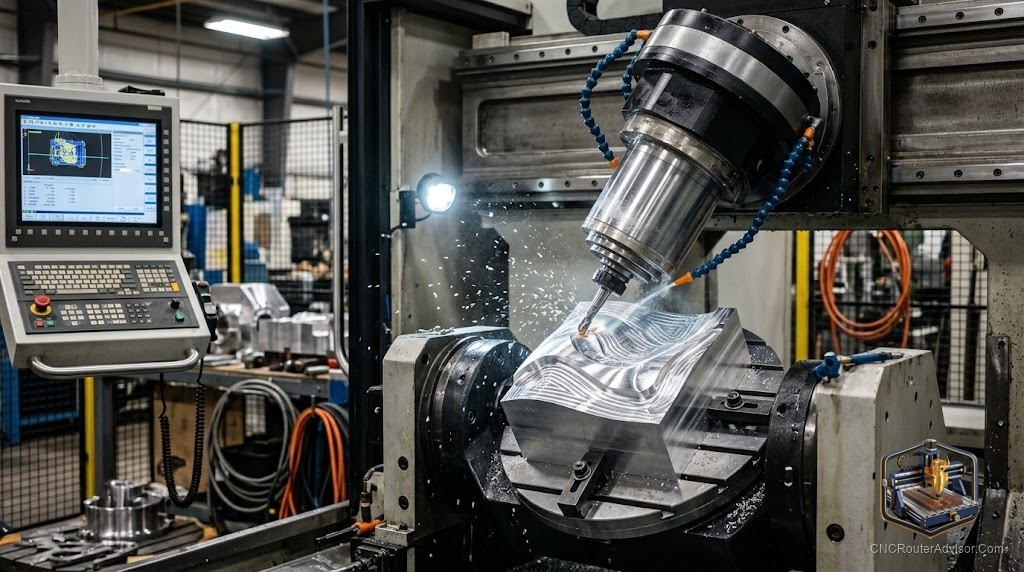
The first time you watch a CNC 5-axis router work, it looks like the machine is showing off. The cutting head tilts and swivels while the gantry moves, reaching the sides of a part and carving compound curves in a single setup. It is genuinely impressive, and it is also genuinely expensive and complex. Before you decide you want one, it is worth understanding exactly what those extra axes do, because for a lot of work they solve a problem you may not have.
A CNC 5-axis router is a machine that moves a cutting tool along the three linear axes (X, Y, and Z) plus two additional rotational axes, letting the tool approach a workpiece from almost any angle. This allows complex, contoured parts to be machined in a single setup rather than being repositioned by hand.
The direct answer before the details: a 5-axis router is the right tool if you make complex three-dimensional parts, deep undercuts, or angled features, and if repositioning parts by hand is costing you accuracy and time. If your work is mostly flat sheet cutting, engraving, and 2.5D carving, a 3-axis machine does the job for far less money and complexity. The extra axes are powerful, but they earn their keep only on the right work. The sections below explain what they add and where the cost lands.
What the two extra axes actually do
The two rotational axes let the tool tilt and rotate relative to the part. In practice that means the machine can reach the sides and angled faces of a workpiece without you unclamping and reorienting it. Two things follow. First, complex shapes like turbine-style curves, molds, and sculptural forms can be cut in one setup. Second, tool orientation can stay optimal to the surface, which improves finish and can reduce tool wear on contoured work.
The catch is that this capability multiplies complexity everywhere: in the machine, the control, and above all the software and programming. Five-axis toolpaths are a different discipline from 3-axis, and the learning curve is real.
Where the cost and complexity land
Five-axis machines cost far more than 3-axis routers, and the CAM software and training add to that. Programming demands more skill, collision avoidance becomes a serious concern, and setup and fixturing require more thought. This is why 5-axis routers live mostly in production shops, aerospace, marine, and mold making rather than in home workshops. The capability is extraordinary, but so is the investment in money and expertise.
When a 3-axis machine is the smarter choice
For flat sheet work, signs, engraving, joinery, and most 2.5D and simple 3D carving, a 3-axis router is more than enough and dramatically simpler to own and run. Many shops that think they need 5-axis really need a rigid 3-axis machine and better fixturing. Buy the axes you will actually use, because paying for motion you never program is an expensive way to own a machine.
If your real need is simpler multi-side work, our 4th axis CNC router guide covers rotary machining, a big capability step that costs far less than full 5-axis.
Who should skip a 5-axis router
Skip it if you are a hobbyist, a sign maker, or a shop doing mostly flat and 2.5D work. The cost, programming difficulty, and support needs will outweigh the benefit. Five-axis makes sense for businesses producing genuinely complex contoured parts at a volume that justifies the investment and the specialized skills.
Final verdict
A CNC 5-axis router is a specialist’s tool that removes setups and unlocks complex contoured parts, and on the right work it is transformative. On the wrong work it is an expensive, complicated machine solving a problem you do not have. Be honest about your parts: if they are flat, engraved, or simple 3D, stay with a rigid 3-axis machine and invest in fixturing. If they are truly multi-surface and contoured, and the volume justifies the money and the programming skill, 5-axis pays back. Match the axes to the parts, not to the ambition.
FAQ
What is a CNC 5-axis router? It is a machine that moves a tool along three linear axes plus two rotational axes, letting the tool approach a part from nearly any angle and machine complex shapes in a single setup.
What can a 5-axis router do that a 3-axis cannot? It can reach the sides and angled faces of a part without repositioning it, cutting compound curves, undercuts, and molds in one setup while keeping the tool optimally oriented to the surface.
Is a 5-axis router worth it for a hobbyist? Usually not. The cost, programming complexity, and support needs are hard to justify for flat and 2.5D work, where a 3-axis machine performs well for far less.
Why is 5-axis programming harder? Five-axis toolpaths add tool orientation and collision avoidance to the problem, requiring more capable CAM software and more operator skill than 3-axis work.
What industries use 5-axis routers? Aerospace, marine, mold making, and production shops that machine complex contoured parts benefit most, since the capability offsets the higher cost and complexity.
Is a 4-axis machine a cheaper middle ground? Yes. Adding a rotary 4th axis expands capability for cylindrical and multi-side work at a fraction of the cost and complexity of full 5-axis motion.
References
- Avid CNC, multi-axis machine capabilities: https://www.avidcnc.com
- Autodesk, multi-axis CAM and 5-axis machining overview: https://www.autodesk.com
- ShopSabre, CNC router product range and specifications: https://www.shopsabre.com