
Large Format CNC Router Guide: Features, Specifications, and Buying Considerations
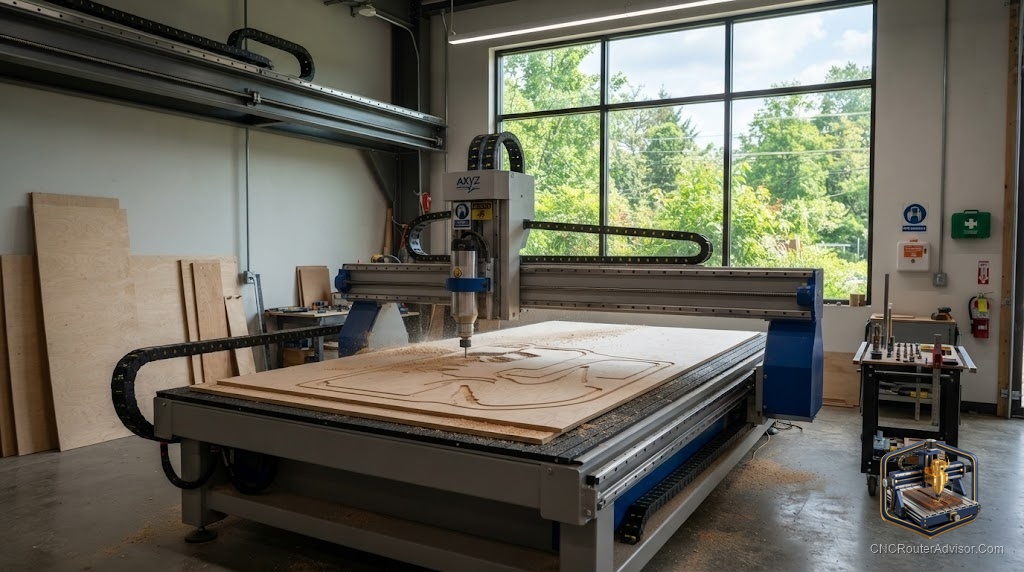
There comes a point in a growing shop where cutting things in pieces stops making sense. You are tiling a design across two sheets, gluing panels to fake a bigger part, or turning down jobs because the material will not fit your machine. That is the moment a large format CNC router starts paying for itself. But scaling up is not just a bigger version of a desktop machine, longer axes bring new engineering challenges, and buying one well means understanding what changes when a machine gets big.
A large format CNC router is a machine with a big cutting area, commonly full-sheet 4 by 8 feet or larger, built to cut oversized panels, sheet goods, and high-volume production in wood, plastics, and composites. Scaling up introduces challenges a small machine never faces: keeping a long gantry rigid, driving long axes accurately and fast, and holding big material flat. Buying well means weighing work area, rigidity across the span, drive system, spindle, and the support infrastructure a large machine needs.
Short answer: a large format CNC router handles full sheets and beyond for production and oversized work, but its challenges are rigidity across a long gantry, accurate fast motion over long axes, and holding big panels flat. Prioritize a rigid frame and gantry, a capable drive (often rack and pinion for long travel), a real spindle, strong vacuum or clamping workholding, and serious dust collection. Confirm true work area, footprint, power, and support before buying.
What changes when a machine gets big
Scaling up is not linear. A large machine must solve problems a desktop never has:
- Gantry rigidity. A wide gantry spanning several feet wants to flex and twist, so it must be engineered stiff or cut quality suffers.
- Long-axis motion. Moving accurately and quickly over 8 feet or more favors different drives than a short desktop axis.
- Workholding at scale. Holding a full sheet flat needs vacuum tables or extensive clamping, not a couple of clamps.
- Dust and chips at volume. Big jobs make a lot of waste, demanding serious extraction.
- Space and power. Footprint, clearance, and electrical requirements grow significantly.
Specifications to weigh
- Work area. Confirm the true cutting envelope, full-sheet or larger, and match it to your material and jobs.
- Frame and gantry rigidity. The most important factor at scale, since a long gantry’s stiffness sets finish quality and cutting speed.
- Drive system. Rack and pinion is common on large machines for fast travel over long distances; ball screws favor precision on shorter axes. Understand the trade.
- Spindle power. A real VFD spindle, sized for continuous production and the materials you cut.
- Controller. Often a more capable standalone controller suited to production, sometimes with tool changing.
- Workholding. Vacuum table, T-slot clamping, or both, essential for large panels.
Infrastructure a large machine needs
A large format router is a shop commitment, not just a purchase:
- Space for the machine footprint plus material handling room around it.
- Power that may exceed standard circuits, so confirm electrical needs.
- Dust collection sized for high-volume waste.
- Material handling, since moving full sheets on and off the bed is real work.
- Support and service, which matter more when downtime stops production.
Materials and use cases
Large format machines cut plywood, MDF, hardwoods, and softwoods at full-sheet scale, plus plastics like acrylic and HDPE and composite panels, and with the right setup light aluminum. Typical work includes cabinet and furniture production, large signage, panel processing, nested small-part runs, and any job simply too big for a smaller bed.
Product note and picks
Most true large format machines, full-sheet and larger, are sold direct by specialist manufacturers and configured to a shop’s needs rather than bought off a marketplace, so verify specifications and support directly with the maker. For shops stepping up from desktop size toward larger work without going full-sheet, a bigger rigid desktop machine can bridge the gap:
SainSmart Genmitsu PROVerXL 4030S (a step up in size). A rigid, larger-format desktop machine that handles bigger signs and panels than a compact unit while staying accessible. Honest flaw: it is still far short of full-sheet capacity, so it bridges toward large work rather than replacing a true large format machine. On Amazon.
Who should buy, and who should skip
Buy a large format CNC router if you produce cabinets, furniture, or signage at volume, routinely cut full sheets, and have the space, power, and material-handling capacity to support it. Skip it if your work is small to mid-size, since a desktop or mid-format machine costs far less and fits a normal shop, and skip full-sheet capacity you will rarely use, as it wastes money and space. Size the machine to real, recurring demand.
The bottom line
A large format CNC router opens up full-sheet and production work, but scaling up brings real engineering demands: a rigid gantry across a long span, accurate fast long-axis motion, and workholding that keeps big panels flat. Prioritize rigidity, a capable drive, a real spindle, serious workholding and dust collection, and confirm work area, footprint, power, and support. Match it to recurring demand for oversized or high-volume work, and it transforms what your shop can take on. Buy it for capacity you truly use, not capacity that sits idle.
FAQ
What is a large format CNC router? A machine with a big cutting area, commonly full-sheet 4 by 8 feet or larger, built for oversized panels, sheet goods, and high-volume production.
What is the biggest challenge with large machines? Keeping a long, wide gantry rigid so it does not flex or twist, along with accurate fast motion over long axes and holding big panels flat.
What drive system do large routers use? Rack and pinion is common for fast travel over long distances, while ball screws favor precision on shorter axes. Each trades speed against accuracy.
How do you hold a full sheet down? With a vacuum table, extensive T-slot clamping, or both, over a flat, surfaced spoilboard, since a few clamps cannot hold a full sheet reliably.
Do large format routers need special power? Often yes. Larger machines and spindles may exceed standard circuits, so confirm the electrical requirements before buying.
What can a large format router make? Cabinet and furniture parts, large signage, panel processing, and nested small-part production at full-sheet scale in wood, plastics, and composites.
Should I buy full-sheet capacity? Only if you use it regularly. If your work is small to mid-size, a desktop or mid-format machine costs far less and fits a normal shop better.
References
- CNCRouterInfo, how to choose a CNC router: https://cncrouterinfo.com/guides/how-to-choose-a-cnc-router/
- CNC Dad, best CNC router for beginners: https://www.cnc-dad.com/blog/best-cnc-router-for-beginners/