
Large CNC Router: What Counts as Large, What to Expect, and How to Choose
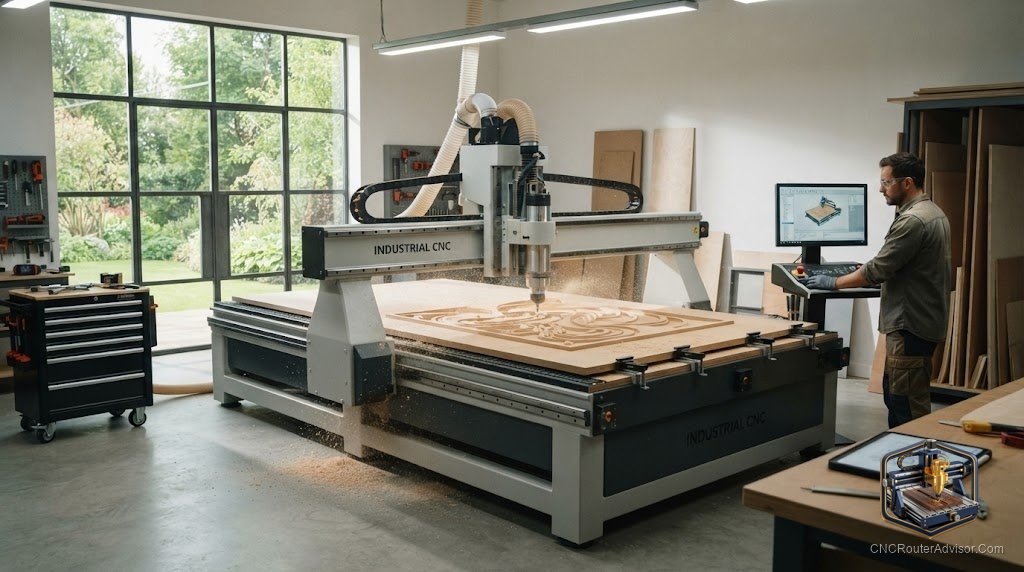
Size is the variable that changes everything about owning a CNC router. A larger machine opens up the work you can do but demands more floor space, more power, more money, and more infrastructure. Getting the size question right is one of the most important decisions in buying a CNC router.
A large CNC router has a work area beyond the desktop class, typically 24 by 36 inches or more, up through full 4-by-8-foot and larger production machines.
What “large” means in practice
- Mid-size (24 by 36 to 32 by 32 inches): substantial signs, furniture components, medium cabinet parts.
- Prosumer large (48 by 32 to 48 by 48 inches): large panels and most furniture-scale work. Onefinity Foreman lives here.
- Full 4-by-8-foot production: full sheet of plywood or MDF in one setup.
- Larger production (5-by-10 and beyond): industrial, not typically hobbyist purchases.
What larger machines demand
- Floor space. The machine plus clearance to work and load sheets.
- Power. Larger spindles often run on 220V.
- Rigidity. Larger gantries need to stay stiff. Heavier equals more rigid.
- Vacuum or workholding. Holding a full sheet requires a vacuum table or substantial clamping.
- Dust and material handling. Large machines produce more dust and move heavy sheets.
Notable machines worth knowing
Onefinity. The Woodworker (32 by 32), Journeyman (48 by 32), and Elite Foreman (48 by 48) are serious prosumer machines built on ball screws and closed-loop steppers. Browse at the Onefinity machine shop. Honest flaw: real money and space commitment; work area still does not rival a true 4-by-8 production machine.
Grizzly. The G0894 (24 by 36 inches) through the G0895 (4 by 8 feet) and G0932 (4 by 8 feet with rotary 4th axis). US-based support and warranty. The G0895’s 6 HP spindle and 6-zone vacuum table make it a genuine production tool.
How to choose the right size
- What is your largest regular project? Buy so it fits with room to spare.
- What are your planned future projects? If full sheets are in your future, buy for it now.
- What does your shop have room for? Measure before committing.
- What is your electrical service? Large spindles often want 220V.
Most common mistake: buying too small and re-buying within six months.
Who should buy a large router
Makes sense if you: cut sizeable signs, furniture, or cabinet components; are ready for a real shop machine; run a small business depending on cutting throughput.
Wait if you: are still learning; do mostly small parts; have not sorted shop space or electrical.
The bottom line
The right size is the smallest that covers your real projects with room to grow. Mid-size machines like the Grizzly G0894 or Onefinity Journeyman serve serious hobbyists and small shops. Full 4-by-8 production machines like the G0895 belong in cabinet shops running full sheets. Measure your shop, know your electrical, and buy for the work you actually do.
Frequently asked questions
What is considered large? Cutting area of 24 by 36 inches or more, from mid-size through full 4-by-8-foot production routers.
Can it run on standard household power? Many can, but larger spindles often want 220V. Check electrical requirements.
What can a 4-by-8 do that smaller machines cannot? Cut a full sheet in one setup, the core requirement for cabinet shops and sign makers.
Is the Onefinity a large router? The Elite Foreman at 48 by 48 is large for a prosumer machine; not a full 4-by-8 production machine.
Do I need a vacuum table? For full-sheet work, a vacuum table makes workholding fast and repeatable.
Should a beginner buy large? Usually not. Start smaller and step up when work justifies it.
References
- Onefinity CNC machine lineup specifications. Grizzly Industrial G0894, G0895, and G0932 product pages.