
DIY CNC Router Build: What It Really Takes to Build Your Own
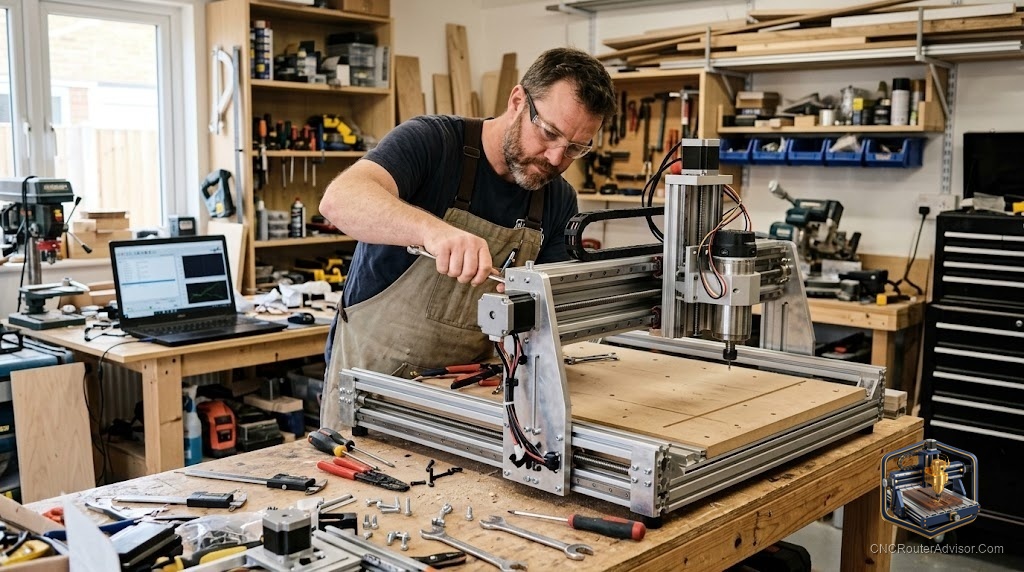
Building your own CNC router is one of the most rewarding projects in the hobby, and one of the most romanticized. There is a powerful appeal: understand every part, tailor it to your shop, save money. Plenty of people do exactly that and love the result. But there is an honest reality the build videos skip.
Be honest about why you are building
- To learn and understand: a great reason.
- To customize: a specific size or capability off-the-shelf machines do not offer.
- For the enjoyment: if you love building, this is its own reward.
- To save money: proceed with caution. Once you count every part, your time, and the mistakes you re-buy, savings are often smaller than expected.
If your only goal is the cheapest working machine and you do not enjoy the build, buying a well-supported value machine is frequently the better call.
The spectrum of DIY
Assembly kits. All parts and instructions come together; you bolt it up. Gentlest DIY: known-good result, less customization.
Open-source designs with sourced parts. Follow a proven community design and buy the parts yourself. Projects from OpenBuilds give you a tested blueprint with room to customize. The sweet spot for many builders.
Full scratch build. Design the machine and fabricate everything. Maximum control, maximum risk. For experienced builders.
The major subsystems
- Frame and gantry. Determines rigidity, the single biggest cut-quality factor.
- Linear motion. Rails, wheels, or shafts. Better motion means better accuracy.
- Drive system. Belts, lead screws, or ball screws. Ball screws give best accuracy.
- Motors. Stepper (common, simpler) or servos (higher performance).
- Controller and electronics. Often GRBL-based for hobby builds.
- Spindle. From a trim router to a water-cooled spindle.
Honest trade-offs vs. buying
Building wins on: learning, customization, the satisfaction of the project.
Buying wins on: time (works today), known-good result, manufacturer support, a community around a specific model. Machines like the Genmitsu PROVerXL 4030 V2 and FoxAlien XE-PRO set a real benchmark. Build because you want to build.
Tips for a successful build
Start from a proven design or kit. Prioritize rigidity in every choice. Do not cheap out on electronics and motion components. Budget for the whole system including bits, software, and re-buys. Join the community around your chosen design.
The bottom line
A DIY build is deeply rewarding if your goal is to learn, customize, or enjoy the process. Proven open-source designs like OpenBuilds offer a smart middle path. Be clear-eyed: rigidity is everything, and cost savings versus a good value machine are often smaller than the videos suggest. Build because you want the knowledge and the machine that is exactly yours.
Frequently asked questions
Is it cheaper to build your own? Often less than expected. Count every part, your time, and re-buys. Build to learn or customize.
What do I need? A rigid frame and gantry, linear motion, drive system, motors, controller and electronics, a spindle, and CAD/CAM/sender software.
Should a beginner build or buy? If you enjoy building, a kit or open-source design is a great start. If you just want a working machine, buying is usually better.
Easiest way to build? An assembly kit with all parts and instructions included.
What controller? Many hobby builds use a GRBL-based board with stepper drivers.
Most important part? Rigidity. Frame, gantry, and linear motion determine cut quality above all else.
References
- OpenBuilds community build designs. Genmitsu PROVerXL 4030 V2 and FoxAlien XE-PRO specs as benchmarks.