
CNC Router Tool Changer: Types, Trade-offs, and How to Choose
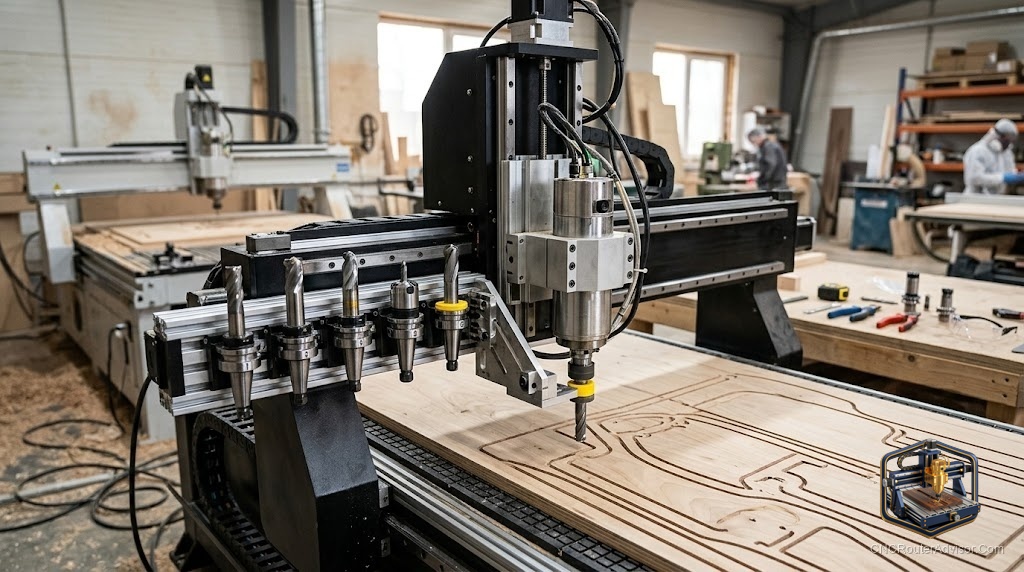
A tool changer solves one specific and real problem: you should not have to stand at the machine every time it needs a different cutter. Whether running a complex sign needing six tools or producing a hundred identical cabinet doors with the same three-tool swap, stopping to change bits by hand is the bottleneck that makes the machine less valuable.
The types of tool changers
Automatic tool changer (ATC)
A true ATC uses a pneumatic drawbar to release and grip tools automatically, with a rack or carousel nearby. When the program calls for a tool change, the machine deposits the current tool, picks up the next one, and resumes without human involvement. The gold standard.
What it requires: an ATC-capable spindle with a pneumatic drawbar, proper tool holders (ISO 20 or HSK), clean dry compressed air, a controller that supports ATC commands, and significantly higher initial investment. Honest flaw: all components must work together reliably. One loose fitting or contaminated holder ruins a job.
Manual tool changer / quick-change systems
Standardized holder sleeves that lock into the spindle quickly and consistently. You still walk to the machine, but the tool returns to the same Z height automatically, eliminating the most time-consuming part of a manual change: re-probing Z. Practical, affordable improvement for hobbyists who run multi-tool jobs without needing a full ATC.
Rack vs. carousel ATC
Tools can be stored in a linear rack (the gantry visits a row of holders) or a carousel (rotating holder presents the next tool). Rack systems are simpler and common on prosumer machines. Carousels are faster and more common on full industrial machines.
What an ATC actually demands
- ATC spindle. Your existing spindle almost certainly cannot be converted. A real ATC spindle has a pneumatic drawbar, a specific holder taper, and through-spindle air. Replacing the spindle is a significant investment.
- Tool holders. Each tool needs its own holder. An ongoing per-tool cost.
- Compressed air. Clean, dry, reliable shop air plus a compressor and often a filter-dryer.
- Controller compatibility. The controller must support M6 tool change commands.
Is an ATC worth it?
An ATC earns its cost if you:
- Run the same multi-tool job repeatedly in production.
- Sell your work, so time and machine uptime have dollar value.
- Run jobs overnight or unattended.
An ATC is overkill if you:
- Mostly run single-tool or simple two-tool jobs.
- Enjoy the craft and do not mind stopping to change a bit.
- Would be better served by a quick-change manual system that costs a fraction as much.
The bottom line
A CNC router tool changer spans from manual quick-change systems that speed up hand swaps to full ATCs that run multi-tool jobs unattended. A true ATC needs a pneumatic spindle, proper holders, compressed air, and a compatible controller, and the total system cost is real. It earns its place when multi-tool production is your main constraint and you are committed to the infrastructure. A quick-change manual system solves most hobbyist pain at a fraction of the cost.
Frequently asked questions
What is an automatic tool changer? A system using a pneumatic spindle, tool rack or carousel, and a controller that triggers automatic tool swaps during a job. No human involvement needed.
Can I add a tool changer to my existing router? Often no. A true ATC requires a pneumatic spindle, holders, air supply, and a compatible controller. Many hobby machines cannot support it.
What is a manual tool changer? A quick-change system where you still change tools by hand but standardized holders return each tool to a consistent Z height, eliminating re-probing.
What tool holder standard is common? ISO 20, HSK 25, HSK 32, and HSK 40 at the prosumer and light-industrial level.
Do I need an air compressor? For a pneumatic ATC, yes. Clean, dry, reliable shop air is required.
Who should get an automatic tool changer? Those running multi-tool production jobs, selling their work, or running long unattended jobs.
References
- PwnCNC and similar ATC spindle documentation. CNC controller documentation (Mach 4, LinuxCNC) on M6 tool change support.