CNC Router 6040 Guide: Work Area, Machine Size, and Buying Factors
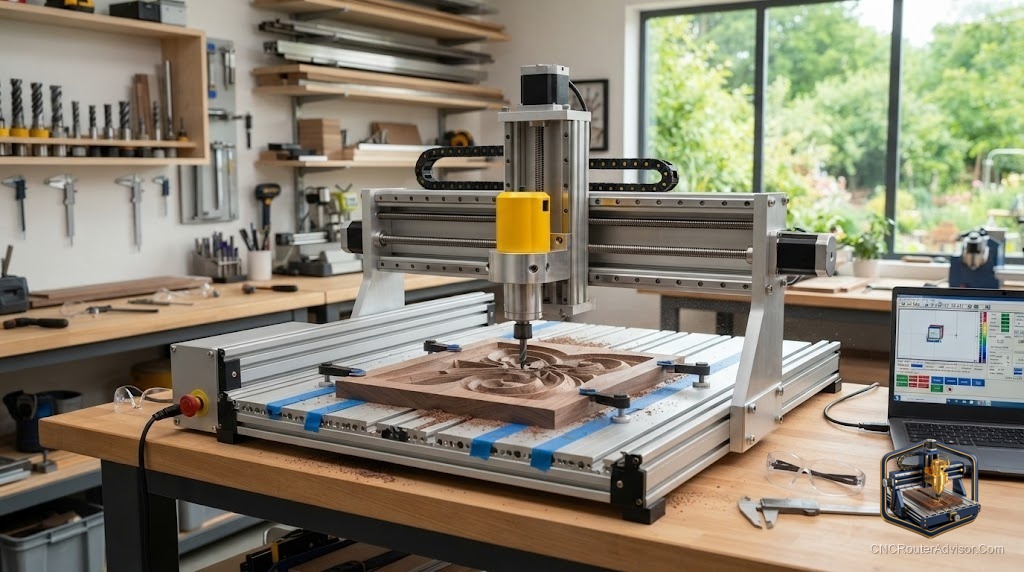
The number is the pitch. A CNC router 6040 gets its name from a work area of roughly 600mm by 400mm, and that single spec is why so many people land on it. It is the machine that sits between the toy-sized 3018 and the furniture-sized 4x8 tables: big enough to make real parts, small enough to live on a sturdy bench in a garage. For a lot of makers, that middle ground is exactly right.
A 6040 is a benchtop CNC router with about 600mm of travel on the long axis and 400mm across, usually built on a cast aluminum frame with ball screws and a water cooled spindle. That build is what separates it from the hobby 3018 class: it is heavier, stiffer, and it comes ready to cut aluminum and hardwood, not just soft materials.
What the work area really gets you
600mm by 400mm is around 24 inches by 16 inches. That is enough to cut medium signs, control panels, guitar bodies, nameplates, gears, and small furniture parts. What it will not do is process a full sheet of plywood, so if your plan is cabinet doors at scale, a 6040 is the wrong tool. Z travel is the spec people forget: many 6040 machines have limited clearance, often around 100mm or less, which caps how thick your stock and fixtures can be. Check that number against the tallest thing you want to cut.
What makes a 6040 different from a 3018
The jump from a 3018 to a 6040 is not just size. It is class:
- Frame: thick cast aluminum plate instead of light extrusion and plastic, so it resists flex.
- Motion: ball screws instead of lead screws or belts, for tighter accuracy and less backlash.
- Spindle: a real water cooled spindle, commonly 800W up to 2.2kW, driven by a VFD, instead of a small trim-router-style DC spindle. Quieter, more powerful, and it holds RPM under load.
- Collet: usually ER11 or ER16, so it accepts a wider range of proper bits.
Those upgrades are why a 6040 can machine 6061 aluminum with the right single flute bit and shallow passes, something the 3018 only manages marginally.
Buying factors that actually matter
Most 6040 machines are made by Chinese manufacturers and sold under many labels, so specs vary more than the shared name suggests. Weigh these:
- Spindle power and cooling: a 1.5kW or 2.2kW water cooled spindle is a meaningful step up from 800W if you cut metal or hardwood often.
- Controller: older machines ship with parallel-port Mach3 boards that need an old PC. Newer ones use USB GRBL boards or standalone DSP controllers. The controller decides which software you can run and how painful setup is.
- Rigidity and weight: heavier is better here. A flexy 6040 loses the main reason you bought it.
- Support and documentation: with generically branded machines, the community and the seller’s manuals matter. Buy from a source with real documentation.
- Ball screws and linear rails: confirm real ball screws and supported round or profile rails, not just lead screws dressed up in the listing.
Who it is right for, and who should look elsewhere
A 6040 is the sweet spot for a maker who has outgrown a 3018, wants to cut aluminum and hardwood, and can dedicate bench space and a bit of setup patience. It is not for someone who wants plug and play simplicity out of the box, and it is not for anyone whose real work is full sheet goods. If you want a polished beginner experience with strong support, a Shapeoko or an Onefinity may suit you better even at a similar size. If you want raw capability on a bench and are willing to tinker, the 6040 delivers more machine for the space.
The honest verdict
The 6040 is a genuine workhorse hiding behind a confusing model number and a hundred brand stickers. Its strengths are real: cast frame, ball screws, water cooled spindle, and metal capability in a benchtop footprint. Its risks are variable quality, dated controllers on some units, and thin support. Buy the heaviest one you can from a seller with real documentation, confirm the Z clearance and controller, and you get a machine that punches well above its size.
Frequently asked questions
What does 6040 mean on a CNC router? It refers to the work area, about 600mm by 400mm. Similar naming gives you the smaller 3018 and 3040 and the larger 6090.
Can a 6040 cut aluminum? Yes, with a rigid setup, a single flute bit, shallow passes, and cooling or lubrication. Its cast frame and ball screws make it far more capable in metal than a 3018.
How thick a workpiece fits under a 6040? Check the Z travel, which is often around 100mm or less. That clearance, minus your bit and fixturing, sets the maximum stock height.
What spindle comes on a 6040? Usually a water cooled spindle from 800W up to 2.2kW driven by a VFD, with an ER11 or ER16 collet. More power helps with metal and hardwood.
What software runs a 6040? It depends on the controller. Older Mach3 parallel-port boards need an old PC, while newer USB GRBL boards or DSP controllers work with modern software.
Is a 6040 good for beginners? It suits a beginner who is comfortable tinkering. If you want polished support and plug and play setup, a name-brand machine may be easier to start on.
Can a 6040 cut a full sheet of plywood? No. Its work area handles medium parts, not 4x8 sheets. For sheet goods you need a large format table.