
Handheld CNC Router: When the Machine Comes to the Work
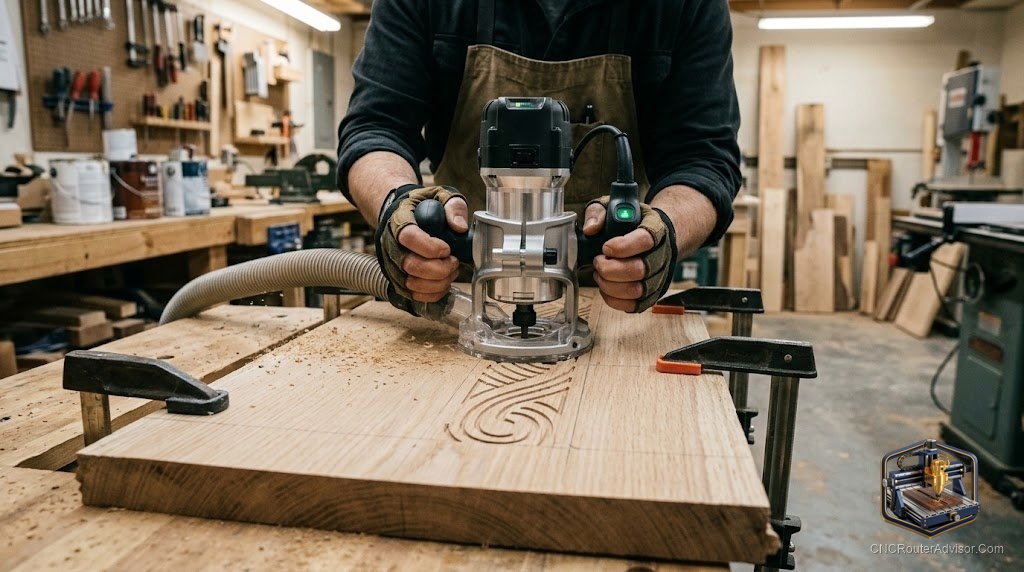
Every standard CNC router has the same constraint: the workpiece must fit on the table. That works until the day you need to route a hinge pocket on a door frame already hung in a wall, carve a sign into a log slab too heavy to move, or inlay a design into a counter you cannot disassemble. That is the day a handheld CNC router makes sense.
The handheld CNC router inverts the normal relationship. Instead of the machine holding still while the workpiece sits on a table, the machine moves over the workpiece. The operator or the device itself handles positioning.
The Shaper Origin is the leading product in this category and the only one worth recommending for serious work. It uses printed tape applied to the workpiece to optically track position, then adjusts the bit path in real time to compensate for hand movement. The result is a router that cuts a toolpath accurately on any surface it can reach. Accuracy for the Origin is specified at plus or minus 0.1mm.
For lighter work, desktop and hobby machines like the Genmitsu 4040-PRO handle most sign and panel work at a fraction of the cost. The working area constraint exists, but for most workshops, most of the time, a table-based machine is the right answer.
The honest case for handheld: large fixed pieces, site work, and one-off operations on substrates that cannot come to a shop. For repeat production of standardized parts, a table machine wins every time.
How Shaper Origin Works
The Origin uses ShaperTape, a printed reference tape placed on or near the work surface. An onboard camera reads the tape and tracks position. The bit path is locked to the digital template, adjusted in real time as the operator moves the tool. The operator steers in the general direction; the machine handles sub-millimeter correction.
Designs are created on Shaper’s online platform or imported as SVG files. The workflow is closer to tablet design than desktop CNC: touch-screen interface, visual confirmation of toolpath on screen, manual plunge depth set before each pass.
The limitation: pocket depth is limited by the router bit length and the manual plunge mechanism. The Origin cannot do 3D relief carving or the kind of multi-pass nesting that a table machine handles with automated tool changes.
Who a Handheld CNC Router Is For
Cabinet installers who need to rout hardware mortises in place. Furniture restorers working on pieces that cannot be moved. Sign makers cutting into architectural elements. Any workflow where the workpiece is the constraint.
For everyone else: buy a table machine. The accuracy, repeatability, and production capability of a fixed CNC router far exceeds what any handheld solution offers at comparable cost.
FAQ
What is a handheld CNC router used for? Site work, large fixed pieces, and operations on substrates that cannot be brought to a shop. Hardware mortises, on-site signage, and large architectural carving are the primary use cases.
Is the Shaper Origin worth it? For professional cabinet makers and installers who regularly need accurate routing on fixed pieces, yes. For hobbyists who can bring their work to a table machine, no.
Can a regular router replace a handheld CNC? A regular hand router requires a jig or template for each cut. The Shaper Origin eliminates that need by tracking its position optically. For one-off shapes and curves in field conditions, the Origin is significantly more capable than a templated hand router.
References
- Shaper Tools. Origin product specifications. shapertools.com
- Carbide 3D. Shapeoko comparison. carbide3d.com