CNC Router Guide: Features, Specifications, and Buying Considerations
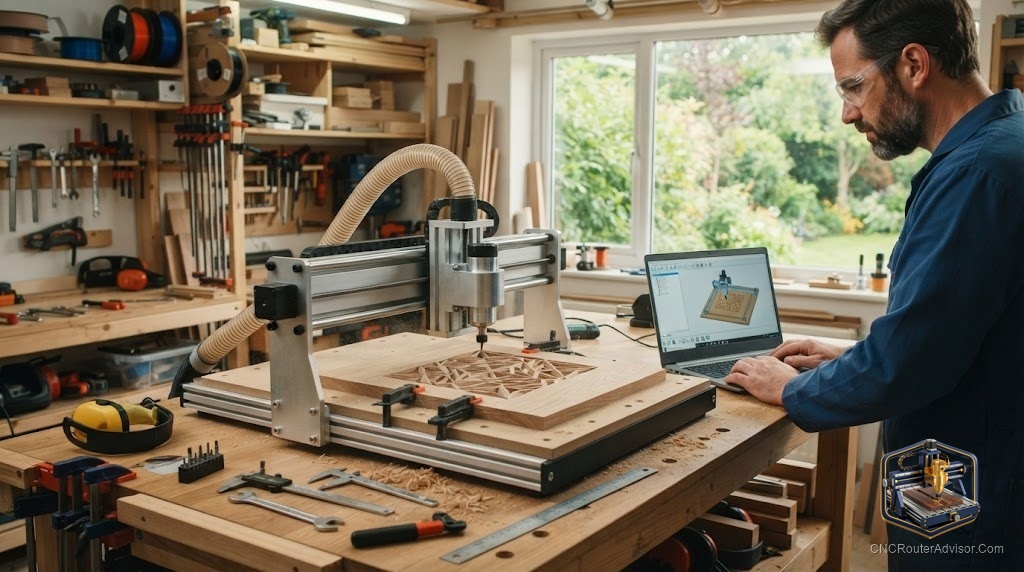
A CNC router is one of those tools that changes what you think is possible in a workshop. You load a file, press start, and the machine carves the design into real material with a repeatability and precision no hand tool can touch. Signs, furniture parts, inlays, carvings, enclosures, brackets, and production panels - the list of what a CNC router can make is defined mainly by the size of the bed and the hardness of your material. For anyone who builds or makes, it is one of the highest impact tools you can add to a shop.
This guide covers what a CNC router is, the specifications that decide whether one is good for your work, and the buying considerations that determine which machine is right for you.
What a CNC router is
CNC stands for Computer Numerical Control. A CNC router is a computer-controlled machine that moves a spinning cutter along a programmed path to remove material and create a shape. You design a part in software, generate a set of instructions called G-code, and the router follows those instructions precisely across the X, Y, and Z axes. The machine does this repeatably: the same file produces the same part, to the same accuracy, every time.
A router differs from a CNC mill primarily in its design target. Routers are optimized for high-speed cutting in wood, soft plastics, and soft aluminum over large work areas. They use a gantry that traverses a flat bed, and their spindles spin at high RPM to remove material quickly. They are the right tool for most making, crafting, and small production work.
The short answer
The right CNC router is the one that matches your material, your project size, and your support needs. Prioritize frame rigidity and a quality motion system over raw bed size or spindle number. Match the spindle to your densest material. Confirm the controller runs a documented, well-supported system like GRBL. Size the work area to your real projects with margin, not your maximum ambition. And weight community support as a real specification, because a machine you can get help running is worth more than an unsupported one with better specs.
Key specifications explained
Work area is the ceiling on part size. It is the usable cutting travel in X, Y, and Z - not the outer frame dimension. Confirm travel against your largest realistic project, with margin for clamping.
Frame rigidity determines cut quality. A stiff frame resists the cutting forces that cause chatter and inaccuracy. Heavier, stiffer frames cut cleaner and hold tolerance better over time.
The motion system decides precision and repeatability. Ball screws on quality linear rails are the most accurate and durable. Lead screws with anti-backlash nuts are adequate for wood and plastic on a budget. Belts and V-wheels are the lowest cost and suit light hobby work.
The spindle determines your material ceiling. A trim router is accessible and adequate for wood and plastic. A VFD spindle gives variable speed control and more sustained power, which opens up aluminum and longer production runs.
The controller and software chain define your workflow and long-term flexibility. GRBL is the widely used open-source firmware with the largest community and broadest software compatibility.
Buying considerations
Support is the most underrated factor. A machine backed by an active community, available parts, and responsive help solves problems fast and stays useful. A machine with no community leaves you alone with every issue.
Start with the work your projects actually require rather than the work you imagine you might do someday. A machine sized to your real needs with a stiff frame and good support beats a larger, flimsier, unsupported machine at every practical level. You can upgrade later with experience telling you exactly what to upgrade.
Who is a CNC router for
A router suits makers, crafters, woodworkers, sign makers, furniture builders, and small production shops cutting wood, plastic, and soft aluminum. It is not a steel-cutting machine - that is a mill. Within its material range, it is one of the most versatile and productive tools in a shop.
Comparison: machine tier by use case
| User | Work area | Priority | Spindle |
| Hobbyist, crafts | Compact to mid | Community support | Trim router or small VFD |
| Woodworker | Mid to large | Rigidity, precision | VFD for hardwood |
| Sign and small shop | Mid to full sheet | Uptime, repeatability | VFD, possibly ATC |
| Aluminum focused | Mid, metal frame | Rigidity, spindle | VFD, water or air cooled |
For a compact, well-supported starting machine, the Genmitsu 3020 PRO MAX is at this listing. For a larger rigid mid-size platform, the Genmitsu PROVerXL 4030 is at this listing. For a metal-frame, tougher-material option, the Genmitsu 3030 PROVer Ultra is at this listing.
The verdict
A CNC router is a design-to-physical-part machine, and the right one makes that translation accurate, repeatable, and reliable for the work you actually do. Get the match right between your materials, your project size, and a rigid, well-supported machine, and the router pays for itself in the quality and volume of what it enables. Miss the match by chasing headline specs on a flexible, unsupported platform, and the machine becomes a source of frustration rather than a tool. Buy on rigidity, support, and fit. The rest follows.
Frequently asked questions
What does a CNC router do? It moves a spinning cutter along computer-controlled paths in three axes to cut, carve, or profile material. You supply a design file and the machine cuts it in real material, accurately and repeatably.
What materials can a CNC router cut? Wood including plywood, MDF, hardwoods, and softwoods; soft plastics like acrylic, HDPE, and Delrin; and, on rigid machines, soft aluminum. Hard metals like steel need a mill.
How much does a CNC router cost? The range is very wide. Compact desktop hobby machines sit at the entry level, mid-size benchtop machines are in the mid range, and full-sheet and industrial machines are capital equipment investments. Choose based on what your work genuinely requires.
Is a CNC router hard to learn? The basics come together quickly. A first cut in a simple design can happen in a weekend with well-supported equipment and software. The depth of the craft grows with your projects, but the learning curve is manageable.
What software do I need? A design tool for creating parts, a CAM program for generating toolpaths and G-code, and a controller program for sending the code to the machine. Many beginner-friendly options combine these steps.
What is the difference between a CNC router and a CNC mill? A router is optimized for high-speed cutting in wood, plastic, and soft aluminum over large work areas. A mill is built for hard metals like steel, with higher torque, lower RPM, and far greater machine mass and rigidity.
References
- CNC Router Info, How to Choose a CNC Router: https://cncrouterinfo.com/guides/how-to-choose-a-cnc-router/
- CNC Dad, Best CNC Router for Beginners: https://www.cnc-dad.com/blog/best-cnc-router-for-beginners/