
Acmer Ascarva 4S CNC Router Machine Explained: Uses, Setup, and Key Considerations
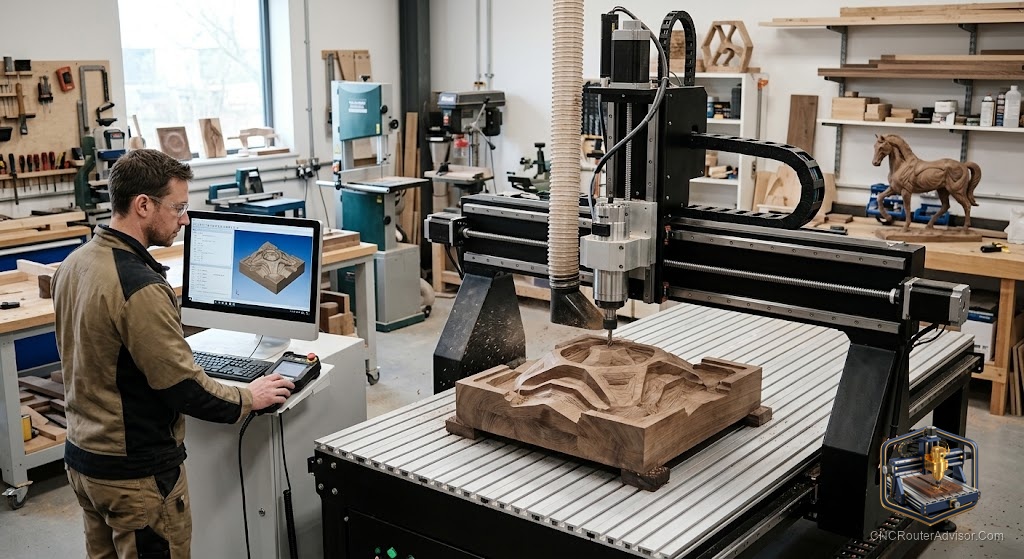
Specific model names in the CNC router space come and go faster than review coverage can keep up, and the Acmer Ascarva 4S is one of those names that surfaces in search results without a long track record to lean on. If you have found it and you are trying to decide whether it is worth buying, the honest answer is that the name matters less than the verified specifications behind it, and any machine in this class needs to pass the same checklist before it earns your money.
This guide gives you that checklist for the Acmer Ascarva 4S and any similar compact desktop router, so you buy on facts rather than on a listing that sounds right.
What machines in this class do
A compact CNC router like the Acmer Ascarva 4S sits in the desktop hobby category: a gantry machine that moves a spinning cutter across a modest work area in the X, Y, and Z axes, guided by a GRBL controller and driven by a motion system of lead screws, ball screws, or belts on linear rails or V-wheels. The category cuts wood, soft plastics like acrylic and HDPE, and on the more rigid models, soft aluminum. The appeal is footprint, entry cost, and approachability.
The Acmer brand produces laser engravers and desktop CNC type tools across a range of models. The Ascarva 4S appears to be a compact desktop CNC router in that lineup. Because the product catalog and spec sheets for newer models change, always verify current specifications directly from the manufacturer or a live listing rather than relying on any secondhand summary.
The short answer
Before buying the Acmer Ascarva 4S or any lesser-known compact router, verify four specifics: the actual work area in travel, not just the outer frame dimension; the motion system type, because ball screws and linear guides outperform belts and V-wheels for accuracy; the spindle power and whether it uses a fixed motor or a trim router mount; and the controller, confirming it is a documented system like GRBL that works with standard software. Then weigh the support picture: is there an active user community, and are replacement parts findable? A machine with good specs and no community support can strand you fast.
How to read the specifications
Work area in travel is the number that caps what you can make. Some listings quote the outer machine frame or the rail length rather than usable cutting travel, which inflates the apparent size. Ask or look for the actual X, Y, and Z cutting travel, not the frame dimensions.
Motion system tells you about precision and durability. Lead screws with anti-backlash nuts are common at this price point and are adequate for wood and plastic, though they do not match ball screw accuracy. V-wheel gantries save cost but wear faster than linear rail guides. Know which your machine uses.
Spindle matters for material capability. A small fixed DC motor handles light wood and plastic with modest depth of cut. A trim router mount or a VFD spindle expands range and power. Match the spindle to your planned material.
Controller and software compatibility determine how smoothly you learn and troubleshoot. A GRBL based controller pairs with a wide range of control and CAM software with large community support. A closed or undocumented system leaves you dependent on whatever the brand provides.
Setup and use
Machines in this class typically need straightforward assembly: attach the gantry, square the frame, connect the controller, and configure the firmware steps per unit. The most important step is squaring, because a machine assembled slightly out of square cuts parts that do not fit together. Take the time to check all axes before making a first cut, and run the spindle through its range of motion by hand to confirm smooth, binding-free travel.
Dust collection and workholding need planning even for a small machine. A dust shoe paired with a shop vacuum keeps the work area clear, and firm clamping or tape-and-glue workholding keeps the part from shifting on what is a lighter machine frame.
Who should skip this specific model
Skip the Acmer Ascarva 4S if you cannot find clear, current specifications and active user support for it before you buy. A machine with thin documentation and no community is a troubleshooting risk on a first CNC. Skip it too if your projects need a larger work area, because compact desktop beds have real limits. And skip any desktop router if your main material is metal, which calls for a rigid, purpose built machine rather than a compact hobbyist frame.
Comparison: things to verify on any compact router
| Spec | What to verify | Why it matters |
| Work area | Actual cutting travel, not frame size | Caps the size of what you make |
| Motion system | Ball screw, lead screw, or belt and rail type | Determines precision and wear |
| Spindle | Power and fixed vs mount | Sets material capability |
| Controller | GRBL or documented system | Software compatibility and help |
| Community | Active forum or user base | Speed of solving problems |
The verdict
The Acmer Ascarva 4S may be a capable compact router, but the honest advice is to verify its specifications and support ecosystem before committing, because in this category the brand name alone tells you little. Any compact desktop router, this one included, earns its place by passing the same checklist: real cutting travel, a sound motion system, a matched spindle, a well documented controller, and an active enough community that problems get solved. If those boxes check, it may be a fine machine. If they do not, or if documentation is hard to find, lean toward a platform with a longer track record and a proven user base.
Frequently asked questions
What is the Acmer Ascarva 4S used for? As a compact desktop CNC router, it is designed for hobby work in wood, soft plastics, and light engraving. Verify current specifications for exact material range and work area before purchasing.
Is the Acmer brand reliable? Acmer produces various desktop tools including laser engravers. As with any value brand, judge by verified specs, current owner reviews, and the strength of community support rather than brand reputation alone.
What software does it use? If it runs a GRBL controller, it is compatible with a wide range of control and CAM software. Confirm the controller system before buying to ensure broad software and troubleshooting support.
Can it cut aluminum? Compact lightweight desktop machines cut soft aluminum only with careful technique and limited depth. For regular aluminum work, a rigid metal framed machine is a more capable starting point.
What should I check in the specs before buying? Actual cutting travel (not frame size), motion system type, spindle power and type, controller documentation, and evidence of active user support. Those five tell you far more than the headline model name.
What if I cannot find good specs or community support? Treat that as a red flag and consider a machine with clearer documentation and a larger user base. On a first CNC router, the ability to get answers quickly matters as much as the hardware.
References
- CNC Router Info, How to Choose a CNC Router: https://cncrouterinfo.com/guides/how-to-choose-a-cnc-router/
- CNC Dad, Best CNC Router for Beginners: https://www.cnc-dad.com/blog/best-cnc-router-for-beginners/