
5 × 10 CNC Router Guide: Work Area, Machine Size, and Buying Factors
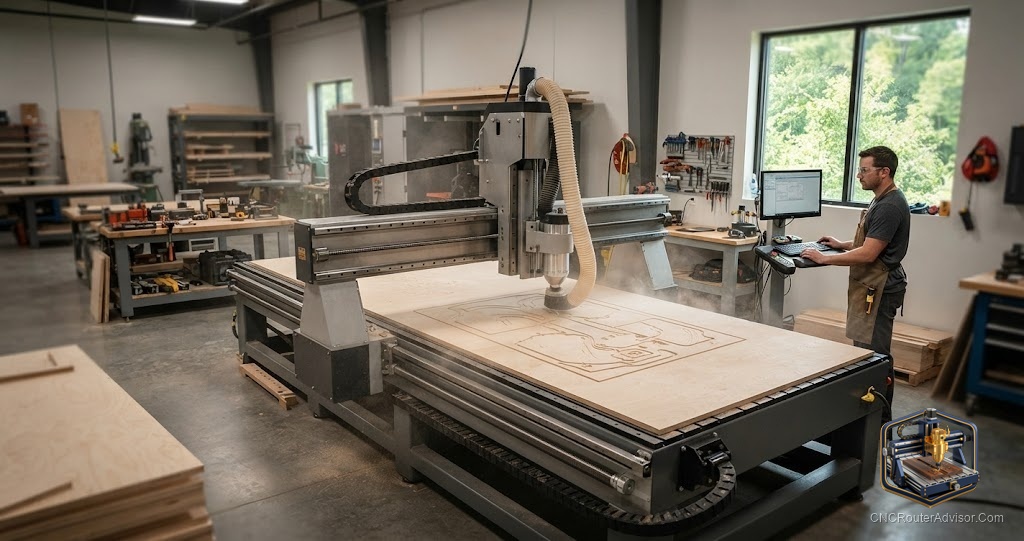
A 5 by 10 CNC router is a serious commitment before you buy one. At five feet wide and ten feet long, it commands a dedicated room, needs industrial power, and costs far more than a benchtop machine. But for the shops it fits, it is not excess: it is the machine that lets you process full and oversized sheets without quartering them, cut production panels without stopping to reposition, and take on the commercial sign and cabinetry work that a smaller machine simply cannot handle in one pass.
This guide covers who actually needs a 5 by 10, the machine features and specifications that matter at this scale, and the honest buying factors before you commit.
What a 5 × 10 machine is for
A 5 by 10 router is a production machine. Its work area, roughly 60 by 120 inches, covers a full sheet of plywood or MDF plus overhang, meaning you load a sheet and cut it entirely without repositioning. That eliminates a workflow step that costs time on smaller machines, and it matters whenever you cut volume: cabinetry panels, large format signs, commercial displays, architectural millwork, and production furniture.
The frame, gantry, and motion system on a machine this size must be far more substantial than a desktop router. At this span, frame rigidity is an engineering challenge, not just a spec line, because a gantry covering ten feet of travel flexes under load unless the structure is heavy and well designed. Rack and pinion drive is common at this scale because it handles long travel reliably, paired with good linear rails and a strong VFD spindle.
The short answer
Buy a 5 by 10 when your work genuinely fills that bed on a regular basis, your shop space can house it, and your power supply and budget support an industrial purchase. Do not buy it to future proof a business that does not yet have the volume to fill it, because the cost, space, and maintenance commitment is substantial. A full sheet 4 by 8 machine is a more common starting point and handles most commercial work well. A 5 by 10 makes sense when a 4 by 8 is your proven bottleneck.
Machine size and shop requirements
Plan the full footprint before you buy. The machine needs its nominal work area plus clearance on all sides for loading sheets, moving around safely, and doing maintenance. Add the infrastructure: dedicated three-phase or heavy single-phase power, serious dust collection with a capacity matched to full sheet cutting, and a material handling setup so you are not lifting 4 by 8 sheets by hand onto a ten foot table. These are not afterthoughts, they are part of the purchase.
Accessories common at this scale include a vacuum table for workholding across large sheets, an ATC spindle for production runs that change tools without stopping, and load rollers or a material cart for sheet handling.
Specifications that matter at this size
Rigidity and machine mass are the headline specs because they determine whether a ten foot gantry cuts cleanly or chatters. Frame material and cross-section, gantry mass and support, and the drive mechanism all predict this. Ask makers for cut demonstrations or owner references for the materials you plan to cut, because a chattery 5 by 10 is worse than a rigid 4 by 8.
Spindle power must match your material and feed rates. Full sheet cabinetry and production work benefit from a strong, reliable VFD spindle. ATC capability is worth evaluating for production operations where tool changes add up.
Control and software compatibility matter for the long run. Confirm the machine runs a documented, updatable control system so you are not stranded by obsolete firmware years from now.
Who should skip a 5 × 10
Skip a 5 by 10 if you are still proving out a business or hobby that might settle at lower volume. A 4 by 8 full sheet machine is the right first large format buy for most shops, because it covers full sheet work without the extra cost and footprint of the larger bed. Skip it too if your shop space requires compromise, because a machine operating without proper material handling and clearance is a safety and workflow problem. This is a machine you grow into with proven demand, not one you speculate into.
Comparison: 5 × 10 vs 4 × 8 for production shops
| Factor | 4 × 8 machine | 5 × 10 machine |
| Sheet coverage | Full 4x8 sheet, some repositioning for oversize | Full sheet plus oversize in one pass |
| Floor space | Substantial | Very large, needs dedicated room |
| Cost | High but accessible | Industrial, significantly higher |
| Right buyer | Growing commercial shops | High volume proven operations |
| Support path | More options and vendors | Fewer vendors, direct sale industrial |
A 5 by 10 CNC router is a large format industrial machine sold direct by manufacturers and dealers. Evaluate them through established makers such as Avid CNC, ShopBot, Laguna, and others with strong industrial support, and request cut demonstrations and owner references before committing. These are direct sale systems, not marketplace purchases.
The verdict
A 5 by 10 CNC router is the machine for high volume full sheet and oversize production work in a properly equipped shop. Its value is the ability to cut a complete sheet in one setup, without repositioning, which matters when you cut panels by the dozens or hundreds. Buy it when proven volume fills the bed, your space and infrastructure support it, and you have evaluated the machine through demonstrated cuts and vendor support. If the volume is not yet proven, start with a 4 by 8. The upgrade to 5 by 10 is much easier to justify when an order book makes the case for you.
Frequently asked questions
What does a 5 × 10 CNC router cut in one pass? Full sheets of plywood, MDF, and sheet goods up to roughly 60 by 120 inches, plus oversize panels that a 4 by 8 machine cannot cover without repositioning. That eliminates a handling step for production work.
How much space does a 5 × 10 router need? The machine footprint alone is substantial, and you need clearance on all sides for loading sheets, safe movement, and maintenance. Plan for a dedicated room or large open shop bay, not just the nominal machine dimensions.
What power does a 5 × 10 router require? Most require dedicated heavy power, often three-phase or high amperage single-phase. Confirm the power requirements with the manufacturer before you plan the installation.
Should I buy a 5 × 10 or 4 × 8 first? Start with a 4 by 8 unless your current order book already fills a 5 by 10 bed regularly. The 4 by 8 handles most full sheet commercial work, costs and fits better, and proves out the volume before you commit to the larger machine.
Where do I buy a 5 × 10 CNC router? From established industrial manufacturers and dealers who provide training, support, and parts. These are direct sale machines, not marketplace purchases, so vendor relationship and support quality matter significantly.
Is an ATC spindle necessary on a 5 × 10? Not necessary but valuable for production runs where multiple tool changes add up. An automatic tool changer removes the stop, change, and re-zero step for each bit, which is real time savings at volume.
References
- CNC Router Info, How to Choose a CNC Router: https://cncrouterinfo.com/guides/how-to-choose-a-cnc-router/
- Avid CNC: https://www.avidcnc.com
- Laguna Tools, CNC machines: https://lagunatools.com/cnc/