CNC Router Machinery: Understanding the Whole Machine
Most buying guides rush you toward a purchase before you understand what you are buying. This one slows down. A CNC router is a system of parts working together, and understanding how the frame, motion, spindle, and control interact is what lets you evaluate any machine on its merits rather than trusting a spec sheet or a marketing claim. Learn the machinery once, and every future buying decision becomes clearer, because you know what actually determines whether a machine cuts well.
This guide takes apart the CNC router conceptually, explaining what each major system does, how they depend on one another, and which ones matter most for the results you care about.
What CNC router machinery is
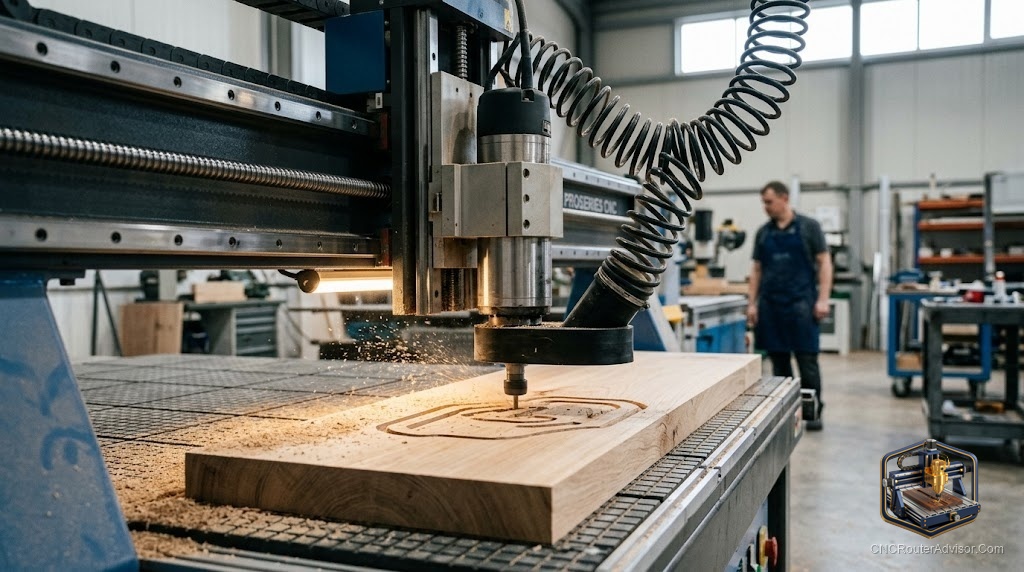
A CNC router is a Computer Numerical Control machine that moves a spinning cutter across three axes, X (left to right), Y (front to back), and Z (up and down), following G-code to carve wood, plastics, and soft metals. But that simple description hides a system of interacting parts: a frame that provides rigidity, a motion system that moves precisely, a spindle that does the cutting, and a controller that turns your design into coordinated movement.
The crucial insight is that these systems depend on each other, and the weakest one sets the ceiling for the whole machine. A powerful spindle on a flexible frame still chatters. A rigid frame with sloppy motion still cuts inaccurately. Precise motion with an underpowered spindle still stalls in hard material. Evaluating a machine means judging every system and finding the weak link, not being dazzled by a single strong spec. The sections below walk through each system so you can do exactly that.
The short answer
Understand a CNC router as four interacting systems: frame rigidity, motion, spindle, and control. Rigidity and motion together determine cut quality and accuracy, the spindle sets what materials and speeds are possible, and control and software turn your design into movement. Judge a machine by its weakest system, not its best spec, and match all four to your intended work.
The fundamentals apply across every tier, from a desktop starter to an industrial machine. A rigid, well-rounded desktop machine like the Genmitsu 4040-PRO MAX is a good example of the systems working together at an accessible level: Check on Amazon
The four systems at a glance
| System | What it does | Why it matters |
| Frame | Provides rigidity | Flex causes chatter and rough cuts |
| Motion | Moves the tool precisely | Sets accuracy and repeatability |
| Spindle | Spins and drives the cutter | Determines materials and cutting speed |
| Control | Runs G-code and coordinates axes | Turns your design into movement |
Frame and motion: the foundation
Rigidity and motion together are the heart of cut quality. The frame, whether aluminum extrusion, a heavier steel structure, or a hybrid, resists the forces of cutting, and a stiffer frame produces cleaner cuts with less chatter. The motion system then moves the tool along that frame, using components like ball screws, lead screws, or timing belts for drive, and linear rails or V-wheels for guidance. Ball screws and linear rails offer more precision and stiffness at higher cost, while belts and V-wheels are common on affordable machines. Together these set positioning accuracy and repeatability, the ability to return to the same point cut after cut. No spindle can compensate for a weak foundation here, which is why experienced buyers judge these systems first.
Spindle and control: capability and command
The spindle spins the cutter and determines what you can cut and how fast. A trim router is common on hobby machines and works well for lighter wood, while a VFD spindle offers more power, quieter operation, and speed control for demanding materials and metal. More spindle power only helps if the frame and motion can hold the tool steady, so it must be matched to the foundation. The controller, meanwhile, is the machine’s brain: it reads G-code and coordinates the axes, often running GRBL on hobby machines. Your software generates the G-code and a post-processor formats it for that controller, so control and software together turn your design into precise, coordinated movement. A capable machine needs both a suitable spindle and a controller that matches your workflow.
Judging by the weakest link
The single most useful habit when evaluating machinery is to find the weakest system. Marketing highlights the strongest spec, often spindle power or work area, but the machine performs no better than its weakest link allows. A big spindle on a flimsy frame chatters. A rigid frame with imprecise motion cuts inaccurately. A precise machine with a controller your software cannot drive frustrates you daily. When you compare machines, ask what the weak system is and whether it limits the work you intend to do. A balanced machine, where no system badly lags the others, almost always outperforms one with a single impressive spec and a hidden weakness.
Matching machinery to your work
Once you understand the systems, match them to your intended use. For light hobby wood work, a modest frame, belt or lead-screw motion, and a trim router suffice, with a GRBL controller. For clean hardwood and tight joinery, prioritize a rigid frame and precise motion with linear rails or ball screws. For metal, demand rigidity, controlled spindle power, and accurate motion above all. For production or full sheets, everything scales up, including the control and dust systems. There is no universally best machine, only the one whose four systems together suit the material, precision, and volume you actually need. That judgment is exactly what understanding the machinery gives you.
Who this understanding serves
This systems view serves anyone about to buy or upgrade, because it turns a confusing market into a clear evaluation. It helps beginners avoid being dazzled by a single spec, helps upgraders identify their machine’s real weak link, and helps everyone match a machine to their work. If you only ever want to cut a few simple signs, you can keep it simple and buy a modest balanced machine. But even then, knowing why it cuts the way it does makes you a better, more confident user. Understanding the machinery is never wasted.
The verdict
CNC router machinery is best understood as four interacting systems, frame, motion, spindle, and control, where the weakest one sets the ceiling for the whole machine. Rigidity and motion determine cut quality and accuracy, the spindle sets what materials and speeds are possible, and control and software turn your design into movement. Judge any machine by its weakest system rather than its flashiest spec, and match all four to the material, precision, and volume you actually need. Learn the machinery once, and every buying and upgrading decision afterward becomes clearer and more confident. Understand the whole machine, and you will never be at the mercy of a spec sheet again.
Buy the balanced machine that suits your work, know why it cuts the way it does, and the machinery becomes a tool you truly command rather than merely own.
Frequently asked questions
What are the main parts of a CNC router? Four interacting systems: the frame for rigidity, the motion system for precise movement, the spindle for cutting, and the controller that runs G-code and coordinates the axes.
Which part of a CNC router matters most? Frame rigidity and motion together determine cut quality and accuracy, so they usually matter most. But the weakest of all four systems sets the machine’s true ceiling.
What is the difference between a trim router and a VFD spindle? A trim router is common on hobby machines and suits lighter wood. A VFD spindle offers more power, quieter operation, and speed control for demanding materials and metal.
Why does my machine cut poorly despite a strong spindle? Likely a weaker system is limiting it, often a flexible frame or imprecise motion. A machine performs only as well as its weakest link allows.
What does the controller do? It reads the G-code and coordinates the axes, often running GRBL on hobby machines. Your software generates G-code and a post-processor formats it for that controller.
How do I choose the right machinery for my work? Match all four systems to your material, precision, and volume. Light wood needs less, hardwood and metal need rigidity and precision, and production scales everything up.
References
- CNCRouterInfo, how to choose a CNC router: https://cncrouterinfo.com/guides/how-to-choose-a-cnc-router/
- CNC Dad, best CNC router for beginners: https://www.cnc-dad.com/blog/best-cnc-router-for-beginners/