
ShopSabre CNC Router: What the Brand Offers and Who It Fits
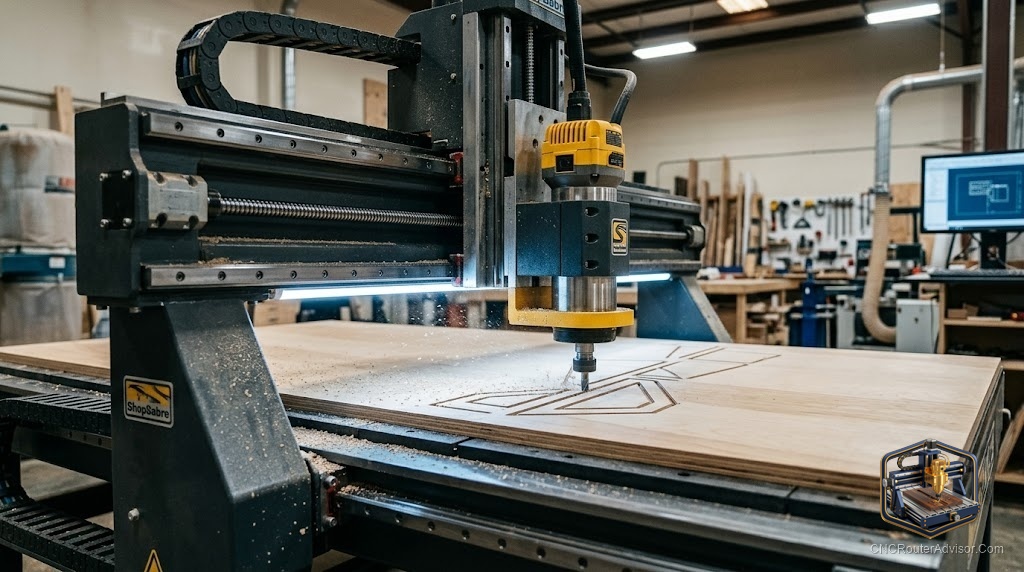
When your search moves from hobby machines to names like ShopSabre, something has changed. You are no longer shopping for a first router to learn on. You are looking at industrial and professional equipment built for shops that make parts for a living, and the questions worth asking shift accordingly. This guide covers what ShopSabre represents, how to evaluate a machine at this level, and, just as importantly, who does not need one yet.
I will be direct about the tier boundary throughout, because the biggest mistake at this level is not choosing the wrong industrial machine. It is buying industrial capability you cannot yet use.
What ShopSabre is
ShopSabre is an American manufacturer of CNC routers aimed at professional and industrial users, from serious small shops to production operations. Like any CNC router, its machines are Computer Numerical Control systems that move a spinning cutter across the X, Y, and Z axes, guided by G-code, to cut wood, plastics, and metals. What distinguishes this class of machine from a hobby router is not the concept but the execution: heavier frames, more powerful spindles, larger work areas, and the rigidity to run hard, all day, accurately.
Machines at this level are typically sold direct with professional support, setup guidance, and training, because a business buying production equipment needs a relationship, not just a box. That support and build quality are much of what you pay for, and they matter enormously when downtime costs you money. Evaluate this tier on rigidity, spindle capability, and support as much as on any single spec.
The short answer
Consider an industrial machine like a ShopSabre when CNC routing is central to your income, you run full sheets regularly, and reliability and support justify the investment. Look for a rigid steel or heavy frame, a real VFD spindle sized to your materials, a large work area matched to your stock, and a manufacturer that provides genuine setup help and service.
If you are not yet running a shop, this tier is likely premature. A capable desktop or benchtop machine will teach you the workflow and prove your demand first. A rigid desktop router such as the Genmitsu 4040-PRO MAX is a sensible place to build skill and volume before committing to industrial equipment: Check on Amazon
What to evaluate at this level
| Factor | Why it matters at industrial scale |
| Frame rigidity | Sustains accuracy under heavy, continuous cutting |
| Spindle power (VFD) | Cuts faster and in tougher material reliably |
| Work area | Full sheets in one setup save real time |
| Motion system | Ball screws or rack and pinion for speed and precision |
| Support and training | Minimizes downtime that costs a business money |
| Dust and safety systems | Required for continuous professional use |
Where the industrial tier earns its keep
The value of a professional machine shows up in throughput and reliability. A heavy, rigid frame holds tolerance while cutting hard for hours, which is what production demands. A large work area that takes a full sheet in one setup removes the tiling and repositioning that slow a small machine. And manufacturer support means that when something goes wrong, you have a phone number and a service path rather than a forum thread. For a business, that reliability is not a luxury, it is the difference between meeting deadlines and missing them.
Where buyers overreach
The honest risk at this level is buying capability ahead of need. An industrial machine demands space, power, dust and safety infrastructure, and a real budget, and it only pays back when it runs. A hobbyist who buys one to skip the learning curve usually ends up with an expensive machine running occasional small jobs, which any desktop router would have handled. Capability you do not use is not an investment, it is idle cost. Match the machine to demonstrated demand, not to ambition.
Who should skip this tier for now
Skip industrial machines if CNC is a hobby or a side interest, since the cost, space, and infrastructure vastly exceed what occasional work justifies. Skip it too if you have not yet proven steady demand for your parts, because a desktop or benchtop machine lets you build skill and validate that demand at a fraction of the risk. And if you cannot provide the power, dust control, and space a professional machine needs, resolve that before buying, because an industrial router in the wrong environment cannot perform. Step up when volume and income clearly call for it.
The verdict
A ShopSabre-class CNC router is the right tool when routing drives your business and you need rigidity, power, work area, and support that hobby machines cannot match. Evaluate it on frame, spindle, motion, and above all the manufacturer’s service, and buy it when proven demand justifies the investment. If you are still learning or your volume is uncertain, a capable desktop machine is the smarter step, building your skill and validating your market before you commit to industrial equipment. Buy this tier for a business that is ready, not for a hope that it will be.
Industrial machines reward shops with real demand. Grow into that demand first, and the right machine becomes an obvious, confident purchase.
Frequently asked questions
Is a ShopSabre router for hobbyists? Generally no. These are professional and industrial machines built for shops with real production demand. Hobbyists are usually better served by desktop or benchtop routers.
What separates an industrial router from a hobby one? Heavier frames, more powerful VFD spindles, larger work areas, and the rigidity to run hard continuously while holding tolerance, plus professional support and service.
Why does manufacturer support matter at this level? For a business, downtime costs money. Direct support, setup help, and service keep a production machine running, which a hobby-grade forum cannot guarantee.
Do I need a full-sheet work area? Only if you regularly cut full sheets. A large work area saves significant time in production, but it also demands more space, power, and dust infrastructure.
Should I buy industrial to skip the learning curve? Usually not. Learn the workflow on a desktop machine and prove your demand first. Buying industrial capability you do not yet use is idle cost.
What infrastructure does an industrial router need? Adequate space, electrical power, dust collection, and safety systems. Confirm you can provide all of these before committing to a professional machine.
References
- CNCRouterInfo, how to choose a CNC router: https://cncrouterinfo.com/guides/how-to-choose-a-cnc-router/
- CNC Dad, best CNC router for beginners: https://www.cnc-dad.com/blog/best-cnc-router-for-beginners/