
Axyz CNC Router Price Guide: Costs, Features, and Buying Factors
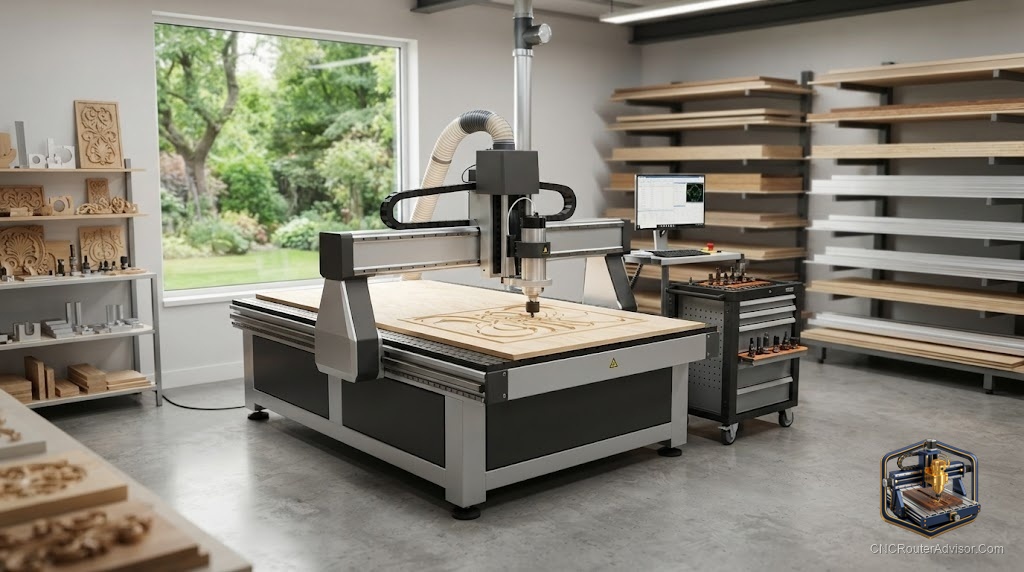
With AXYZ, the price question is really a system question: these are industrial, configured-to-order machines, so what matters is understanding the cost drivers and the total cost of ownership rather than chasing a single number. Here’s how to think about what an AXYZ CNC router costs - and what shapes that cost.
Why AXYZ is quoted, not priced off a shelf
AXYZ (the Canadian manufacturer, founded 1991, now under AAG - the AXYZ Automation Group) builds industrial CNC router machines that are configured and quoted per customer. Size, spindle, controller, tool changer, and vacuum options all move the number, and prices vary with configuration, model line, and market conditions. Because of that, a fixed figure quickly goes stale - what serves you better is knowing the cost drivers so you can read a quote intelligently. Always get a current, written quote from AXYZ/AAG or an authorized dealer for your exact configuration.
What drives the machine price
The features that make an AXYZ productive are also what set its price:
- Model line and size. Entry-level Z-Series, the hybrid Trident, and the flagship configurable Infinite occupy different tiers; larger process areas cost more.
- Frame and rigidity. A heavy welded steel frame for frame rigidity - fundamental, and not where to economize.
- Motion system. Servo drives on robust linear rails for precise, fast motion across the X axis, Y axis, and Z axis.
- Spindle. A high-power VFD spindle sized for all-day cutting; more power and better cooling raise cost and throughput.
- Automatic tool changer. An ATC adds meaningful cost and meaningful productivity.
- Vacuum hold-down. A zoned vacuum table and pump for full-sheet workholding.
- Controller and software. The industrial control package plus any CAM/nesting software.
The costs beyond the machine
- Freight and rigging - a large machine shipped and moved into place.
- Electrical - often 3-phase power, possibly requiring electrical work.
- Compressed air - for ATC and pneumatic functions.
- Dust collection - serious extraction sized to the bed.
- Vacuum system - pump and plumbing for workholding.
- Software and tooling - CAM/nesting software and a working set of quality bits.
- Training and support - operator training and ongoing parts/service.
How to evaluate the investment
- Think payback, not price. If the machine unlocks throughput or new work, calculate how quickly the capacity pays for itself.
- Compare like-for-like. Normalize quotes for spindle, ATC, vacuum, controller, and support - a cheaper base machine can cost more fully equipped.
- Weigh new vs. used. A used AXYZ can save money if you inspect the frame, rails, servos, spindle, and controller and confirm parts support (used units appear on industrial resale platforms).
- Build the total number. Machine plus freight, power, air, dust, vacuum, software, and tooling - the real delivered-and-running cost.
The bottom line
An AXYZ CNC router’s price is a system cost set by model line and size, frame, motion, spindle, controller, and options like ATC and vacuum - plus the freight, electrical, air, dust, software, tooling, and training that make it productive. Get a current written quote for your configuration, build the full ownership cost, and evaluate it on payback so the machine becomes an asset rather than a surprise.
Frequently asked questions
How much does an AXYZ CNC router cost? It’s configured and quoted by AXYZ/AAG or its dealers, varying with model, size, options, and market conditions. Get a current written quote for your exact setup rather than relying on a fixed figure.
Which options most affect the price? Model line and size, spindle power, an automatic tool changer, the vacuum system, and the controller/software package.
What extra costs should I budget? Freight and rigging, electrical (often 3-phase), compressed air, dust collection, the vacuum system, software, tooling, and training.