
Artisan 408 CNC Router Price Guide: Costs, Features, and Buying Factors
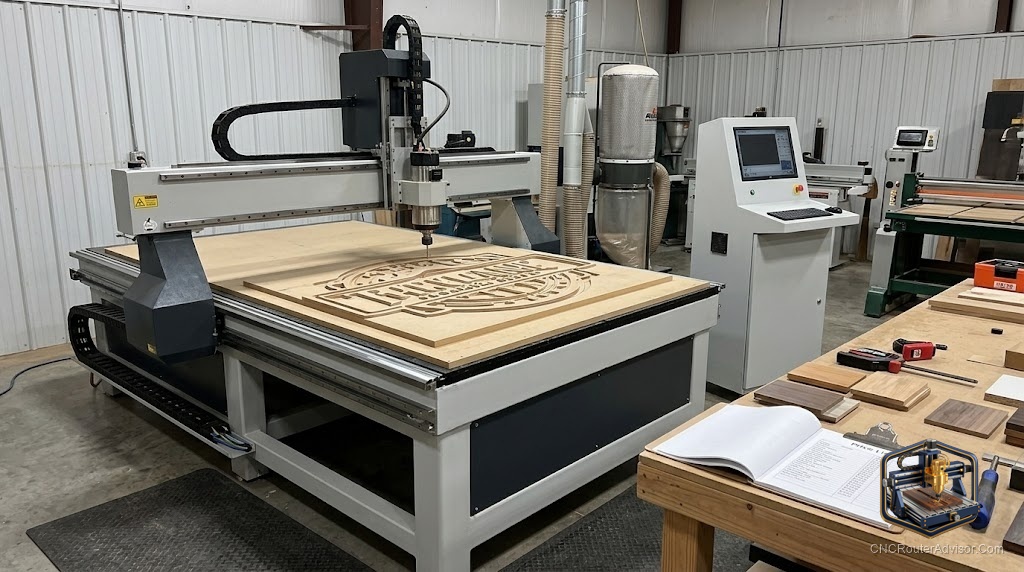
When you’re eyeing a machine like the Artisan 408, the real question isn’t just “what does it cost?” - it’s “what does it cost to own and run?” A full-sheet production router is a business investment, and the sticker is only the first line of the budget. Here’s an honest guide to the cost factors, what you’re paying for, and how to think about the total investment.
Why we’re talking cost factors, not a single number
The Artisan 408, from Industrial CNC, is a 4×8 full-sheet CNC router in the prosumer-to-industrial tier. Machines in this class are configured and quoted - spindle choice, controller, vacuum system, and options all move the number - and prices shift with configuration and market conditions. Rather than a figure that goes stale, what genuinely helps is understanding the drivers of cost so you can read any quote intelligently and budget for the whole picture. Always get a current, written quote from the manufacturer for your exact configuration.
What drives the machine price
The fundamentals that make a full-sheet machine capable are the same ones that set its price:
- Frame and rigidity. A welded steel frame built for frame rigidity costs more than a light one - and it’s the last place you’d want to save.
- Motion system. Heavy linear rails and a quality drive that keep the X axis, Y axis, and Z axis precise across a full sheet.
- Spindle. A liquid-cooled spindle with a proper VFD - higher spindle power and better cooling raise the cost but pay off in throughput.
- Controller. The control package that streams your G-code and integrates with CAM.
- Work area and Z clearance. Full 4×8 capacity and generous Z travel for thick stock are core to the value.
The costs beyond the machine
This is where budgets get real - and where surprises live if you skip the planning:
- Freight and rigging. A full-sheet machine ships by freight and needs to be moved into place - not trivial for a machine this size and weight.
- Electrical. Often 220V service and possibly specific phase requirements; you may need an electrician.
- Dust collection. A machine cutting full sheets produces serious dust - budget a capable collector.
- Workholding. A vacuum table and pump, or a robust T-slot setup, to hold sheets flat.
- Software. CAM/nesting software to feed the machine efficiently.
- Tooling. A working set of quality bits from day one.
- Downtime and support. Factor the value of the manufacturer’s support and parts availability - uptime is money in a production shop.
How to evaluate the investment
- Think in payback, not price. If the machine unlocks jobs or throughput you can’t do now, calculate how quickly the added capacity pays for itself.
- Compare like-for-like. When you gather quotes, normalize for spindle, controller, vacuum, and support - a cheaper base machine can cost more once equipped.
- New vs. used. A used full-sheet machine can save money if you inspect the frame, rails, drives, and spindle carefully and confirm parts support.
- Total delivered-and-running cost. Build the real number - machine plus freight, power, dust, workholding, software, and tooling - before deciding.
The bottom line
The Artisan 408’s price is best understood as a system cost, not a single figure: a rigid steel frame, quality motion, a liquid-cooled spindle, and a controller, plus the freight, electrical, dust, workholding, software, and tooling that make it productive. Get a current written quote for your configuration, budget the whole picture, and evaluate it on payback - that’s how a full-sheet machine becomes an asset rather than a surprise.
Frequently asked questions
How much does the Artisan 408 cost? It’s configured and quoted by Industrial CNC, and pricing varies with options and market conditions - get a current written quote for your exact setup rather than relying on a fixed figure.
What hidden costs should I budget for? Freight and rigging, electrical service, dust collection, workholding, CAM software, and tooling - plus the value of support and uptime.
Is a used one cheaper? It can be, if you inspect the frame, rails, drives, and spindle carefully and confirm parts support for the model.