
6-Axis CNC Router: What Full Robot-Arm Motion Adds (and What It Costs)
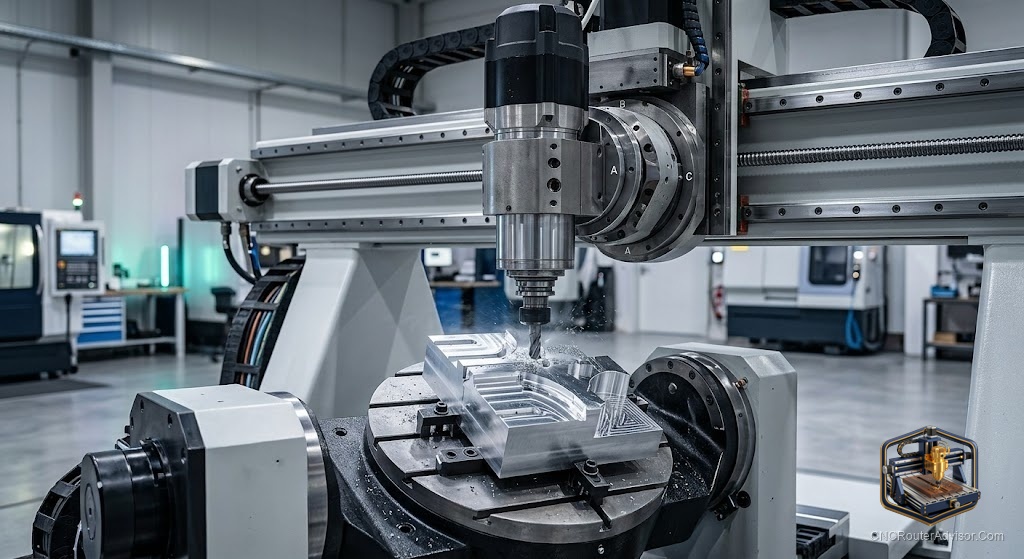
A 6-axis CNC router is not a 5-axis machine with one extra motion. It’s a fundamentally different machine architecture: an articulated robot arm with a spindle at the end, moving through full spherical range of motion around a stationary or moving workpiece. The machines that do this well are industrial robots (Kuka, ABB, Fanuc) with CNC machining end effectors, not conventional gantry CNC routers with an extra axis bolted on.
A 6-axis CNC router is a machine that uses a 6-degree-of-freedom robot arm to position and drive a cutting spindle in full three-dimensional space. All six axes working together give the spindle the ability to reach any point in the work envelope at any orientation angle - a capability that no gantry or table-based CNC machine can match.
The direct answer: true 6-axis robotic CNC routing is industrial infrastructure. It’s used for large composite aerospace parts, automotive body production, and complex architectural sculpture at a scale that requires the robot’s work envelope and reach. The companies that implement it include large aerospace contractors, auto manufacturers, and a small number of high-end custom fabrication shops.
What 6-Axis Adds Over 5-Axis
Full spherical motion: The spindle can reach any point at any angle. Undercuts, re-entrant features, and surfaces pointing in any direction are all accessible.
Large work envelope: Industrial robots have reaches from 1.5 to 4 meters, enabling machining of very large parts that no gantry machine can reach from above.
No gantry constraint: The arm can position the spindle from any direction - from below, from the side, from any angle - without the gantry overhead constraint.
Limitations vs. Gantry Machines
Lower stiffness: A robot arm has compliance (flex) under cutting loads that a rigid gantry machine does not. This limits achievable cutting forces and surface finish quality in materials that require high chip loads.
Higher programming complexity: 6-axis robot machining programs require offline programming software (Mastercam Robot, RoboDK, SprutCAM Robot) and inverse kinematics computation that conventional CNC G-code doesn’t address.
Cost: A production-grade 6-axis machining robot with appropriate spindle, workholding, and programming software is a capital investment proportional to its capability.
Where 6-Axis Robotic Machining Is Used
- Aerospace composite trimming and drilling
- Automotive body panel trimming
- Large-scale architectural and artistic sculpture
- Foam pattern making for very large cast pieces
- Wind turbine blade trimming and surface finishing
Verdict
For woodworking, sign making, and conventional furniture production: 6-axis robotic machining is not relevant. For large-scale composite, aerospace, or sculptural work where full spherical reach and a 3-meter work envelope are required: it is the correct tool, and a specialized industrial implementation.
- 6-axis CNC routing is articulated robot arm machining, not a conventional gantry router
- Full spherical motion enables any orientation at any point in the work envelope
- Lower stiffness than gantry machines limits achievable chip load and surface finish
- Relevant applications: aerospace composite, automotive, large-scale sculpture
- Not relevant for woodworking, furniture, or sign production
FAQ
What is a 6-axis CNC router? An articulated robot arm with a machining spindle, providing full 6-degree-of-freedom motion. Not a conventional gantry CNC router with additional axes.
Does a woodworking shop need a 6-axis CNC router? No. Woodworking and furniture applications are well within 3-axis and 4-axis capability.
Who makes 6-axis CNC machining robots? Kuka, ABB, Fanuc, and Yaskawa Motoman make the robot arms. Specialized machining end effectors and integration are handled by systems integrators.
What CAM software generates 6-axis robot toolpaths? Mastercam Robot, SprutCAM Robot, RoboDK, and Siemens NX CAM with robot simulation support.
References
- Kuka robotics: kuka.com
- ABB robotics: abb.com
- RoboDK: robodk.com