
1325 CNC Router Price Guide: What Drives Cost and What You Are Actually Paying For
The price range on 1325 CNC routers is wide enough to make a first-time buyer’s head spin: the same nominal machine format, the same quoted work area, the same listed spindle wattage can appear at wildly different points on the market. That range is not random noise. It reflects real differences in the components inside the machine, the service infrastructure around the sale, and the manufacturing quality of the frame, drive system, and spindle. Understanding what drives the cost difference is more useful than knowing any specific price, because prices change and the underlying value drivers do not.
A 1325 CNC router’s market price varies based on six principal factors: frame construction quality, drive system type, spindle specification, vacuum table and pump specification, controller type and software, and the service and support infrastructure the seller provides. Each of these has a meaningful impact on what the machine actually costs to own and operate over its life, and each is worth evaluating independently rather than treating price as a single summary number.
The short version of the value drivers: ball screws cost more than rack-and-pinion, which costs more than lead screws. A 3.2kW Italian spindle costs more than a 2.2kW Chinese domestic spindle. A welded steel frame costs more than a bolted extrusion frame. Service infrastructure from an established importer costs more than factory-direct with no support. Each premium is real. Whether each one is worth it depends on your production volume and tolerance for downtime.
What drives 1325 machine cost: component by component
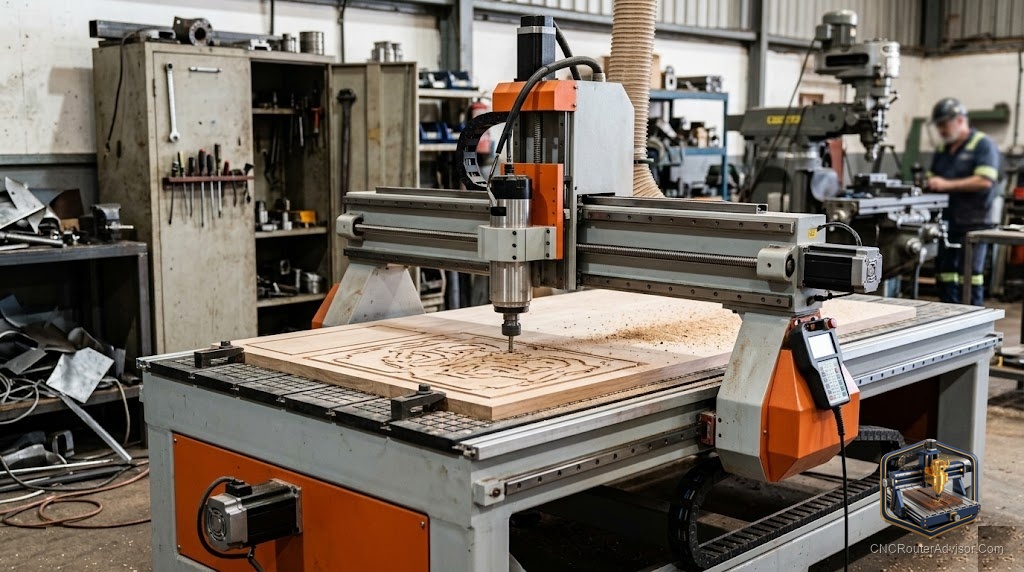
Frame construction. A welded steel gantry and bed structure is rigid and durable under production loading. A bolted aluminum extrusion frame is less rigid and cheaper to manufacture. The visual difference on inspection is clear: welded steel shows continuous welds and thick steel plate; bolted extrusion shows T-slot aluminum tubes connected with bolt hardware. For production use, the welded steel frame is the correct choice.
Drive system. Ball-screw drive on all three axes is the highest-cost drive option and provides the best repeatability, lowest backlash, and longest service life under production conditions. Rack-and-pinion on X and Y is lower cost and faster, appropriate for high-speed panel and sign production where precision requirements are somewhat more relaxed. Lead screws are the lowest-cost option and least appropriate for sustained production at 1325 format.
Spindle. Spindle quality has two cost levers: the power rating and the brand/origin. Italian brands (HSD Mechatronics, Teknomotor) are premium; German brands (Perske) are premium; reputable Chinese brands (Changsheng, Yingchuang) are mid-range; no-name domestic spindles are the lowest cost. Runout spec and bearing quality track with these tiers. A higher-power spindle (3.2kW to 4.5kW) costs more than a lower-power one. A water-cooled spindle costs more than air-cooled.
Vacuum table and pump. A properly zoned vacuum table with a 2.2kW to 3.0kW vacuum pump costs more than a simple T-slot table with manual clamping. For production sheet goods work, the vacuum table is essential and worth specifying, not optional.
Controller and software. PC-based systems with genuine software licenses (Mach4, SYNTEC) cost more than DSP offline controllers but offer more capability and community support. Verify what software is included and whether the license is genuine and transferable.
Service infrastructure. An established US or European importer who maintains spare parts, technical support, and service technicians adds margin to the machine price that pays back in reduced downtime and accessible help when things go wrong. A direct factory purchase with no support infrastructure is the lowest acquisition price and often the highest total cost of ownership when service issues arise.
The total cost of ownership beyond the machine price
Beyond the machine purchase, budget for: international shipping and import duties (significant for a machine this size and weight), rigging and installation, electrical work for the required power supply, tooling (spoilboard surfacing bit, production bits, collets), software if not included, and training time. First-time buyers consistently underestimate these costs when comparing machine prices.
Also budget for the first year’s consumable tooling, because a 1325 in production goes through bits, collets, and spoilboard material at a rate that hobby machine owners are not prepared for.
For the full machine evaluation framework that puts price in context, our guide on how to choose a CNC router walks through every relevant variable.
The takeaway: the price of a 1325 CNC router reflects the drive system, spindle, frame, and service infrastructure in that machine. Each premium component is a real upgrade in production reliability and output quality. Evaluate the components and the service, not the number alone.
Frequently asked questions
Why is the price range on 1325 CNC routers so wide? Because the same nominal format (1300×2500mm) comes with dramatically different drive systems, spindle quality, frame construction, and service infrastructure. Each of these has real cost and a real impact on production reliability.
What is the most important component to specify correctly on a 1325 machine? The drive system (ball screw vs. rack-and-pinion vs. lead screw) has the greatest impact on long-term production accuracy and maintenance cost. The spindle is a close second.
Does buying direct from a Chinese factory save money overall? On acquisition price, yes. On total cost of ownership when service issues arise, sometimes no. Service infrastructure has real value that is hard to quantify until something goes wrong.
What import costs should I budget for a 1325 CNC router? International freight for a machine this size and weight, import duties (varies by country and HS code), rigging from port to facility, and electrical installation. These typically add significantly to the machine’s ex-factory price.
Are Italian spindles worth the premium on a 1325 machine? For shops running production hours daily, yes. HSD and similar Italian spindles have documented longer bearing life and lower runout than comparable Chinese domestic spindles. For lower-volume use, mid-range Chinese spindles perform adequately.
Is a vacuum table always worth specifying on a 1325? For production sheet goods work, yes. Manual clamping is impractical at production volume on a machine this size. The vacuum table is production-enabling infrastructure, not a luxury option.
References
- Made-in-China, 1325 CNC router specifications and sourcing — https://www.made-in-china.com/
- CNC Router Info, production machine buying guide — https://cncrouterinfo.com/guides/how-to-choose-a-cnc-router/
- CNCZone, Chinese CNC machine price and quality discussions — https://www.cnczone.com/forums/chinese-cnc-machines/