
Used 5-Axis CNC Router Buying Guide: Inspection Checklist and Hidden Costs
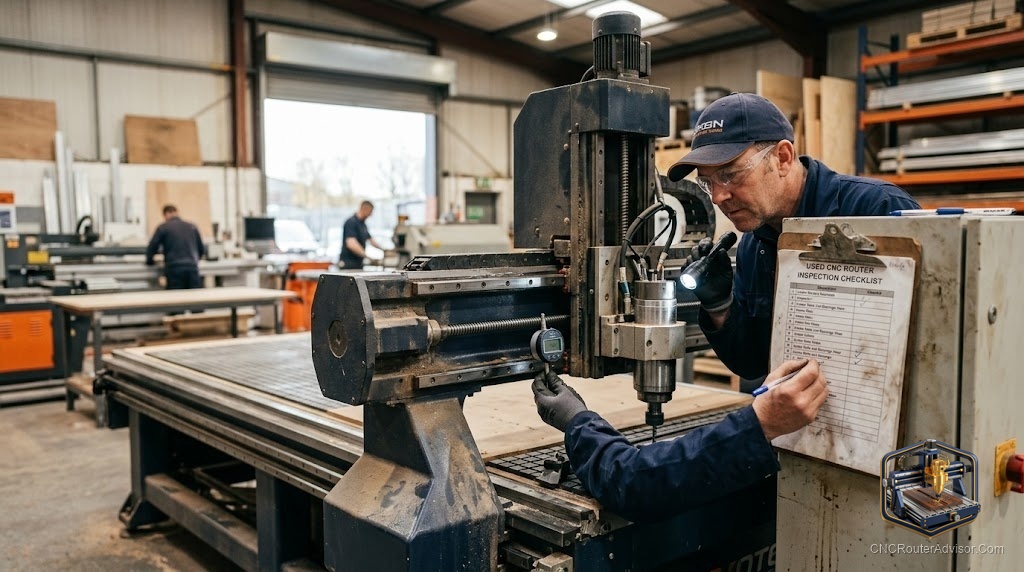
A used 5-axis CNC router is one of the most capable and most complex machines you can bring into a shop, and those two facts are inseparable. The fifth and sixth axes (usually A and B rotation) that give 5-axis machining its power also add bearing assemblies, servo systems, calibration requirements, and software complexity that are absent from 3-axis machines. Buying used multiplies the due diligence requirement because a 5-axis machine with worn rotary axes is not just a machine with worn parts, it is a machine whose entire positioning geometry is compromised. The buyer who understands this goes in prepared; the one who does not goes in optimistic.
A used 5-axis CNC router is a CNC routing machine capable of simultaneous motion in all five axes (X, Y, Z, plus rotation in A and B), enabling continuous 5-axis contouring of complex three-dimensional surfaces, undercuts, and compound angles. These machines are used in aerospace composite work, automotive tooling, complex mold work, and high-end architectural millwork. On the used market, they appear from aerospace subcontractors, mold shops, and manufacturers upgrading to newer equipment, and they represent genuine capability at a steep discount from new prices.
The short buying guide: verify the rotary axis positioning accuracy and backlash before everything else, because these are the most expensive components to repair and the most likely to be worn. Verify the CAM software license transfers with the machine. Budget for calibration, which all 5-axis machines need after moving. And ask honestly whether your shop has the CAM expertise to program 5-axis work, because the machine’s capability is only realized through software that many shops do not yet have.
What 5-axis capability actually adds
Three-axis CNC routing moves the tool in X, Y, and Z while the workpiece is stationary and the tool stays perpendicular. This handles flat sheets, prismatic shapes, and most 2.5D work well. It cannot reach undercuts, compound angles, or curved surfaces that require the tool to tilt relative to the workpiece.
5-axis adds two rotation axes (typically A around X and B around Y, or variations depending on machine design), enabling the tool to approach the workpiece from almost any angle. This unlocks: true 3D contouring of sculptural forms without fixturing steps, undercut machining in one setup, compound angle profiling for aerospace parts, and impeller and propeller shapes that are mechanically impossible in 3 axes.
For a router specifically, the most common 5-axis applications are aerospace composite panel work, complex architectural shapes, full-size foam models, and high-end joinery (curved furniture parts, compound-angle joinery). If your work does not genuinely require these capabilities, a well-maintained 3-axis machine at a fraction of the price produces better results per dollar.
The inspection checklist for 5-axis machines
All 3-axis inspection requirements apply (frame, linear rails, spindle, controller, test cuts). Add these 5-axis specifics.
Rotary axis backlash. Mount a precision bar in the spindle and set a dial indicator against it. Command A and B axis moves and reverse direction, measuring how much the spindle moves before the table follows. Backlash in the rotary axes translates directly into dimensional errors on angled surfaces. Any measurable backlash in the rotation axes on a machine used for precision work is a significant problem.
Rotary axis bearing condition. Listen for grinding or roughness when jogging the A and B axes slowly. Feel the table for vibration. Worn rotary bearings are expensive to replace and their replacement usually requires disassembly of major machine components.
Calibration records. Ask for the most recent calibration report. A 5-axis machine that has not been calibrated recently may have accumulated geometric errors in the rotary axes that affect positioning accuracy. After moving the machine, budget for recalibration by a qualified technician.
Control software and post-processor. 5-axis CAM requires a post-processor configured for the exact machine kinematics (the mathematical model of how A and B rotation relates to the tool tip position). Verify that a working post-processor exists for your CAM software and the specific machine. Without this, the machine is unmovable despite being perfectly operational.
Tool change system. Many 5-axis routers have automatic tool changers, and these are additional mechanical systems with wear components. Test the full tool-change cycle.
Hidden costs specific to 5-axis used machines
Beyond the standard used-machine costs (rigging, delivery, electrical), 5-axis adds:
- Calibration after move: typically several thousand dollars from a qualified service technician
- Post-processor development or licensing: if the seller’s post-processor does not match your CAM software, this can run from free (community-developed) to thousands of dollars
- 5-axis CAM training: if your team does not know 5-axis CAM, budget for this before the machine is productive
- Rotary axis service: if the inspection reveals worn rotary bearings or backlash, repair costs can equal or exceed the machine’s purchase price on older machines
Who should buy a used 5-axis CNC router
Buy one if your work genuinely requires simultaneous 5-axis capability, your team has or will develop 5-axis CAM skills, you can perform a thorough mechanical inspection (or hire someone who can), and you have the budget for calibration and potential service after purchase. Buy a 3-axis machine if your work is primarily sheet goods, signs, or prismatic parts: you will get more production per dollar and far less complexity.
Our guide on how to choose a CNC router covers machine class selection for various work types.
Frequently asked questions
What is the most important thing to check on a used 5-axis CNC router? The rotary axis backlash and bearing condition. These are the most expensive components to repair and the most likely to be worn.
Do I need special CAM software for a 5-axis router? Yes. You need a CAM program capable of 5-axis simultaneous toolpaths and a post-processor configured for the specific machine’s kinematics. Verify both before buying.
Is 5-axis harder to program than 3-axis? Significantly. Simultaneous 5-axis toolpaths require specialized CAM knowledge and machine-specific post-processors. Budget for training if your team does not already have this skill.
Does a 5-axis machine need calibration after being moved? Yes, always. Moving disrupts the geometric calibration of the rotary axes. Budget for professional recalibration after delivery.
Where do I find used 5-axis CNC routers for sale? Machineseeker.com, Surplex, eBay Industrial, and specialist used CNC equipment dealers. They also appear on industry auction sites when aerospace and automotive shops upgrade.
Is 5-axis worth it for woodworking? For complex architectural millwork, curved furniture, and custom joinery, yes. For typical sign and cabinet production, a well-maintained 3-axis machine is more productive per dollar.
References
- Machineseeker.com, used 5-axis CNC router listings — https://www.machineseeker.com/
- Autodesk, “5-Axis Machining: A Beginner’s Guide” — https://www.autodesk.com/products/fusion-360/blog/5-axis-machining-guide/
- Practical Machinist, 5-axis used machine discussions — https://www.practicalmachinist.com/forum/