
Genmitsu PROVerXL 4030 V2 CNC Router Review: Ball Screws and Closed-Loop Motors Under a Grand
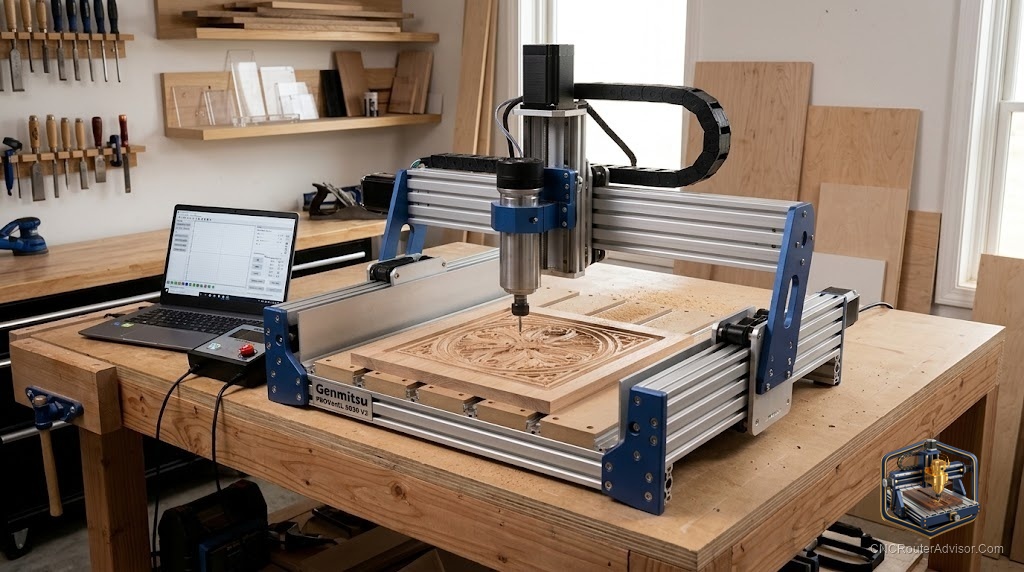
The machine spec that got people’s attention when the PROVerXL 4030 V2 appeared was ball screws and closed-loop motors at a price that had never seen those two features together. Ball screws are the motion system that precision machines use when accuracy under load matters more than belt stretch. Closed-loop stepper motors are the drive type that confirms position rather than assuming it, which means lost steps stop being a silent failure mode. Putting both on a desktop machine and pricing it where hobby-to-semi-pro buyers live was a legitimate engineering decision that the market noticed.
Whether the execution matches the spec is the question this review answers. The short version is: the mechanical platform is genuinely strong for the price. The software setup causes real frustration and deserves a warning. Quality control reports vary. Those three facts together determine who this machine suits.
The Genmitsu PROVerXL 4030 V2 is a desktop CNC router made by Sainsmart under the Genmitsu brand. Work area is 400 by 300 by 110 millimeters (about 15.8 by 11.8 by 4.3 inches). The machine runs on dual linear guide rails and 1204 ball screws on all axes, NEMA23 closed-loop stepper motors, a 400W spindle, and GRBL 1.1h firmware on a 32-bit controller. Published accuracy is circular error of 0.05mm or better; rectangle error 0.02mm or better. Assembly time is 25 to 30 minutes. The spoilboard is a hybrid T-slot aluminum plate.
For a machinist who has outgrown a belt-drive hobby machine and wants mechanical platform quality without stepping into a several-thousand-dollar machine, the PROVerXL 4030 V2 is the right size conversation.
View the Genmitsu PROVerXL 4030 V2 on Amazon
What the ball screws and closed-loop motors mean in practice
Ball screws replace lead screws (which use sliding contact to convert rotation to linear motion) with rolling balls between nut and screw. The result is lower friction, less backlash, and better accuracy under cutting load. For a machine doing repeat positioning work like cabinet joinery or multi-pass profiles, the improved accuracy shows directly in part quality.
Closed-loop motors add position feedback to the stepper drive. A standard stepper motor operates open-loop: the driver sends step pulses and assumes the motor moved. Under heavy load or rapid acceleration, steppers lose steps, which means the machine ends up in the wrong position without knowing it. A closed-loop motor detects and corrects this in real time. The practical benefit is fewer scrap parts from lost-step failures and the ability to push feed rates closer to the machine’s mechanical limit without silent errors.
For the price class the PROVerXL 4030 V2 occupies, these are genuine differentiators. Most competitors at this level still use open-loop steppers and lead screws.
The work area: genuinely useful, not unlimited
At 400 by 300 mm, the PROVerXL 4030 V2’s work area is substantially more useful than the 3018 class it replaces for most upgraders, but it is still a desktop-class footprint. Cabinet doors, small furniture panels, tiles, signs up to A3 size, and production runs of smaller parts all fit. Full 4-by-8 sheet work does not, and neither do large furniture panels without repositioning.
The 110mm Z clearance is the real step up from entry machines. 110mm allows for workpiece thickness plus fixturing, which is the practical limit that the 60mm-clearance entry machines routinely hit. For held-down thick stock and work with fixtures, the extra Z matters.
Software setup: the real friction point
Multiple community reports, including posts on Router Forums and the Sainsmart support community, describe the software setup as confusing. The machine runs GRBL 1.1h, which is compatible with UGS (Universal Gcode Sender), Candle, and other open-source senders, as well as commercial CAM tools that support GRBL. The confusion arises from the machine arriving with documentation that points to several software options without clearly recommending a starting workflow, and from the closed-loop driver configuration, which requires understanding the DIP switches and encoder settings.
Sainsmart provides a resource page with assembly videos, software guides, and community links, which helps. But compared to a Shapeoko or Onefinity that arrives with opinionated software integration and step-by-step onboarding, the PROVerXL 4030 V2 demands more self-direction from the first-time buyer. If you are comfortable reading documentation and troubleshooting, it resolves. If you want a plug-and-cut experience, this is not that machine.
Quality control reports
The community conversation around the PROVerXL 4030 V2 includes reports of QC variation: some units have required motor DIP switch adjustments, and some buyers report customer service experiences that fell below expectations. This does not mean every unit has problems, but it is a pattern worth noting when evaluating the machine relative to competitors that have more consistent QC reputations. If you buy, examine the package on arrival and test all axes before committing the machine to production.
What it cuts well
With a 400W spindle and ball-screw accuracy, the PROVerXL 4030 V2 handles hardwood at reasonable feeds, aluminum with light passes and the right tooling, MDF and plywood at production-appropriate speeds, and acrylic cleanly with the right bit. The closed-loop motors provide confidence on longer jobs where open-loop fatigue or acceleration errors would otherwise produce failures.
This is a machine that can produce cabinet joinery, sign work, jewelry fixtures, and short-run parts in a range of materials. It is not a 4-by-8 production machine, but within its work area it performs at a level the 3018 class cannot approach.
Who it is for and who should look elsewhere
For: A maker or small-shop operator who has outgrown belt-drive hobby machines and wants ball-screw accuracy in a desktop footprint without stepping into an Onefinity or ShopSabre price level. Also suits anyone who does multi-pass hardwood work or aluminum routing where lost steps on an open-loop machine have caused problems.
Who should look elsewhere: Anyone who wants a polished, opinionated software onboarding experience (Carbide 3D and Inventables do that better). Anyone whose work requires a 4-by-4 or larger work area. Anyone whose QC tolerance is low and needs a more consistent manufacturing reputation.
The verdict
The PROVerXL 4030 V2 delivers mechanical platform quality that should not exist at its price, which is its genuine selling point. Ball screws, closed-loop motors, and a useful Z clearance on a desktop footprint is a real combination. The software setup and QC variation are real friction points that a motivated buyer can navigate. Match it to the buyer who understands GRBL, can handle self-directed setup, and needs accuracy-under-load performance that belt-drive machines do not provide.
Three things to take with you:
- The ball screw and closed-loop motor combination is the actual differentiator and it is real; few competitors at this price offer both.
- Software setup requires self-direction and documentation reading; it is not a plug-and-cut experience out of the box.
- Check all axes and motor settings on delivery; QC variation in this class is a known community observation.
FAQ
What is the work area of the Genmitsu PROVerXL 4030 V2? 400 by 300 by 110 millimeters (about 15.8 by 11.8 by 4.3 inches).
What does closed-loop stepper motor mean on the PROVerXL 4030 V2? Closed-loop motors use an encoder to confirm actual motor position and correct errors in real time, unlike standard open-loop steppers that assume position without feedback. This prevents lost-step failures that standard steppers can suffer under heavy load.
What software does the PROVerXL 4030 V2 use? GRBL 1.1h firmware, compatible with UGS, Candle, Carbide Create, VCarve, Fusion 360, and other GRBL-compatible CAM and sender programs. Sainsmart’s software guide at their resource page is the recommended starting point.
Can the PROVerXL 4030 V2 cut aluminum? Yes, with appropriate tooling, light passes, and chip clearance. The 400W spindle and ball-screw accuracy make it capable for soft metal work in the desktop class.
Is the PROVerXL 4030 V2 hard to set up? The mechanical assembly takes 25 to 30 minutes. The software configuration requires more self-direction than machines with opinionated onboarding. Community reports indicate the documentation is adequate but not step-by-step guided.
How does the PROVerXL 4030 V2 compare to the Genmitsu 3018-PRO? A significant step up in every dimension: larger work area, higher Z clearance, ball screws instead of lead screws, closed-loop instead of open-loop motors, a 400W instead of 60W spindle, and a 32-bit instead of 8-bit controller.
References
- Sainsmart, PROVerXL 4030 V2 product page: https://www.sainsmart.com/products/proverxl-4030-v2
- Sainsmart, PROVerXL 4030 V2 resource page: https://docs.sainsmart.com/article/bhhdcyg7hk-prover-xl-4030-v2