
CNC Router vs. CNC Mill: Key Differences and Which to Choose
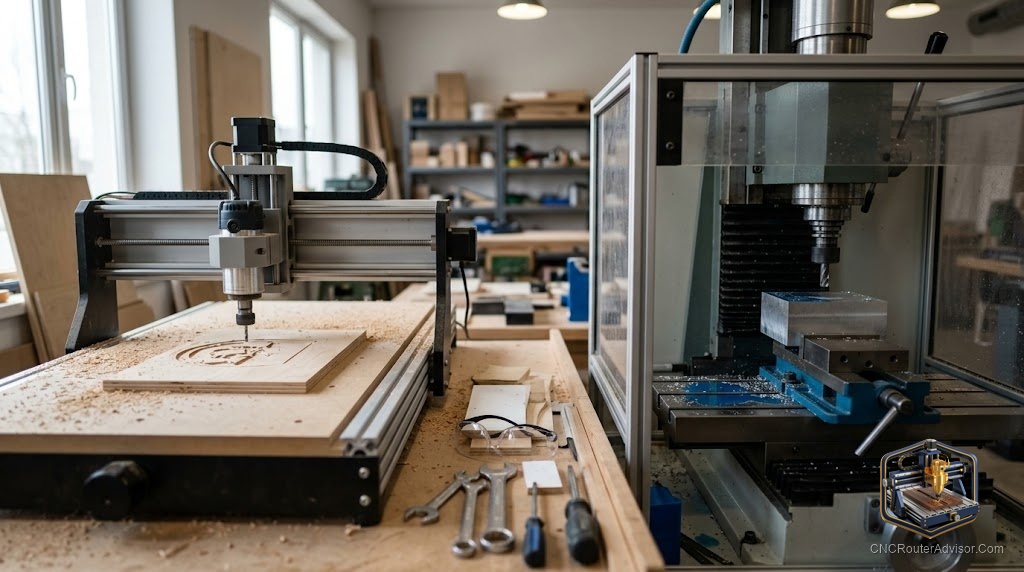
The confusion between a CNC router and a CNC mill is one of the most persistent in the shop. People use the names interchangeably, assume one can substitute for the other, and sometimes buy the wrong machine entirely because the surface similarity hides a deep engineering difference. Both are computer controlled cutting machines. Both move a spinning cutter through material following a file. But they are built for opposite ends of the material hardness spectrum, and what makes one machine excellent at its job makes the other inadequate at the same job. Sorting out which one you actually need is one of the most important calls in the buying process.
What a CNC router is built for
A CNC router is designed for high speed cutting in wood, soft plastics, and soft aluminum. Its spindle spins fast, often at thousands of RPM, to cut quickly through materials that do not need high force to remove. The frame is lighter and larger than a mill because wood and plastic do not push back as hard as steel, and the work area is wider and longer to accommodate panels, sheets, and large stock.
The motion system on a router prioritizes travel range and speed. The gantry moves across a large bed, and the machine values feed rate over torque. A router is optimized for surface area: carving, cutting profiles, engraving, and routing large panels efficiently.
What a CNC mill is built for
A CNC mill is designed for cutting hard materials: steel, stainless, titanium, hardened alloys, and hard plastics. Its spindle runs at lower RPM with much higher torque, and the entire machine is far more massive and rigid than a router. A mill’s frame, column, and table are engineered to resist the cutting forces that hard metal generates, which are an order of magnitude greater than wood or aluminum on a router.
The motion system on a mill prioritizes precision and stiffness over range. Work areas are smaller and the table is shorter, but the Z axis is extremely rigid and the whole structure is designed to hold tolerance under the forces of hard metal cutting. Every design choice trades range for rigidity.
The short answer
Choose a router for wood, soft plastics, and soft aluminum at volume or large size. Choose a mill for hard metals including steel, stainless, and precision hard alloys, and for applications where tight tolerance in dense material is the priority. If your work is wood or plastic, a mill is over-engineered, expensive, and limited in work area. If your work is steel or hard alloys, a router is under-built, and it will break tools, chatter, and wear itself out before it produces the results a mill achieves easily.
Key differences at a glance
Spindle speed and torque are the most fundamental difference. A router spins fast and light. A mill spins slower with far more torque, which is what hard metal needs to cut without work hardening or destroying the tool.
Frame mass and rigidity follow directly. A mill is enormously heavy for its work area because that mass absorbs vibration and cutting forces. A router trades mass for range because wood and plastic do not demand the same absorption.
Work area is the third dimension. Routers handle large sheets and panels. Mills work on smaller, often fixtured workpieces where precision over a smaller area matters more than coverage.
Coolant is the fourth. Most serious mill work uses flood coolant or at minimum mist, because hard metal generates heat that destroys tools without active cooling. Routers use chip evacuation and occasionally light cutting fluid for aluminum, but they are not built for flood coolant.
Where the overlap exists
Soft aluminum sits in the overlap zone. A rigid router with a real VFD spindle, aluminum specific tooling, and disciplined technique can cut soft aluminum effectively for many purposes. A mill does it with less fuss and higher precision, but for fabricating aluminum brackets, faceplates, and small structural parts, a well set up router is a real tool. That overlap does not extend to steel or hard alloys: the router runs out of capability there and the mill takes over completely.
Who should skip the debate
Skip the router vs mill debate if your work is clearly in one camp. If you cut wood panels, signs, and furniture, you want a router and a mill would be a poor choice at any budget. If you machine steel parts to tight tolerance, you want a mill and a router cannot substitute. The debate matters only in the aluminum and soft material overlap, where the right answer is determined by your volume, part size, and tolerance requirements.
Comparison: CNC router vs CNC mill
| Factor | CNC router | CNC mill |
| Best materials | Wood, plastic, soft aluminum | Steel, hard metals, precision alloys |
| Spindle | High RPM, lower torque | Lower RPM, high torque |
| Frame mass | Lighter, larger footprint | Very heavy, smaller footprint |
| Work area | Large, good for panels | Smaller, fixtured parts |
| Coolant | Air and light fluid for aluminum | Flood or mist for hard metals |
| Right buyer | Wood, plastic, sign, cabinet shops | Metal machinist, precision parts |
For a capable router platform covering wood, plastic, and soft aluminum, the Genmitsu PROVerXL 4030 is a strong choice at this listing, and the rigid metal-frame Genmitsu 3030 PROVer Ultra handles tougher aluminum work at this listing. For true CNC milling, look at dedicated benchtop mills from established machine tool brands evaluated through the milling market rather than the router market.
The verdict
A CNC router and a CNC mill are not the same machine at different price points. They are machines designed for opposite ends of the material hardness spectrum, and buying the wrong one is expensive in different ways: a router in steel breaks tools and wastes time, and a mill on a wood panel shop adds cost, limits work area, and provides rigidity you do not need. Identify your primary material, match the machine to that material, and use the overlap zone of soft aluminum as the only area where the two genuinely compete. Get that call right and the decision simplifies quickly.
Frequently asked questions
Can a CNC router do everything a CNC mill can? No. A router handles wood, plastic, and soft aluminum well but cannot substitute for a mill in hard metals like steel, stainless, or hard alloys. The frame, spindle, and coolant requirements for hard metal are fundamentally different.
Can a CNC mill cut wood? Technically yes, but a mill is over-built and expensive for wood and severely limited in work area compared to a router. A mill on a wood shop is the wrong tool for the job in nearly every practical situation.
Which is more expensive, a router or a mill? Comparable capability mills are typically more expensive because of the mass, rigidity, and precision engineering required. Capable routers at the hobby and prosumer tier are more accessible.
Is aluminum better suited to a router or a mill? Soft aluminum can be done well on a rigid router with the right tooling and technique. A mill does it with less fuss and higher precision. For hobby and small shop aluminum work on a router-sized machine, the router is the practical choice. For tight tolerance aluminum machining or hard alloys, the mill wins.
Why does a mill spin slower than a router? Hard metals need high torque at lower RPM to cut without work hardening or destroying the tool. High RPM in steel generates heat and work hardens the surface, ruining the tool quickly. The mill’s low RPM high torque spindle is engineered for this.
What if I want to cut both wood and steel? You need two machines, or you need to accept the significant limitations of trying to do both on one platform. A router cannot replace a mill in steel, and a mill is a poor substitute for a router on large wood panels. The overlap is narrow and the compromises are real.
References
- CNC Router Info, Best Routers for Beginners: https://cncrouterinfo.com/routers/best-cnc-router-for-beginners/
- WorkshopCalc, Best CNC Routers guide: https://workshopcalc.com/guides/best-cnc-routers