
8mm CNC Router Bits Guide: Types, Uses, Sizes, and Selection Tips
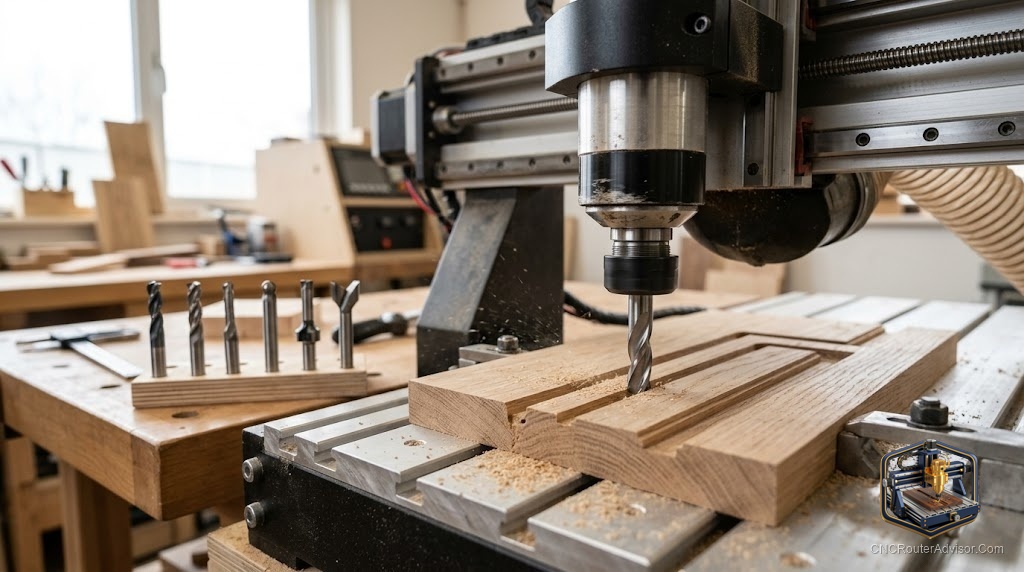
You just snapped your third 1/4-inch bit on the same board. The stock is dense European oak, and the machine is asking too much from a small shank. An 8mm bit on the same job would transfer more torque from the collet to the cutter, flex less under side load, and leave cleaner walls in that deep pocket. That is the practical reason 8mm CNC router bits exist.
An 8mm CNC router bit has an 8mm-diameter shank, the part that fits into the collet. The cutting diameter can match the shank or be smaller. Compared to the common 6mm and 1/4-inch (6.35mm) shanks used on hobby machines, an 8mm shank is noticeably stiffer. That stiffness reduces deflection during cuts, which directly improves edge quality on deep pockets and profile cuts in hardwood.
Here is the short answer if you are choosing between shank sizes: use 8mm when you need lower deflection on deep cuts, when the bit is long (stickout amplifies flex), or when you regularly cut dense hardwood and the 6mm shank feels fragile. Match the collet before you order. Most hobby routers use ER11 or 1/4-inch collets. An 8mm shank needs an 8mm ER20 collet or an ER20-capable spindle.
Why shank diameter matters for CNC cutting
Think of the bit shank as a lever arm. The further out from the collet face the cutter tip sits, the more the shank deflects under the sideways force of the cut. A thicker shank deflects less for the same stickout length because deflection scales inversely with the fourth power of the diameter. Doubling the shank diameter from 4mm to 8mm reduces deflection by a factor of 16 at the same length. That is not a small difference.
For shallow work and soft materials, any shank size works fine. For deep pockets in hardwood, long bits in dense acrylic, or aggressive passes in aluminum, an 8mm shank is a meaningful upgrade.
Collet compatibility: what you need before you order
A collet grips the shank by compressing around it. There is no tolerance: an 8mm shank must go into an 8mm collet. Forcing it into a 1/4-inch (6.35mm) collet does not work and creates a dangerous grip failure.
Most hobby CNC spindles ship with ER11 collets. ER11 collets max out at 7mm. To run 8mm bits, you need an ER20 or larger collet and the spindle must accept that collet size. Most Makita RT0701C and DeWalt DWP611 trim routers use 1/4-inch collets; even with a Elaire Corp metric collet set, neither reaches 8mm. An ER20 water-cooled spindle is the natural home for 8mm bits. Confirm your collet before ordering any 8mm tooling.
Types of 8mm CNC router bits
Two-flute upcut spiral end mills
The standard workhorse for wood, MDF, and hardwood. Two cutting edges, helix facing upward, pulling chips out of the cut toward the spindle. Clean pocket floors, efficient chip clearing, slight tendency to lift fibers on the top face in veneered material.
For general CNC woodworking, a two-flute upcut in 8mm is the first bit to have in any ER20-spindle setup.
Single-flute end mills
One cutting edge and a large gullet for chip clearing. The standard choice for plastics, acrylic, and aluminum: the chip needs to leave the cut before the tool re-enters, and the large gullet does that. In wood, a single-flute bit cuts acceptably but requires higher feed rates to maintain the correct chip load per tooth.
Compression spiral bits
Upcut at the tip, downcut at the top of the flute. The combination leaves clean faces on both top and bottom of through-cuts in veneered sheet goods. The geometry only works correctly when the bit cuts through the full thickness in one or two passes, engaging both flute sections simultaneously.
V-groove bits
A V-bit in 8mm shank cuts the same tapered channel geometry as smaller shanks, but the stiffer shank holds the tip steadier on deep lettering and detail work. For sign-making and fine engraving, the 8mm shank V-bit benefits from the reduced chatter on long cuts.
Ball-nose end mills
Hemispherical tip for 3D relief carving, curved profiles, and smooth surface finishing passes. The 8mm shank version suits larger relief work and bigger machines where the extra rigidity translates to a smoother surface.
Five verified 8mm CNC router bits
Amana Tool 46318 8mm Shank Upcut Spiral
Amana is a well-established name in solid carbide CNC tooling. The 46318 is a two-flute upcut spiral in 8mm shank, designed for clean cuts in hardwood, softwood, and MDF. Edge retention is consistently better than generic carbide in long production runs through abrasive materials.
Honest flaw: Amana tools carry a premium. For occasional hobby use, generic carbide bits from reputable sellers cut just as well initially. The Amana earns its place in production settings where edge life per hour of cut time matters.
HUHAO 8mm Shank 2-Flute Upcut Carbide Spiral Router Bit
Solid carbide, two-flute upcut, 8mm shank, 8mm cutting diameter, available in 25mm and 32mm cutting lengths. The geometry is straightforward and the shank tolerance is tight enough to run low runout in a well-maintained ER20 collet. Handles oak, maple, and MDF at standard feed rates without loading up.
Honest flaw: the shorter 25mm cutting length limits the maximum pocket depth before the shank engages the material.
SpeTool 8mm Shank Compression Router Bit
Compression geometry on an 8mm shank: upcut tip and downcut body. Designed for through-cuts in veneered plywood and laminated MDF where both faces need to be clean. The 8mm shank adds rigidity over the same geometry on a smaller shank, which reduces the side chatter that sometimes appears on the downcut section in dense laminate.
Honest flaw: compression bits require full-depth or near-full-depth engagement to work correctly. In pockets that do not go through the material, the downcut geometry packs chips into the slot and causes overheating.
Genmitsu 8mm Shank 60-Degree V-Bit Set
V-groove bits in 8mm shank covering 60 and 90-degree included angles. Solid carbide, ground to a sharp point. On a mid-size CNC with an ER20 spindle, these give you the stability advantages of the larger shank on sign lettering and decorative V-carving without an adapter.
Honest flaw: V-bits in this shank size are less commonly stocked than 6mm or 1/4-inch versions, so replacement is less immediate.
Drillpro 8mm Shank Single-Flute Carbide End Mill (for aluminum and plastics)
Single-flute, 8mm shank, polished flute geometry for non-ferrous metals and plastics. The single flute maximizes chip clearing space, which prevents the chip re-welding that ruins cuts in acrylic and aluminum. The 8mm shank holds the tip steady on aluminum work where deflection from a smaller shank would cause the chip load to vary.
Honest flaw: single-flute bits require higher feed rates to achieve correct chip load. On a machine with limited maximum feed rate, the larger chip load per tooth increases deflection and can roughen the surface.
Chip load and feed rate for 8mm bits
Chip load is the thickness of material each cutting edge removes per revolution. For an 8mm two-flute bit in hardwood, a starting chip load of 0.10mm to 0.15mm per tooth is appropriate.
The formula: Feed Rate (mm/min) = RPM x Flute Count x Chip Load (mm)
At 18,000 RPM with two flutes and 0.12mm chip load: 18,000 x 2 x 0.12 = 4,320mm/min. In dense hardwood, start at the lower end. In MDF, you can push higher.
A useful rule of thumb for pass depth: start at one times the cutting diameter (8mm) per pass, and reduce chip load by 25% when you go deeper than that.
Comparing shank sizes at a glance
| Feature | 6mm shank | 1/4-inch (6.35mm) shank | 8mm shank |
|---|---|---|---|
| Deflection at 50mm stickout | Moderate | Moderate | Lower |
| Compatible collets | ER11 6mm, ER16 6mm | 1/4-inch (ER11) | ER20 8mm |
| Tooling variety | Wide | Very wide | Narrower |
| Best for | Desktop hobby CNCs | North American hobby CNCs | Mid-size machines with ER20 spindle |
Who should buy 8mm CNC router bits?
Buy 8mm bits if your machine has an ER20 or larger collet, your work involves long bits or deep pockets in hardwood, or you have been breaking 6mm bits on demanding cuts. The extra rigidity is a real performance difference on demanding work.
Skip 8mm if your machine only has an ER11 collet. It simply will not accept the shank.
FAQ
What collet do I need for an 8mm CNC router bit? An 8mm collet in an ER20 or ER25 collet nut. ER11 collets max out at 7mm. Check your spindle specification before ordering.
Is an 8mm bit better than a 6mm bit? For deep pockets and long reach in hardwood: yes. The stiffer shank reduces deflection. For shallow work in soft materials, the difference is negligible.
Can I use an 8mm bit in a Makita RT0701C? No. The Makita RT0701C uses a 1/4-inch collet. The maximum metric collet available from aftermarket suppliers for that router is 6mm. An 8mm shank needs an ER20-capable spindle.
What is the best 8mm bit for hardwood? A two-flute upcut spiral in solid carbide. Amana Tool and SpeTool both make well-regarded 8mm upcut bits. For veneered hardwood sheet goods, a compression bit on the same shank is the better choice.
What chip load should I use for an 8mm bit in hardwood? Start at 0.10mm to 0.12mm per tooth. At 18,000 RPM with two flutes, that is approximately 3,600 to 4,320mm/min feed rate.
Are 8mm bits harder to find than 6mm? Somewhat. The 8mm shank is less common in the hobby CNC market than 6mm or 1/4-inch, so variety is narrower. Production tooling suppliers and specialist carbide sellers stock them reliably.
References
- cncrouterinfo.com, “Best CNC Router Bits Guide”: https://cncrouterinfo.com/guides/best-cnc-router-bits/
- CNC Shop, “Troubleshooting Cutting Problems”: https://cncshop.com/pages/troubleshooting-cutting-problems
- Amana Tool, product specification for carbide spiral bits: https://www.amanatool.com