
6mm CNC Router Bits: Types, Uses, and How to Choose the Right One
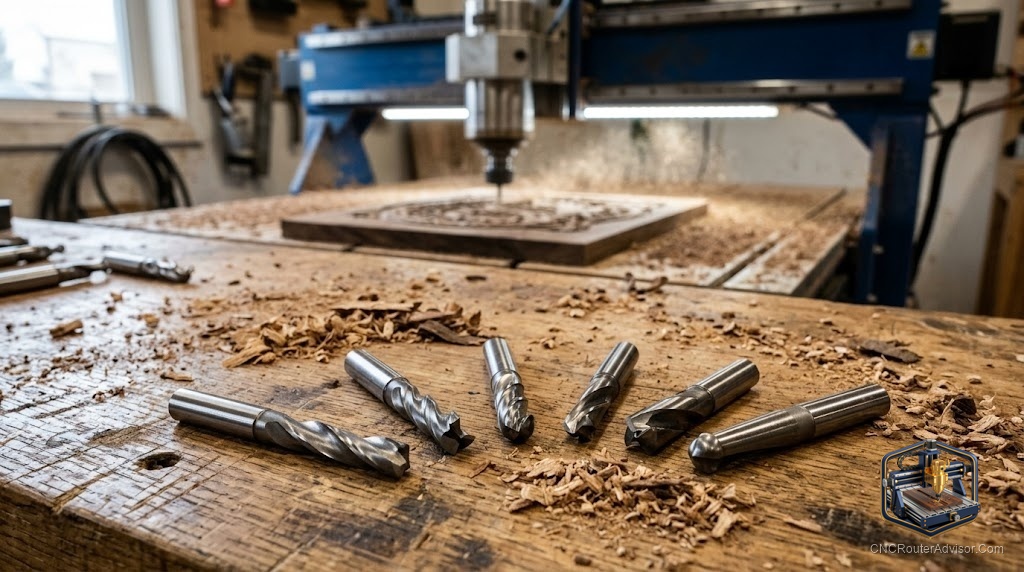
You load a fresh piece of oak into your CNC, run your first toolpath, and the bit snaps clean off at pass two. You check the collet. Turns out you had a 1/4-inch collet gripping a 6mm shank. The gap is only 0.35mm, but it was enough.
That is the first thing anyone buying 6mm CNC router bits needs to understand. Once you get the collet question sorted, the rest of the choices open up in ways that actually matter: cut direction, flute count, geometry. This guide covers all of it, with ranked picks and honest flaws for each recommendation.
What Is a 6mm CNC Router Bit?
A 6mm CNC router bit is a carbide end mill designed to be held in a CNC spindle by its 6mm-diameter shank. The cutting diameter can match the shank (6mm) or be smaller, such as 4mm or 3mm, while the shank stays 6mm for a secure grip.
The short version if you are just starting: 6mm bits are metric. Your North American hobby machine almost certainly came with a 1/4-inch collet. Those two are not the same, and forcing one into the other is a real way to send a spinning bit across the room.
6mm Shank vs. 1/4-Inch Collet: The Critical Difference
A 1/4-inch shank measures exactly 6.35mm. A 6mm shank measures 6mm. The gap is 0.35mm, about the thickness of a sheet of paper. That sounds trivial. It is not.
A 6mm bit sitting in a 1/4-inch collet does not grip evenly around the shank. The collet tightens on one side, introduces runout (wobble), and can release the bit at speed.
The fix is simple: buy the right collet. For the Makita RT0701C, Elaire Corp makes a drop-in 6mm collet. BitsBits.com also sells Makita-compatible 6mm collets. DeWalt DWP611 owners can buy Elaire Corp’s metric collet set covering 6mm, 8mm, and 10mm shanks.
Once you have the right collet, 6mm bits become very attractive: the Chinese and European cutting-tool market defaults to metric sizing, so 6mm tooling is often sold in larger sets, with better variety, at lower per-bit cost than equivalent 1/4-inch tooling.
The Main Types of 6mm CNC Router Bits
Upcut Spiral End Mills
The helix angle faces upward, pulling chips out of the cut and up toward the spindle. The result: clean floors on dado cuts and pockets, but some tearing on the top face as fibers lift before the bit severs them.
Upcut bits are the default workhorse. They handle softwood, hardwood, MDF, and most plastics. The lifted-fiber issue on the top face matters most on veneered sheet goods; on solid wood or solid MDF it is barely visible.
Downcut Spiral End Mills
The helix faces the opposite direction, pushing chips down into the cut. This keeps the top face crisp: no lifting, no tear-out. It is the right choice for veneered plywood, laminated MDF, or any project where the face visible to a customer needs to be clean off the machine.
The trade-off: chips pack into the cut rather than evacuating, which builds heat faster. Keep passes shallower than you would with an upcut. Also avoid plunging straight down; ramp entry at a shallow angle or drill a start hole first.
Compression End Mills
A compression bit runs upcut geometry at the tip and downcut geometry higher up the flute. The bottom of the material gets an upcut finish; the top gets a downcut finish. Cut both faces cleanly in one pass.
This geometry only works correctly when you are cutting fully through the material in a single or double pass, and when the bit is engaged deeply enough that both flute sections are cutting simultaneously. For sheet goods (plywood, veneered MDF) in the 12mm to 18mm range, a compression bit is often the best choice.
Single-Flute End Mills
One flute, one cutting edge, maximum chip space. The gullet is enormous compared to a two-flute bit, so chips clear even when you are pushing feed rate. This is the bit for plastics, acrylic, foam, and aluminum: materials that want the chip gone before it re-welds or clogs the cut.
For wood, a single-flute bit can feel rough at lower feed rates because each tooth takes a larger bite. Run it faster, and it evens out.
Two-Flute End Mills
The standard choice for wood. Two cutting edges produce a smoother finish than a single flute at the same feed rate, and the geometry handles hardwood without loading up. Most 6mm carbide spiral bits on Amazon are two-flute.
V-Groove Bits
A V-groove bit cuts a tapered channel defined by the included angle: 60 degrees produces a narrow, sharp-bottomed V; 90 degrees opens that up; 120 and 150 degrees go wide and shallow. These are for sign lettering, engraved designs, and decorative edge work.
The 6mm shank V-groove format is common on hobby machines because it fits cleanly in a 6mm collet without an adapter.
Ball-Nose End Mills
A hemispherical tip allows the bit to cut on the rounded bottom, making smooth-surfaced 3D terrain, relief carving, and curved profiles. The trade-off is step-over: the scallop height between adjacent passes depends directly on how close together you run them. Tight step-overs give a near-smooth surface but take longer.
What Does Chip Load Actually Mean?
Chip load is the thickness of material each cutting edge removes per revolution. Too low, and the bit rubs rather than cuts: heat builds, the edge dulls fast, and the cut surface looks burnished. Too high, and the tool deflects, produces rough edges, and can snap.
For a 6mm two-flute carbide end mill cutting softwood or MDF, start around 0.08mm to 0.12mm per tooth. At 18,000 RPM that gives a feed rate of roughly 2,880mm/min to 4,320mm/min. In hardwood, start at the low end and work up.
The formula: Feed Rate (mm/min) = RPM x Flutes x Chip Load (mm)
If you cut deeper than one times the cutting diameter per pass, reduce chip load by 25 percent. Deeper than two times the diameter, reduce by 50 percent.
Plunge Rate and Ramp Entry
Plunge rate is how fast the bit descends into the material vertically. For spiral bits, plunge at 30 to 50 percent of your horizontal feed rate. Better still: use a ramp entry. Program a helical ramp at 2 to 3 degrees lead-in angle. The bit enters at an angle, the horizontal component of the cut shares load with the vertical, and tool life extends noticeably.
Ranked Picks: Best 6mm CNC Router Bits on Amazon
1. ZahyoX 6mm Shank Upcut Spiral CNC Router Bit (2-Flute)
Solid carbide, 6mm shank, 6mm cutting diameter, 25mm cutting length, two upcut flutes. The geometry is clean and the shank tolerance is tight enough to run in a well-maintained collet without noticeable runout.
It handles softwood, hardwood, and MDF reliably. At sensible feed rates in pine or poplar, the floor finish is smooth and the walls are sharp.
Honest flaw: The upcut helix does lift fibers on the top face in veneered ply. If your project is a face-visible sheet good, use a compression or downcut bit instead.
2. HOZLY 6mm x 25mm Compression Spiral CNC Router Bit
Compression geometry in a 6mm shank: upcut tip, downcut body, designed to leave clean faces top and bottom when cutting through sheet goods. For cabinet panels, drawer sides, or any flat part cut from plywood or veneered MDF, this is the bit that saves sanding.
Honest flaw: Compression bits require enough depth of cut for both flute sections to engage simultaneously. In shallow pockets or grooves that do not go through the material, this bit underperforms versus a dedicated upcut or downcut.
3. Genmitsu VG05A 5-Piece V-Groove Set, 6mm Shank
Five angles in one set: 60, 90, 120, and 150 degrees, plus a 20-degree detail V. Solid tungsten carbide construction. For sign-making and engraving work on a hobby machine with a 6mm collet, this set covers everything from sharp-lettered text (60 or 90 degrees) to wide decorative chamfers.
The 6mm shank is a direct fit in a 6mm collet with no reducer needed.
Honest flaw: V-groove tips dull faster than spiral-flute bits, especially in hardwood. Once the tip radius opens up even slightly, engraved text edges go soft. Buy a backup set if sign work is a regular part of your production.
4. AUNMAS 6mm Single-Flute Downcut CNC Router Bit
Single flute, 6mm cutting diameter, downcut spiral. The one-flute geometry maximizes the gullet for chip clearance while the downcut direction keeps the top face clean. For acrylic and PVC on a hobby machine, this combination is close to optimal: the single flute prevents chip re-melting in plastics, and the downcut helix eliminates the tear-out or chipping you get at acrylic edges with an upcut.
Honest flaw: Single-flute bits require higher feed rates to produce the right chip load. If your machine has a low maximum feed rate, the per-tooth engagement increases, deflection rises, and the surface can roughen. This bit rewards machines that can move fast.
Head-to-Head: Which 6mm Bit for Which Job?
| Job | Best Pick | Why |
|---|---|---|
| Solid wood pockets and dados | ZahyoX Upcut | Clean floor, efficient chip clearing |
| Veneered ply through-cuts | HOZLY Compression | Clean top and bottom face in one pass |
| Acrylic or PVC sheet cutting | AUNMAS Single-Flute Downcut | Chip evacuation prevents re-welding; downcut prevents chipping |
| Sign lettering and engraving | Genmitsu VG05A Set | Correct angle for any letter width or depth |
| MDF with visible top face | HOZLY Compression or AUNMAS Downcut | Downcut geometry keeps top edge clean |
| 3D carving and relief work | Ball-nose (6mm shank, any brand) | Curved tip follows contours; tight step-over for finish |
Do You Need a 6mm Collet? How to Check
Open your spindle or router manual or look at what collet is installed. If the router is a Makita RT0701C, it ships with a 1/4-inch (6.35mm) collet. That is a mismatch for 6mm shanks.
Elaire Corp makes Makita-compatible 6mm collets sold as direct replacements. BitsBits.com also carries them. DeWalt DWP611 owners can source the metric set from Elaire Corp as well.
Install the 6mm collet, torque it to the router manufacturer spec, and confirm no wobble on a test spin before loading expensive material.
What Wears Out a 6mm Bit Faster Than It Should
Three things kill 6mm bits early:
Chip recutting. When chips are not evacuating and the bit passes through them again, they act as an abrasive. Keep feed rate up and vacuum actively.
Shallow chip load. Running too slow is as bad as running too fast. A chip load below 0.05mm per tooth in wood means rubbing, not cutting. Double your feed rate before you conclude the bit is poor.
Dirty collet. Sawdust and resin in the collet bore allow micro-slippage. Clean the collet bore before every significant run.
FAQ
Can I use a 6mm bit in a 1/4-inch collet? No. The 0.35mm gap between a 6mm shank and a 1/4-inch collet prevents proper clamping. The bit will slip, wobble, or eject. Get the right 6mm collet.
What is the difference between shank diameter and cutting diameter? Shank diameter is the part that goes into the collet: 6mm in this case. Cutting diameter is the width of the fluted section that actually removes material. A 6mm shank bit can have a 4mm, 5mm, or 6mm cutting diameter.
How deep can I cut per pass with a 6mm bit? A good starting rule is one times the cutting diameter per pass (so 6mm deep with a 6mm cutter). At two times the diameter, reduce chip load by 25 percent.
Upcut or downcut for MDF? Downcut for any cut where the top face is what the customer sees. Upcut for pockets and dados where the floor quality matters. Compression for full-thickness cuts through veneered or laminated sheet goods.
What spindle RPM should I use for a 6mm bit in wood? Most hobby spindles run 10,000 to 24,000 RPM. For wood, 16,000 to 20,000 RPM is a practical range. Set your feed rate using the chip-load formula rather than picking RPM and feed rate independently.
Why does my 6mm bit leave a rough surface even at the right speed? Check runout first. Remove the collet, clean the bore and the collet taper, reinstall, and measure again if you have a dial indicator. If the collet is clean and tight, check stick-out: the longer the exposed length of the bit below the collet face, the more it deflects under load.
Are nano-coated 6mm bits worth it for wood? Nano coatings reduce friction and can extend edge life in abrasive materials like MDF or hardwood. In softwood the benefit is modest. If you cut a lot of veneered ply or hardwood, the coating pays back in bit longevity.
Can I use 6mm CNC router bits for aluminum? Yes, with the right geometry. Single-flute or two-flute upcut bits with a polished flute designed for non-ferrous metals are the correct choice. Keep feed rates conservative and use cutting fluid or compressed air.
How do I know when a 6mm bit is dull? The first sign is usually increased cutting noise: a dull bit works harder and vibrates more. Follow that with visible burn marks on the wood surface, a rougher than usual finish, and higher required feed forces.
References
- ShopBot Tools, Feeds and Speeds Charts: https://shopbottools.com/wp-content/uploads/2024/01/FeedsandSpeeds.pdf
- Amana Tool, Solid Carbide Compression Spiral Router Bits Feeds and Speeds: https://www.amanatool.com/pub/media/productattachments/Solid-Carbide-Compression-Spirals-v8.pdf
- GDP Tooling, CNC Chip Load Calculator for Router Bits: https://gdptooling.com/chipload-calc/
- Elaire Corp, Dewalt Style Router Collets (metric sizing): https://elairecorp.com/dewaltroutercollets/
- cncrouterinfo.com, “Best CNC Router Bits Guide”: https://cncrouterinfo.com/guides/best-cnc-router-bits/