
60 Degree CNC Router Bit: Types, Uses, Sizes, and Selection Tips
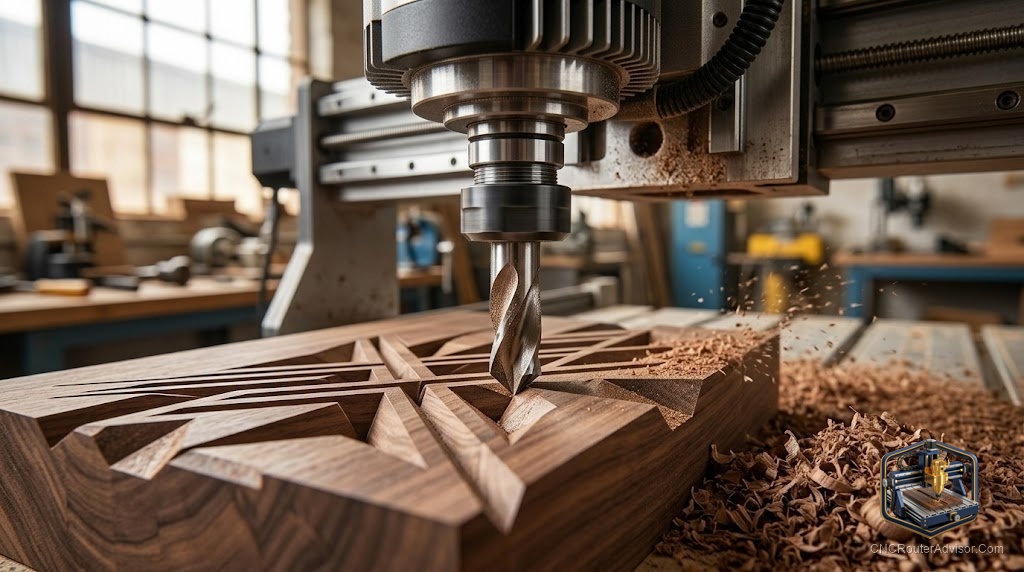
You load a chunk of oak, dial in your V-carve toolpath, and watch the spindle trace your lettering. Then the bit comes out and the edges look fuzzy, the corners are rounded, and the depth is inconsistent across the board. Ninety percent of the time, the answer is not feeds or speeds. It is the wrong angle.
A 60 degree CNC router bit is a V-groove bit ground to a 60° included angle, meaning the two cutting faces form a 60° wedge when viewed from the end. Feed it into material and it cuts a V-shaped channel whose width equals twice the depth times the tangent of 30° (half the included angle). At 3mm deep, a 60° bit produces a channel about 3.46mm wide. The geometry is fixed, so every dimension the bit makes is a direct function of how deep you plunge.
Here is the short answer if you are comparing V-bits right now: use a 60° bit for tight, sharp lettering in hardwood or MDF, detailed inlay grooves, and PCB trace isolation. Use a 90° bit for larger, bolder text and decorative carving where narrower grooves look cramped. The 60° angle gives you more side-wall height per unit of width, which translates to crisper serifs and cleaner narrow lines.
What the included angle actually controls
The included angle is the full opening of the V, measured across both cutting edges. A 60° bit is narrower and taller than a 90° bit at the same depth. A 30° bit is tighter still, used for micro-engraving and PCB work.
The practical effect on your carving:
- Wider angles (90°, 120°) cut fast, waste less depth on narrow text, and look bold. Use them on large signage.
- Narrower angles (60°, 45°, 30°) cut deeper channels per unit width, sharpen corners and serifs, and suit detailed or small-scale work.
- Most beginners go too wide. If your lettering looks soft and the serifs are gone, try dropping to 60°.
Depth and width are always linked by the angle. Your CAM software uses this relationship to calculate depth per pass when you set a flat depth or a target width. If the angle is set wrong in software, every dimension shifts.
60° bits vs. 90° bits: when each one wins
| Feature | 60° bit | 90° bit |
|---|---|---|
| Channel width at 3mm depth | ~3.46mm | ~6mm |
| Best for | Small text, detailed inlays, PCB | Large signage, bold lettering |
| Depth needed for a 10mm wide V | ~8.7mm | ~5mm |
| Side-wall height per mm of width | Higher | Lower |
| Tip fragility | Higher | Lower |
For text below about 25mm cap height, a 60° bit consistently outperforms a 90° because it can reach into tight counters and serifs without the channel blowing out to a width the text cannot support. Above 50mm cap height, a 90° bit finishes faster because it clears more material per pass at the same depth.
Sizes, shanks, and what fits your machine
CNC V-bits come in 1/4” (6.35mm) shank for North American routers and trims, and 6mm shank for metric machines. Both are widely available. Confirm your collet before ordering.
Body diameters run from 6mm up to 1 inch or more. Wider bodies carry more side-wall support, which helps on longer bits. For most desktop CNC work, a 1/4” body on a 1/4” shank is the sweet spot.
Tip diameter matters on some listings. A true V-bit comes to a point (0mm tip). Some bits list a small tip flat (0.1mm to 0.2mm) for durability. That flat shows up as a tiny radius at the bottom of every groove, which is invisible on large work and slightly visible on micro-engraving. For PCB isolation routing, use a zero-flat tip.
Five verified 60° CNC router bits worth buying
Genmitsu 20/30/45/60 Degree V-Bits, 5-piece set
Four angles in one box: 20°, 30°, 45°, and 60°, all on a 1/4” shank. Solid tungsten carbide, ground to a sharp point. The 60° bit in this set is the one most people reach for on their first text project.
The honest flaw: the 20° and 30° bits are fragile at the tip. Push feed rate too hard and they snap. Use them only at shallow depths with conservative speeds.
Yonico 1/2” Shank 60° V-Groove Bit
A larger-shank option (1/2”) for routers and table-mounted machines that run the bigger collet. The wider body reduces vibration on deeper passes. If you run a full-size trim router or a spindle with a 1/2” ER collet, this is the more stable choice than a 1/4” shank bit.
Honest flaw: only fits routers with a 1/2” collet. Most desktop CNCs use 1/4”, so confirm before buying.
Amana Tool 45615 60° V-Groove, 1/4” Shank
Amana is one of the established names in CNC tooling. The 45615 is their standard 60° single-flute V-groove in solid carbide. Edge retention is noticeably better than generic carbide on long production runs through MDF, which is among the most abrasive common CNC materials.
Honest flaw: costs more than generic V-bits, and for occasional hobby use the generic sets cut just as well at first. The Amana earns its place in production settings.
Amana RC-1148 60° V-Groove Insert Carbide Bit
An insert-style V-groove bit with replaceable carbide tips. When the edge dulls, you replace the insert, not the whole body. For shops that run V-carve production all day, the lower running cost per hour adds up.
Honest flaw: more parts to manage, and the inserts need to be seated correctly or runout increases. Not the right choice for occasional hobby use where a solid bit is simpler.
HUHAO 60° 2-Flute Spiral V-Bit, 1/4” Shank
Most V-bits are single-flute. This is a two-flute spiral version, which improves chip evacuation and surface finish on deeper cuts in softwood and MDF. The spiral geometry pulls chips out of the groove instead of packing them in, which shows up as smoother walls on deep V-carves.
Honest flaw: more expensive than a single-flute, and the spiral geometry makes re-sharpening harder. For shallow engraving, the single-flute is fine. For deep V-grooves, the spiral finish is worth it.
Feeds, speeds, and depth for 60° V-bits
V-bits cut differently from spiral end mills. The cutting diameter changes with depth, which means chip load is not constant. Start conservative and adjust.
Starting points for wood and MDF:
- Spindle RPM: 16,000 to 22,000
- Feed rate: 1,000 to 2,500 mm/min depending on material
- Pass depth: 1mm to 2mm per pass in hardwood, 2mm to 3mm in softwood and MDF
- Plunge: ramp entry at 2° to 3° rather than straight plunging
For acrylic, slow down and reduce RPM to 12,000 to 15,000 to prevent melting. Use a single-pass ramp entry.
Workholding and tramming for clean V-carve
Bad workholding ruins more V-carves than bad bits. The groove depth is a direct function of Z height above the material. If the stock bows or lifts in the middle, depth changes, and the groove width changes with it. Surface the spoilboard and the workpiece flat. Clamp at four corners and, on long pieces, clamp the middle too.
Tram the spindle before V-carving. Even 0.5° of spindle tilt makes one side of the V deeper than the other, which shows up as an asymmetric groove. Check with a tramming gauge and correct before you cut.
Verdict
The Genmitsu 5-piece set is the right starting point for most hobby machines because it gives you 60° plus three flanking angles for comparison. If you run production and need edge life, the Amana 45615 or RC-1148 insert bit earns its place. For deep V-groove finish, the HUHAO two-flute spiral is worth the step up.
Four takeaways before you order:
- Confirm your collet matches the shank. A 6mm bit in a 1/4” collet is a safety issue, not an inconvenience.
- Set the angle in CAM software to match the bit exactly. Wrong angle means every dimension is wrong.
- Surface your workpiece and tram the spindle before cutting.
- Start at shallow pass depths, increase only after you see clean chips and a smooth groove wall.
FAQ
What is a 60 degree CNC router bit used for? A 60° V-groove bit cuts a V-shaped channel with a 60° included angle. It is used for small-to-medium text lettering, detailed inlay grooves, decorative carving, and PCB trace isolation. The 60° angle produces a narrower, taller groove than a 90° bit at the same depth.
60° vs 90° V-bit: which should I use? Use 60° for lettering under about 40mm cap height, tight serifs, and detailed grooves. Use 90° for large bold signage where a wider groove reads better. Most hobbyists benefit from owning both.
Can a 60° V-bit cut aluminum? Yes, with care. Single-flute carbide V-bits can engrave aluminum at slow feeds and shallow depths. Use compressed air or light cutting fluid to clear chips. Avoid deep plunges.
Why is my V-carve depth inconsistent? The most common causes are a workpiece that is not flat, a spoilboard that is not surfaced, or a spindle that is not trammed perpendicular to the bed. All three cause the Z height to vary across the cut.
What collet do I need for a 60° V-bit? Depends on the shank. Most hobby CNC bits use 1/4” (6.35mm) shank and need a 1/4” collet. Some bits use a 6mm shank and need a 6mm collet. The two are NOT interchangeable.
How do I know when a V-bit is dull? Dull V-bits produce fuzzy edges on lettering, require more force to cut, and may leave a slight ridge at the groove bottom. The tip wears fastest; inspect under a loupe after every significant use.
References
- Vectric Ltd, VCarve Pro software documentation on V-bit geometry and toolpath calculation: https://www.vectric.com/support/tutorials
- Amana Tool, technical specifications for bit 45615 and RC-1148: https://www.amanatool.com
- Carbide 3D, “Speeds and Feeds” guide for V-bits and end mills: https://docs.carbide3d.com/support/speeds-feeds
- cncrouterinfo.com, “Best CNC Router Bits Guide”: https://cncrouterinfo.com/guides/best-cnc-router-bits/