
30-Degree CNC Router Bit Guide: What This V-Angle Does and When to Use It
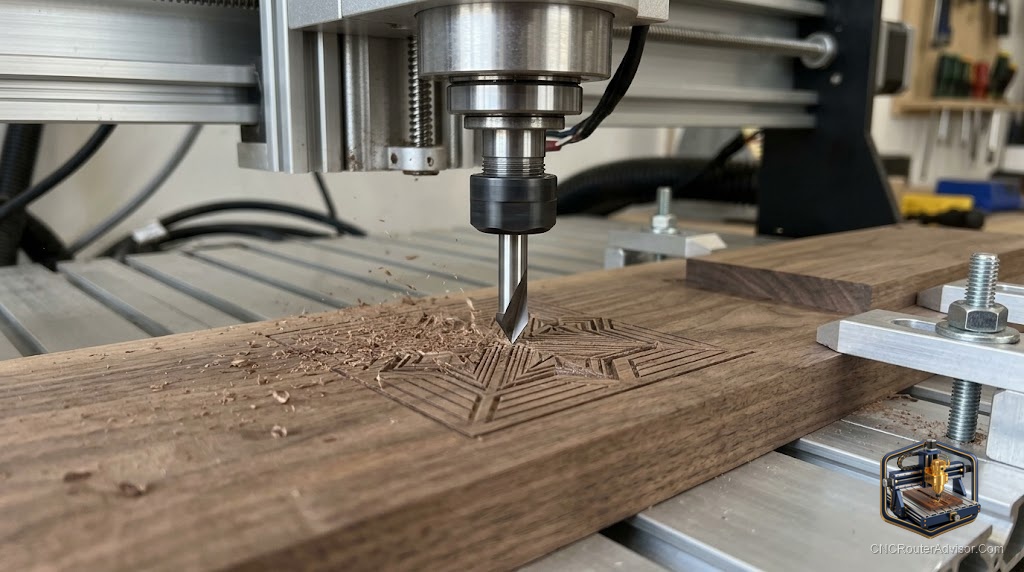
The 30-degree V-bit is the sharpest common V-bit angle in CNC routing, and that sharpness is its defining characteristic. At 30 degrees included angle, the bit produces a very narrow, deep V-groove - a groove that is significantly deeper than what a 60-degree or 90-degree V-bit produces at the same cutting width. That depth-to-width ratio has practical consequences: 30-degree V-bits excel at fine detail work and are the choice for small, intricate text where other V-bit angles produce flat-bottomed results rather than the sharp, cleanly formed V-shaped character strokes that make small lettering legible and crisp.
A 30-degree CNC router bit is a V-shaped engraving bit with a 30-degree included angle (meaning the two cutting faces meet at 30 degrees, producing a very narrow, deep V). It is used for fine detail V-carving, small text engraving, sharp-pointed detail grooves, and jewelry-scale decorative patterns where the narrow angle is specifically required. At this angle, the bit digs significantly deeper per unit of width than wider-angle V-bits, which means small features produce good visible depth rather than barely-there scratches.
The short guide: use a 30-degree V-bit for fine text at small letter heights (5 - 12mm), for small decorative patterns with tight radii and narrow strokes, and for applications where maximum depth at minimum groove width is the requirement. Use a 60-degree or 90-degree V-bit for larger text, broader decorative patterns, and wide-stroke carving where a shallower profile with clean, flat visual appearance is the goal.
Understanding V-bit angle and what it means for the cut
The included angle of a V-bit determines the relationship between groove width and groove depth. Because a V-bit’s depth of cut is a function of its tip engagement and the slope of the cutting faces, a narrower angle means the bit must go deeper to produce the same surface width at the top of the groove.
30-degree V-bit: At a 1mm groove width (measured at the material surface), the groove depth is approximately 1.87mm. For a 3mm wide stroke: approximately 5.6mm deep. These are significant depths relative to groove width - the groove is clearly visible and well-defined even at small scales.
60-degree V-bit: At a 1mm groove width, the groove depth is approximately 0.87mm. At 3mm wide: approximately 2.6mm deep. Shallower than 30-degree but with cleaner, less-fragile sidewalls for larger text.
90-degree V-bit: At a 1mm groove width, the groove depth is approximately 0.5mm. At 3mm wide: approximately 1.5mm deep. The shallowest common V-bit; best for large text and broad decorative patterns where depth is less important than the crisp visual V-profile at the top surface.
The practical implication: for small text (letter heights under 15mm), the 30-degree V-bit produces the most legible result because it creates visible depth even on narrow strokes. For the same text at 60-degree or 90-degree angles, narrow strokes barely indent the surface and the carving looks shallow and flat.
When the 30-degree V-bit is the right choice
Small text engraving: Personalized jewelry, memorial plaques, small product labels, and signs with 5 - 12mm text all benefit from the 30-degree bit’s deep-to-width ratio. The narrow strokes of small fonts remain legible and clearly defined.
Detailed decorative patterns: Celtic knotwork, fine filigree, and other patterns with narrow, closely spaced strokes at fine scale are served by the 30-degree angle. The narrow bit reaches into tight geometry that wider bits cannot access cleanly.
PCB engraving: For decorative PCB labels and fine engraving on electronics enclosures, the 30-degree angle produces clean, deep marks at the small scale of PCB text.
Jewelry and precious material work: Small-scale work on rings, pendants, and wearable items where small features must be clearly defined uses 30-degree V-bits for their depth advantage at small scales.
When 30 degrees is the wrong choice
For large text (letter heights above 25 - 30mm), a 30-degree V-bit requires deep cuts to match the stroke width of the letters, which increases cutting time significantly over a 90-degree bit and produces a narrow, deep groove rather than the broad, visually clean V-profile that large carved text conventionally uses.
For wide decorative borders and broad swooping patterns, the 30-degree bit’s narrow geometry means it makes many more passes than a wider bit to achieve the same visual width. This increases program run time without improving the result.
The right V-bit for the job is determined by the scale and character of the design. A starter V-bit set covering 30-degree, 60-degree, and 90-degree angles covers the full range. The FoxAlien essential bit kit and similar starter sets include V-bits at common angles appropriate for hobby machine work.
Our guide on how to choose a CNC router covers the machine specifications for detail engraving work.
The takeaway: the 30-degree V-bit is the fine detail tool in the V-bit family - the choice when small text must be legible, when narrow pattern strokes must have visible depth, and when the work scale requires the maximum depth-to-width ratio that a V-bit can produce. Match the angle to the scale of the work, not to a general preference.
Frequently asked questions
What is a 30-degree CNC router bit used for? Fine text engraving at small letter heights, tight decorative patterns with narrow strokes, jewelry engraving, and any application where maximum groove depth at minimum surface width is needed.
How does a 30-degree V-bit differ from a 60-degree or 90-degree bit? The 30-degree bit produces much deeper grooves at the same surface width. It is the right choice for small-scale work; wider angles produce cleaner, shallower results for large-scale work.
What letter height is best for a 30-degree V-bit? 5mm to approximately 15mm letter height. Below 5mm, even 30-degree V-bits begin to lose legibility on most material surfaces. Above 20mm, wider angles produce better-looking results.
What shank size do 30-degree V-bits use? Commonly 1/4 inch (6.35mm) or 1/8 inch (3.175mm) shank. Verify shank size for your machine’s collet.
Does a 30-degree bit require special CAM settings? No, but verify the V-bit angle is entered correctly in your CAM software (VCarve, Carbide Create, etc.). The software uses the bit angle to calculate cutting depth for the V-carve toolpath.
Can I use a 30-degree bit for wide decorative carving? Technically yes, but the narrow angle means the bit must cut very deep for wide strokes, increasing cutting time significantly. A 90-degree bit is a better choice for wide, large-scale V-carving.
References
- Vectric, V-carve toolpath bit angle documentation — https://www.vectric.com/
- ToolsToday, V-bit selection guide — https://www.toolstoday.com/
- CNCCookbook, V-bit angle and depth calculator — https://www.cnccookbook.com/cnc-router-bits-guide/