
1/4-Inch Shank CNC Router Bits: Machine Fit, Collet Systems, and Building Your Bit Set
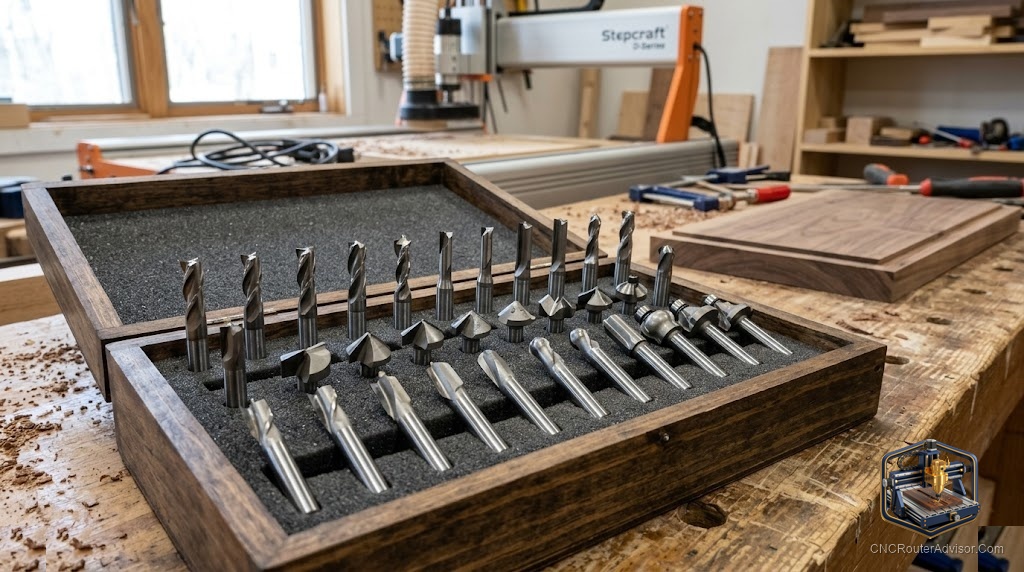
The 1/4 inch shank has become the de facto standard for prosumer and serious hobby CNC routing, and there are real reasons for that. It is large enough to support the bit body without flex on most desktop and prosumer work, small enough to fit ER collet systems that are standard on quality spindles, and the range of bit geometries available in 1/4 inch shank is wider than any other single size. If you are building a CNC bit set for a machine in the Carbide 3D, Onefinity, Avid CNC, or similar prosumer class, virtually your entire set will be 1/4 inch shank. Here is how to build that set intelligently.
A 1/4 inch shank CNC router bit is a bit with a 6.35 mm diameter steel shank that seats in a 1/4 inch collet, ER20 collet with 1/4 inch insert, or ER16 collet with the appropriate insert. The 1/4 inch shank is the most widely standardized size for desktop and prosumer CNC routing, matching the collet on most trim routers used as CNC spindles (Makita RT0701C, DeWalt DWP611) and the most common collet insert size in prosumer ER20 spindles.
The short version of building your bit set around 1/4 inch shank: start with an upcut spiral for pocketing, a compression spiral for plywood through-cuts, a downcut for face-grain profiling, and a 90-degree V-bit for lettering. Those four geometries handle 80 percent or more of CNC woodworking work. Add a ball-nose for 3D carving when you need it.
Why 1/4 inch shank is the prosumer standard
The trim router (Makita RT0701C is the canonical example) ships with a 1/4 inch collet as standard, and trim routers have been the default CNC spindle on prosumer desktop machines for years. Machines like the original Shapeoko and X-Carve were designed around trim routers, and the 1/4 inch shank standard followed from there.
When prosumer machines moved to purpose-built ER20 spindles, they maintained 1/4 inch shank compatibility through ER20 collet inserts, because the installed base of users and tooling was already standardized at 1/4 inch. The result is that 1/4 inch shank tooling is interchangeable across trim-router machines, ER20 spindle machines, and most commercial machines that accept 1/4 inch inserts. It is the widest common standard in the hobby and prosumer tier.
Building the core bit set
The compression spiral. For any machine that cuts plywood or MDF, this is the first single-bit purchase worth making at the premium tier. The Amana Tool 46170-K compression spiral comes in 1/4 inch shank and fits trim router collets and ER20 inserts directly. This is the bit that transforms plywood cut quality.
The upcut spiral. Two-flute, 1/4 inch cutting diameter, 1/4 inch shank: the everyday pocketing and profiling bit. The SpeTool downcut spiral is a well-regarded mid-range option, and SpeTool’s upcut version performs similarly.
The downcut spiral. For face-grain profiling and sign work where the top surface is the finished face. The Whiteside RD2100 is the consistent community recommendation for 1/4 inch downcut quality.
The V-bit. A 90-degree V-bit in 1/4 inch shank is the standard for text V-carving and decorative work. V-bit angle choices: 60-degree for sharp narrow text, 90-degree for broader text and decorative patterns, 120-degree for wide sweeping profiles.
The ball-nose. Add a 1/4 inch ball-nose (or 1/8 inch ball-nose on 1/4 inch shank) when your work includes 3D relief carving or curved surface finishing.
The starter kit. The FoxAlien essential bit kit and SainSmart/Genmitsu 5-piece kit are solid starting sets that cover common 1/4 inch shank geometries at an entry price appropriate for learning.
Collet maintenance: the step most people skip
A 1/4 inch shank bit seated in a dirty or worn collet runs with more runout than the same bit in a clean collet. Before seating any bit:
- Clean the collet bore and the bit shank with a clean cloth or compressed air.
- Verify the collet is not visibly worn or deformed.
- Seat the bit to the correct depth (not too shallow; most manufacturers specify at least 2/3 of the shank length in the collet).
- Tighten to the appropriate torque for your collet system.
Runout on a 1/4 inch bit running at 18,000 RPM means the tip traces a slightly elliptical path rather than a true circle. On precision work, this is visible in the finished surface. On everyday work, it accelerates bit wear and slightly degrades surface quality. Clean collets and correctly seated bits are an easy, free improvement.
For the machine and spindle context, our guide on how to choose a CNC router covers the spindle and collet systems.
The takeaway: 1/4 inch shank is the most widely compatible and well-supplied standard in hobby and prosumer CNC routing. Build your bit set around four core geometries (compression, upcut, downcut, V-bit), maintain your collet correctly, and you have the tooling foundation for the vast majority of CNC woodworking work.
Frequently asked questions
What machines use 1/4 inch shank bits? Trim-router-based CNC machines (Shapeoko, X-Carve, etc.), prosumer machines with ER20 collets and 1/4 inch inserts, and most hobby desktop machines with 1/4 inch collets.
Do I need different bits for different wood species? The same bit geometry works across wood species with adjusted speeds and feeds. Harder species require lower chip loads; softer species tolerate higher feeds.
Can I use 1/4 inch shank bits in a 3018-class machine? Yes, with a 1/4 inch collet adapter for the ER11 spindle. Most 3018-class machines include a 1/4 inch adapter collet.
What is the most important single 1/4 inch bit to own for woodworking? For plywood and MDF: the compression spiral. For sign carving: a 90-degree V-bit. These two bits cover the most common high-value CNC woodworking applications.
How do I know when a 1/4 inch bit needs replacing? Burning wood at correct feed rates (bit is rubbing, not cutting), visibly chipped or dulled cutting edges, or significantly increased cutting resistance at correct settings all indicate a bit that needs replacement.
Is 1/4 inch shank the same as 6.35 mm? Yes, exactly. 1/4 inch = 6.35 mm. Both refer to the same shank diameter and fit the same collets.
References
- ToolsToday, 1/4 inch shank bit catalog — https://www.toolstoday.com/
- Carbide 3D, tooling documentation — https://docs.carbide3d.com/
- CNCCookbook, router bit selection guide — https://www.cnccookbook.com/cnc-router-bits-guide/