
1/4 CNC Router Bits Guide: Types, Uses, and How to Choose the Right One
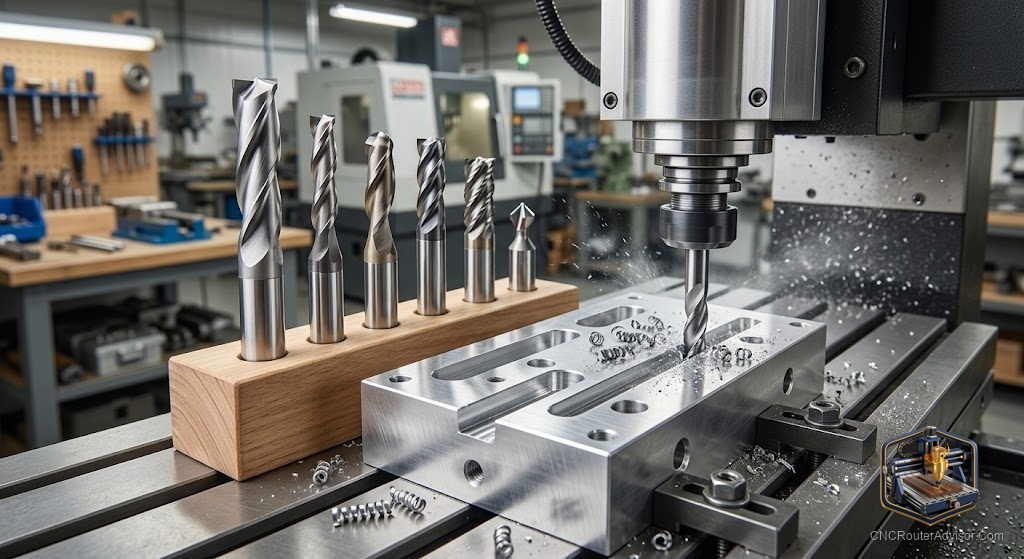
The 1/4 inch diameter is the most useful single bit size in CNC router woodworking, and the reason is straightforward: it is large enough to cut efficiently through wood and MDF at real feed rates, small enough to reach most feature geometry, and small enough to fit in the 1/4 inch collets that come standard on most hobby and prosumer machines. It is also the diameter of most of the good beginner and intermediate tooling on the market, which means the variety of bit types, geometries, and quality tiers available at 1/4 inch is wider than at any other common router bit size.
A 1/4 inch CNC router bit has a 1/4 inch cutting diameter, suitable for profiling, pocketing, slotting, and carving in wood, MDF, plywood, and soft materials. At this diameter, the bit has enough cross-sectional strength to handle real chip loads without excessive breakage risk, while remaining narrow enough for detailed work and fitting in standard 1/4 inch collets on machines ranging from hobby desktop to light commercial production.
The short guide: most CNC woodworking uses upcut spirals for pocketing, compression spirals for through-cutting plywood and MDF, downcut spirals for face-grain clean profiling, and V-bits for lettering and decorative carving. At 1/4 inch diameter, you have excellent options in all of these categories. Match the geometry to the application and the quality to how much you run the machine.
The bit types you will actually use
Upcut spiral end mills are the default workhorse for pocketing and profile cutting in wood and MDF. The upcut helix clears chips efficiently upward and out of the cut, which keeps the cutting zone cool and prevents chip recutting. For through-cuts in solid wood or MDF, an upcut gives clean bottom edges and efficient chip evacuation. The one compromise: the upcut action slightly lifts the top surface fiber, leaving a small burr on plywood top veneers.
Compression spiral bits solve the plywood and veneered sheet problem. They combine an upcut flute at the tip with a downcut flute higher on the shank, cleanly cutting both top and bottom veneers in a single through-cut pass. This is the production standard for cabinet shops cutting sheet goods. The Amana Tool 46170-K compression spiral is the most consistently recommended specific compression bit in the CNC woodworking community.
Downcut spiral bits push chips down into the cut and produce a clean top surface without burr lift. Use downcut for profiling face-grain work, shallow passes where top surface quality matters, and carving where the workpiece’s top face is the finished face. The Whiteside RD2100 downcut is a well-regarded option in the hobbyist and prosumer tier.
V-bits cut an incised V-groove whose width varies with depth, producing classic V-carved lettering and decorative routing. V-bits are sold by their included angle (60°, 90°, and 120° are the most common), with sharper angles producing narrower, crisper text and wider angles producing broader grooves. VCarve software is designed to use V-bits for lettering and drives most V-carving workflows.
Ball-nose bits have a hemispherical tip for 3D relief carving finishing passes and curved surface work. A 1/4 inch ball-nose is the standard finish bit for large-area 3D carving; smaller features need smaller ball-nose bits.
Surfacing and spoilboard bits are wider than standard end mills and are used to surface the spoilboard flat after it has been worn. Not strictly a 1/4 inch cutting diameter item (most surfacing bits are larger), but mention-worthy as a regularly needed bit type.
Material-specific recommendations
For plywood and MDF: compression spiral for through-cuts, upcut for pockets where bottom face quality matters more than top.
For solid hardwood: upcut spiral for pocketing and profiling, with slower feed rates than in MDF. Grain direction matters for finish quality.
For acrylic and plastics: upcut spiral single-flute or two-flute with chip-clearing focus. Slower spindle speed than wood to prevent heat-induced melting.
For sign carving and lettering: V-bit for V-carved lettering, upcut for pocket text, ball-nose for relief work.
Quality tiers: when to invest and when not to
At 1/4 inch, the quality spread between a cheap bit and premium carbide is measurable in cut finish and bit longevity. For a machine that runs a few hours a week on hobby projects, a mid-range bit delivers adequate results. For a machine running regular production, premium carbide like the Amana Tool line (available through ToolsToday and Amazon) pays back in longer bit life and better surface finish that reduces secondary work.
The FoxAlien CNC router bit essential kit covers the common geometries at an entry price that is appropriate for learning and early hobby use.
Our guide on how to choose a CNC router addresses the machine specs that let quality tooling show its advantage.
The takeaway: 1/4 inch CNC router bits are the foundation of most woodworking CNC work. Upcut for pocketing, compression for through-cuts in sheet goods, downcut for clean face profiles, V-bit for lettering. Get those four geometries right and you can cut almost any woodworking project with confidence.
Frequently asked questions
What is the most useful 1/4 inch CNC router bit? A two-flute upcut spiral end mill covers the widest range of pocketing and profile applications. A compression spiral is the single most useful bit for plywood and MDF through-cutting.
What is the difference between upcut and downcut 1/4 inch bits? Upcut clears chips upward for clean bottoms and efficient pocketing. Downcut presses chips down for a clean top face in shallow cuts. Compression combines both actions for clean edges on both faces in through-cuts.
What V-bit angle should I use for sign lettering? 60° for sharper, more detailed text at smaller sizes; 90° for broader text and decorative carving. VCarve and similar software generate the correct toolpath for the angle you specify.
Do I need a specific collet for 1/4 inch bits? Yes, a 1/4 inch collet or a 1/4 inch collet insert for ER collet systems. Do not use an adapter; always use the correct collet size.
Is Amana Tool worth the premium at 1/4 inch? For regular production use, yes. The edge life and dimensional accuracy advantage becomes noticeable with regular use. For occasional hobby work, mid-range bits are adequate.
How many flutes should a 1/4 inch CNC bit have? Two flutes for wood and plastics: balanced chip clearing and cutting edge strength. Single-flute for soft plastics and maximum chip clearing. Four flutes for finishing passes and harder materials.
References
- ToolsToday/Amana Tool, 1/4 inch bit catalog — https://www.toolstoday.com/
- CNCCookbook, CNC Router Bits Guide — https://www.cnccookbook.com/cnc-router-bits-guide/
- Vectric, “Choosing Router Bits” — https://www.vectric.com/