
1/32 CNC Router Bit Guide: What It Cuts, How to Run It, and How to Keep It Alive
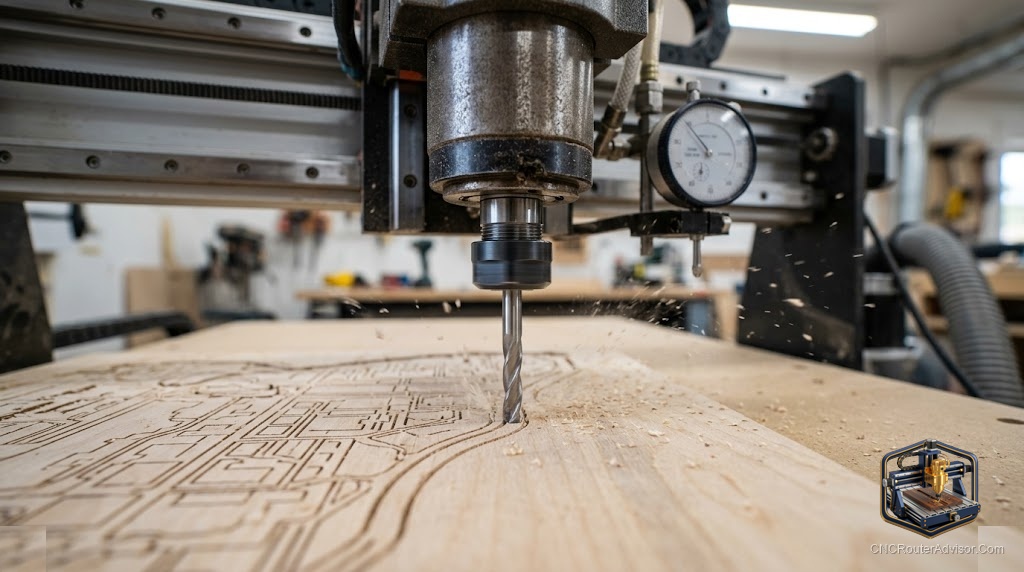
At 1/32 inch, you are at the point where the bit is genuinely delicate, and the discipline required to use it well is different in character from anything you learned with larger diameter tooling. This is not a bit you push harder when the cut is going slowly. This is a bit you run conservatively, with maximum spindle speed, minimum depth per pass, and zero tolerance for workpiece vibration, and you accept that even under perfect conditions, small bits at this diameter have a meaningful failure rate because at 0.8 mm, the cutting forces that a chip load generates are a significant fraction of the bit’s cross-sectional strength. Understanding that going in is the difference between frustration and competence.
A 1/32 inch CNC router bit is a micro-diameter cutting tool with a 0.8 mm cutting diameter, designed for extremely fine detail work, narrow-feature routing, micro-scale text engraving, fine PCB trace isolation, and detail passes on 3D relief carvings where smaller features require sub-millimeter geometry. At this diameter, bit longevity is shorter than at larger sizes even under correct conditions, requiring carbide construction, high spindle speed, conservative chip load, and secure, vibration-free workholding.
The short guide: use a 1/32 inch bit only when the feature genuinely requires 0.8 mm geometry. Run it at maximum spindle speed (24,000 RPM on desktop machines), feed conservatively (200 to 400 mm per minute to start), take passes no deeper than 0.2 to 0.3 mm, secure the workpiece with blue tape and CA glue at minimum, and accept that some breakage is part of the cost of working at this scale. Buy in packs rather than individual bits.
When a 1/32 inch bit is the right tool
Three applications genuinely require 1/32 inch diameter tooling and cannot be substituted with a larger bit.
Micro-scale text and lettering. Characters under 5 mm in height often have interior features (enclosed letterforms in certain fonts, tight serifs) that a 1/16 inch bit would fill in. A 1/32 inch bit reaches the geometry. Run shallow passes; text engraving at this scale is typically shallow V-carving or flat-bottom engraving that does not require deep cuts.
PCB trace isolation at fine pitch. High-density PCB designs with fine trace spacing need narrow isolation passes. A 1/32 inch V-bit or spiral bit is a standard tool in PCB routing for fine-pitch work, and it is used in quantity because FR4 fiberglass is abrasive and dulls micro-diameter bits quickly.
Fine 3D carving detail passes. On a 3D relief carving with extremely fine surface detail, the finishing pass with a 1/32 inch tapered ball-nose reaches detail that a 1/16 inch ball-nose bridges over. This is the application where the quality improvement is most visible to the eye, and where the time investment (micro step-over passes at slow feed) is most justified by the result.
Speeds and feeds: starting points
At 0.8 mm diameter, chip load must be kept very small. Starting points for a 1/32 inch two-flute carbide spiral in wood:
- Spindle speed: 24,000 RPM (maximum for desktop spindles)
- Feed rate: 200 to 400 mm per minute (start at the lower end)
- Depth of cut: 0.15 to 0.3 mm per pass
- Full depth / plunge: Avoid; always ramp or helical entry if possible
For acrylic, use similar feed rates with slightly lower spindle speeds (18,000 to 20,000 RPM) to reduce heat-induced gumming. For PCB material, follow the bit manufacturer’s recommendations for FR4, which typically allow higher feed rates because the material produces shorter chips, but dull the bit faster.
The chip load range for a 1/32 inch two-flute carbide end mill in wood is approximately 0.001 to 0.002 inches per tooth, significantly lower than larger diameters. Chip load calculators like CNCCookbook’s tool confirm these numbers and help you find the correct feed rate for your spindle speed and material combination.
Workholding: non-negotiable at this scale
Any vibration in the workpiece at 1/32 inch diameter breaks bits. The bit’s cross-sectional moment of inertia is tiny: a workpiece that shifts 0.1 mm laterally during a cut at this scale is a workpiece that snaps the bit. Blue tape with CA glue between the two tape faces is the minimum workholding for precision fine work at this diameter. For PCB routing, a dedicated PCB hold-down board or vacuum fixture is standard.
Do not use only double-sided tape on a workpiece that has dimensional variation. The slight height differences across the material surface, combined with a 0.2 mm depth of cut, mean that the bit is alternately cutting too deep and too shallow. A perfectly flat, perfectly held workpiece is the foundation for 1/32 inch work.
Machine requirements for 1/32 inch bits
At 0.8 mm diameter, spindle runout matters in a way it does not at larger bit sizes. A spindle with 0.1 mm runout (tool tip wobble) is 12 percent of the bit’s diameter. This deflects the cutting edge significantly from the programmed path and increases the load on the bit substantially. Machines with tighter spindle runout (purpose-built CNC spindles with ER collets) run 1/32 inch bits more reliably than machines with looser runout (most trim routers).
Z-axis play also matters: any looseness in the Z-axis carriage that allows the spindle to bounce slightly during a cut will snap 1/32 inch bits during the cut. Check and minimize Z-axis play before running micro-diameter tooling.
Bit selection at 1/32 inch: buy in packs
At this diameter, even well-run bits break periodically. Buying single premium carbide bits and expecting them to last as long as larger tooling is a path to frustration. Established suppliers sell 1/32 inch carbide bits in packs of five or ten for exactly this reason. The SpeTool downcut spiral and the Amana Tool carbide line cover the quality end of the market, but for PCB routing where high turnover is expected, quantity packs from tooling suppliers on Amazon serve the application without the premium.
For machine requirements and spindle runout guidance, our guide on how to choose a CNC router addresses the specs that matter for precision fine work.
The takeaway: a 1/32 inch CNC router bit is a genuine precision tool for genuine precision applications. Micro-scale text, fine PCB trace work, and detailed 3D carving finishing passes are where it earns its place. Run it conservatively, hold the workpiece rigidly, keep a spare on hand, and it produces results at a scale that larger bits physically cannot reach.
Frequently asked questions
How fragile is a 1/32 inch CNC router bit? Significantly fragile compared to larger diameters. At 0.8 mm, the cross-section is small enough that workpiece vibration, excessive chip load, or incorrect collet fit can break it. Conservative settings and rigid workholding are required.
What spindle speed is correct for a 1/32 inch bit? Maximum spindle speed available, typically 24,000 RPM on desktop machines, to maintain adequate surface footage at the tiny diameter.
How deep should each pass be at 1/32 inch? 0.15 to 0.3 mm per pass in wood. Never attempt full-depth cuts at this diameter.
Can I use a 1/32 inch bit for PCB routing? Yes, it is a standard PCB routing diameter for fine-pitch trace isolation. Buy in quantity because FR4 fiberglass dulls micro-diameter bits quickly.
Should I buy 1/32 inch bits individually or in packs? In packs. At this diameter, some breakage is expected even under correct conditions, and quantity packs are far more cost-effective than individual premium bits.
What is the minimum feature size a 1/32 inch bit can cut? Features down to approximately 0.8 mm width, limited by the bit diameter. Sharper corners than half the bit radius (0.4 mm) are not possible without EDM or other non-mechanical processes.
References
- CNCCookbook, Feeds and Speeds for Micro-Diameter End Mills — https://www.cnccookbook.com/cnc-speeds-feeds/
- Carbide Depot, micro-diameter CNC router bit selection — https://www.carbidedepot.com/
- Practical Machinist, micro-tooling discussions — https://www.practicalmachinist.com/forum/