
MDF on a CNC Router: The Best Bits, Settings, and Dust Reality
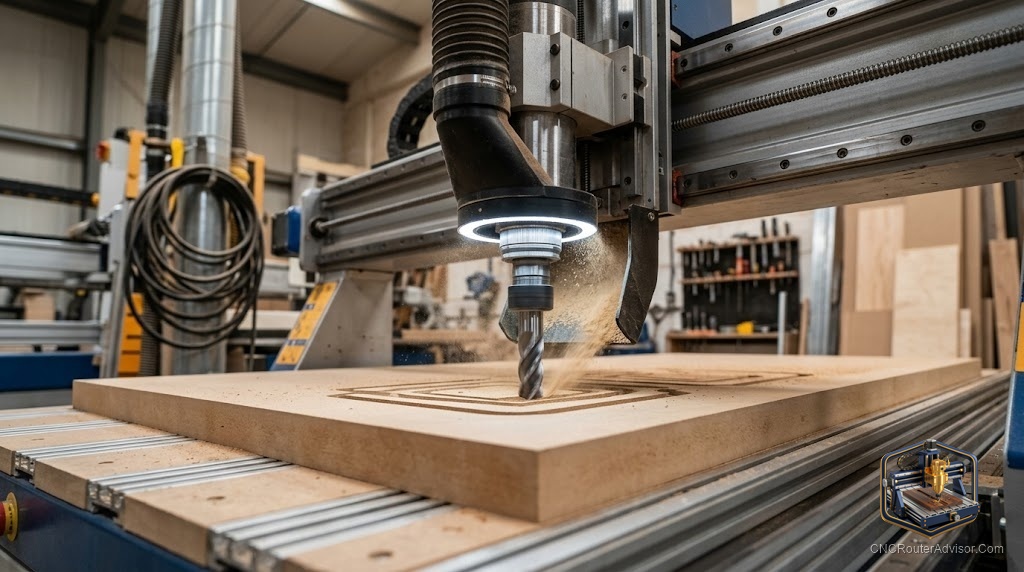
MDF is the material CNC people love to hate and cut anyway, and there is a good reason for the love-hate. It is flat, cheap, uniform in every direction, and it machines into crisp detail that plywood cannot match, which makes it the go-to for signs, jigs, templates, and spoilboards. It also produces the finest, most invasive dust of anything you will put on the machine, and it chews through bits faster than you expect. Cut MDF well and it is a dream material. Cut it carelessly and it is a lung hazard and a bit graveyard. The difference is entirely in your tooling, settings, and dust setup.
MDF (medium-density fiberboard) is an engineered wood made of fine wood fibers bonded with resin under pressure, giving it a dense, consistent structure with no grain direction. On a CNC router that uniformity means clean, chip-free edges and excellent detail, which is why it is a favorite for signs, prototypes, and templates. The catches are aggressive tool wear from the abrasive resin and extremely fine dust that demands serious extraction.
The short answer to cutting it well: use carbide bits, because the resin dulls anything softer fast. Favor down-cut or compression geometry for clean edges. Run a healthy chip load so you are cutting rather than rubbing. And treat dust extraction as mandatory, not optional. Nail those and MDF gives you some of the cleanest results a CNC router is capable of.
Why MDF cuts so cleanly, and so abrasively
MDF’s superpower is that it has no grain. Wood tears out because fibers run in a direction, but MDF’s fibers point everywhere and nowhere, so edges come out smooth and detail stays crisp regardless of cut direction. That is why intricate signs and precise templates are so satisfying to cut in it, and why so many people surface their spoilboards from it.
The same resin that binds those fibers is abrasive, and that is the trade-off. It wears cutting edges noticeably faster than solid wood does, so soft or cheap bits dull quickly and start rubbing instead of cutting, which burns the material and ruins the finish. Bit choice is not a detail with MDF, it is the whole ballgame.
The bits that actually last in MDF
Carbide is the baseline, not an upgrade, because the resin dulls high-speed-steel edges too fast to bother. Beyond material, geometry decides your edge quality.
Compression bits cut up at the bottom and down at the top, leaving clean edges on both faces, which is ideal for through-cuts in thicker MDF. The Amana Tool 46170-K compression spiral bit is a well-regarded solid-carbide option when edge quality on both sides matters.
Down-cut bits push chips downward, leaving a clean top surface, which is exactly what you want for engraving and shallow pocketing where the visible face is on top. The Whiteside RD2100 down-cut spiral is a trusted name-brand choice, and the SpeTool down-cut bit offers a solid option for the same geometry.
If you are still building out a starter set, a router bit essential kit covers common profiles so you can match the cutter to the job, and a spoilboard surfacing bit is worth owning because MDF is the classic spoilboard material and you will want to resurface it flat periodically.
The honest caveat: even the best carbide bit is a consumable in MDF. Expect to replace bits sooner than you would when cutting solid wood, and inspect edges for dullness regularly. Burning and fuzzy cut walls are the tells that a bit is past its peak.
Settings: cut, do not rub
The cardinal sin with MDF is a dull-acting cut caused by too slow a feed for the spindle speed. The bit rubs, generates heat, and burns the material. The fix is a healthy chip load: pair a moderate spindle speed with a feed rate fast enough that the bit is peeling material, not polishing it. Take reasonable depth per pass rather than forcing a full-thickness cut in one go, especially on thicker stock, since MDF’s density loads the bit hard.
Exact numbers depend on your machine’s rigidity and spindle, so start with your bit maker’s recommended chip load and adjust by listening. A clean cut sounds like cutting. A burning cut sounds like whining and smells like it too.
Because MDF is uniform, it is actually a forgiving material to dial in once your chip load is right. It just punishes the specific mistake of rubbing more clearly than most materials do.
The dust reality nobody should ignore
Here is the part that matters more than any bit choice. MDF dust is extremely fine, it hangs in the air, and it contains resin. Breathing it is genuinely bad for you over time. Serious dust extraction is not a finish-quality nicety with MDF, it is a health requirement. Run a dust shoe on the spindle connected to a proper collector, wear a fitted respirator rated for fine particles (a basic paper mask does not filter this dust adequately), and keep the shop ventilated.
Anyone who tells you MDF dust is no big deal has not read the material safety guidance. Treat it with respect and MDF is fine to work with. Ignore the dust and you are trading clean signs for your lungs.
Who MDF is right for, and when to skip it
Reach for MDF when you want crisp detail, dead-flat stock, dimensional consistency, and low cost, for signs, templates, jigs, prototypes, and spoilboards. Skip it when the part needs moisture resistance (MDF swells badly when wet), structural strength, or a visible natural edge, because MDF’s cut edge is plain and its screw-holding is weak compared to solid wood. Match the material to the job and MDF earns its permanent spot in the shop.
If you are choosing a machine with MDF and sheet work in mind, our guide on how to choose a CNC router helps match rigidity and work area to the material.
The takeaway: MDF rewards good tooling and punishes bad habits more clearly than almost any other material. Use carbide, pick down-cut or compression geometry for clean edges, keep a real chip load so you cut instead of rub, and take the dust seriously. Do that and MDF gives you some of the sharpest, most repeatable results your CNC router is capable of.
Frequently asked questions
What bit is best for cutting MDF? A carbide bit, since MDF’s resin dulls softer edges fast. Use compression geometry for clean through-cuts and down-cut geometry for a clean top surface on engraving and pocketing.
Why does my MDF cut burn? Usually because the bit is rubbing instead of cutting, from too slow a feed for the spindle speed, or a dull bit. Increase your chip load and check the bit for wear.
Is MDF dust dangerous? Yes. It is very fine and contains resin, so it is a real respiratory hazard. Use a dust shoe and collector, wear a fitted fine-particle respirator, and ventilate the shop.
How many passes should I use in MDF? Take moderate depth per pass rather than full thickness at once, especially in thicker stock, because MDF’s density loads the bit. Adjust to your machine’s rigidity and spindle power.
Does MDF dull bits faster than wood? Yes, noticeably, because the bonding resin is abrasive. Even good carbide bits are consumables in MDF, so expect to replace them sooner than when cutting solid wood.
Can I use MDF for a spoilboard? Yes, it is a classic spoilboard material because it is flat, cheap, and uniform. Surface it flat with a surfacing bit and resurface periodically as it wears.
References
- Router Forums, “Cutting MDF on a CNC: Bits and Feeds” — https://www.routerforums.com/threads/cutting-mdf-on-cnc.html
- Carbide 3D Community, “Best Bits and Settings for MDF” — https://community.carbide3d.com/t/best-bit-for-mdf/
- CDC / NIOSH, “Wood Dust and MDF Resin Exposure Guidance” — https://www.cdc.gov/niosh/topics/wooddust/