
CNC Router Machine for Wood: Machine Features, Tooling, and Buying Advice
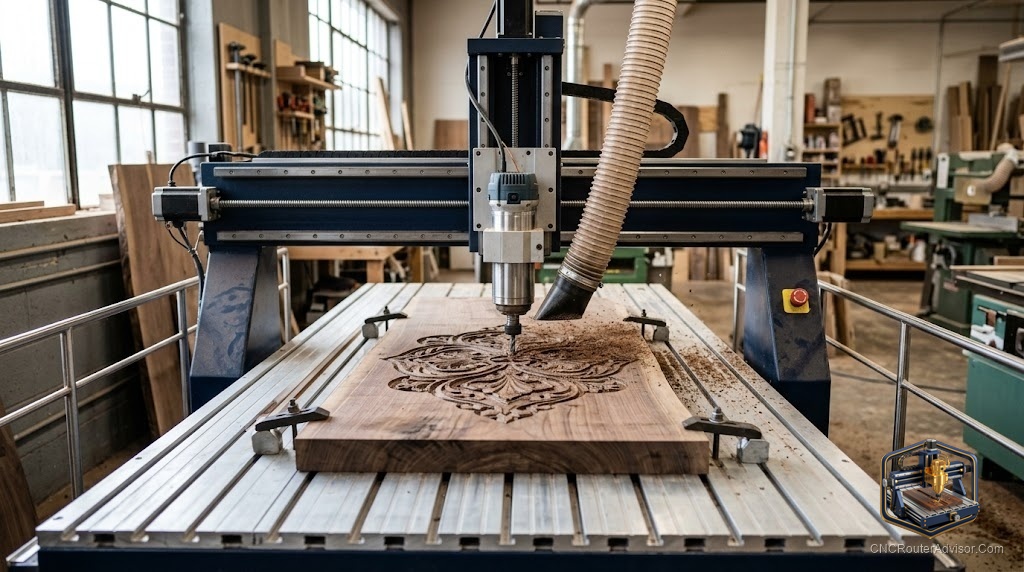
You can find a CNC router machine for wood at every price tier from a few hundred dollars to several hundred thousand. Most of the confusion at buying time comes from comparing machines across tiers as if they were direct competitors. A hobby tabletop unit and an industrial 4x8 production router both cut wood, in the same way a table saw and a hand saw both cut wood. The comparison that matters is between machines built for the same workload.
A CNC router machine for wood is a computer-controlled cutting system that moves a spinning end mill or router bit through wood and wood-based materials along a programmed path. The machine moves on two horizontal axes (X and Y) and one vertical axis (Z). A spindle or router motor at the Z axis holds the cutting tool. The whole system follows a G-code program generated by CAM software from a digital design file.
The short buying answer: match the machine’s work area to your largest regular workpiece, choose a VFD spindle over a trim router for any production use, and verify that the frame is rigid enough for the densest material you plan to cut. Everything else, including the control system and the dust shoe, is adjustable or upgradeable after you are running.
The Machine Types That Actually Exist
Hobby and benchtop CNC routers cover machines with work areas roughly 12 by 12 inches up to about 24 by 24 inches. Common names in this category include the Shapeoko, X-Carve, and Onefinity Woodworker. They use trim routers (Makita RT0701C, DeWalt DWP611) as the cutting head, which limits power and RPM control but keeps the cost accessible. These machines cut softwood, MDF, and thinner hardwood panels well. They struggle with deep passes in dense hardwood because the trim router lacks the torque of a dedicated spindle, and the lighter frame deflects more under cutting force.
Mid-range production routers cover the 24-by-48-inch to 48-by-96-inch range with VFD-controlled spindles in the 1.5kW to 4.5kW range. This is where most small furniture shops, sign businesses, and woodworking studios operate. The step up from a hobby machine is significant: rigid welded steel frames, spindles with proper collets (ER20 or ER25), and linear guide systems that hold accuracy over long cutting sessions.
Industrial production routers start at the 4x8 format and run larger. They add servo drives for closed-loop position control, automatic tool changers, high-power spindles (9kW and above), and vacuum tables as standard.
The Five Features That Actually Matter When Buying
1. Work area. The machine must fit your largest regular workpiece with room for workholding hardware.
2. Spindle type and power. Trim routers (1.25 hp and under) work for light wood and hobby use. For regular production in 3/4-inch hardwood or full-sheet MDF nesting, a VFD-controlled spindle in the 2.2kW to 4.5kW range is the practical minimum.
3. Frame rigidity. Gantry deflection under cutting force is the primary cause of dimensional error and chatter in surface finish.
4. Drive system: stepper or servo. Stepper motors are open-loop. Servo motors are closed-loop and correct errors. For most wood routing work, well-tuned steppers with quality drivers are adequate.
5. Control system. The control system is the interface between your CAM file and the machine’s motors.
Spindle vs. Trim Router: Where the Real Difference Shows
A trim router spins at a dial-controlled speed with no electronic feedback to maintain RPM under load. Under a heavy cut, the spindle slows, chip load drops, and the bit starts to rub. This is why trim-router CNC machines are more prone to burn marks in hardwood than spindle-based machines.
A VFD-controlled spindle maintains its programmed RPM as cutting load increases. The VFD adjusts power to the motor to hold speed. This keeps chip load consistent and produces a cleaner, more repeatable cut across the full sheet.
A 2.2kW VFD spindle is the most common step-up from trim router territory. It handles 3/4-inch full-depth passes in softwood and MDF cleanly.
Collet Systems and Bit Compatibility
- ER11: Accepts up to 7mm. Found on very small hobby machines.
- ER20: Accepts up to 13mm. The most common collet on mid-range production machines.
- ER25: Accepts up to 16mm.
- ER32: Accepts up to 20mm. Found on industrial spindles.
For wood routing with standard carbide bits, ER20 covers the full range of tooling you will realistically use.
The Whiteside CNC Router Bit Starter Set, 5-Piece is a good first kit. All five bits use 1/4-inch shanks and cover profiling, straight cutting, and basic engraving. The honest limitation: the set does not include a compression bit, which you will want to add separately for any through-cut work on plywood or melamine.
For production through-cuts on laminated sheet goods, the Freud 77-208 1/2” Double Compression Bit is the go-to option.
Material Capability by Machine Tier
- Softwood (pine, cedar, poplar): Cuts cleanly on any machine with adequate chip load and sharp tooling.
- Hardwood (oak, maple, walnut): Demands chip load precision. A VFD spindle that holds RPM under load is noticeably better here.
- Plywood: Cuts cleanly with compression bits.
- MDF: The easiest material to machine on a CNC router. Full dust collection is mandatory.
Workholding Options by Method
| Method | Best For | Limitation |
|---|---|---|
| T-slot with clamps | General purpose | Clamps must stay outside toolpath |
| Vacuum table | Full-sheet production | Requires pump |
| Tabs and bridges | Light production | Manual cleanup |
| Double-sided tape | Thin stock | Limited holding force |
| Screws into spoilboard | Odd shapes | Spoilboard accumulates holes |
Buying Advice
For a hobbyist or very small shop doing occasional sign making and light furniture parts, a benchtop machine with a trim router handles the work. For a working woodshop producing cabinet parts, furniture panels, or production sign work, the 4x8 format with a 2.2kW to 4.5kW VFD spindle is the practical standard.
Conclusion
A CNC router machine for wood is most valuable when the machine’s work area, spindle power, and drive system match what you are actually cutting on a daily basis. The tooling choices matter as much as the machine itself. A compression bit on an adequate machine produces cleaner cuts in plywood than an upcut bit on a more expensive machine.
FAQ
What is a CNC router machine for wood used for? A CNC router machine for wood cuts, profiles, carves, and engraves wood and wood-based materials along computer-programmed paths. Common applications include furniture parts, cabinet panels, signs, decorative carvings, and custom woodworking components.
What size CNC router do I need for 4x8 sheet goods? You need a machine with a cutting area of at least 1300 x 2500mm (the 1325 format) to cover a full 4x8 sheet.
What is the difference between a spindle and a trim router on a CNC machine? A VFD-controlled spindle maintains constant RPM under cutting load. A trim router slows down when force increases, which drops chip load and can cause burn marks in hardwood.
What bits do I need to start CNC routing wood? At minimum: a 2-flute upcut spiral for general cutting, a downcut spiral for clean top-surface work, and a compression bit for through-cuts in plywood. A 60-degree V-bit covers sign engraving.
Do I need a vacuum table for CNC wood routing? A vacuum table is not required, but it is significantly more efficient for full-sheet nested production.
How do I prevent burn marks when CNC routing hardwood? Burn marks come from chip load that is too low. Increase feed rate to raise chip load, replace bits that have exceeded their useful life, and adjust the toolpath to eliminate corner dwells.
Can a hobby CNC router cut hardwood? Yes, with limitations. Hobby machines with trim routers can cut hardwood at shallow depths of cut and moderate feed rates.
What is the difference between stepper and servo motors on a CNC router for wood? Stepper motors are open-loop. Servo motors are closed-loop and correct positioning errors. For most wood routing, well-tuned steppers are adequate.
References
- Techno CNC. Chip Load Data Chart. technocnc.com
- ToolGrit. CNC Router Speeds and Feeds for Wood. toolgrit.com
- Wood Magazine. A Buyer’s Guide to Benchtop CNC Machines. woodmagazine.com
- ShopBot Tools. Feeds and Speeds Charts. shopbottools.com
- Whiteside Machine Company. CNC Router Bits Product Line. whitesiderouterbits.com