CNC Spoilboard Surfacing Router Bit Guide: Types, Uses, Sizes, and Selection Tips
Ask experienced CNC users which bit surprised them most with how useful it is, and the surfacing bit comes up again and again. It is not glamorous. It does not carve fine detail or cut delicate shapes. What it does is make everything else on your machine work better, by giving you a truly flat surface to cut on. If your engravings vary in depth or your parts come out inconsistent, a spoilboard surfacing router bit may be the tool you did not know you needed.
What a surfacing bit does
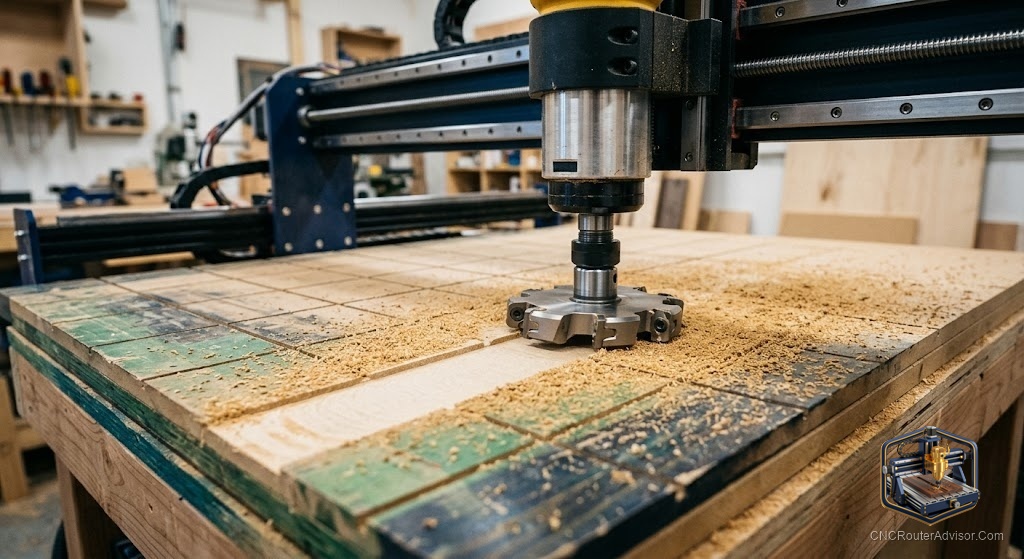
A surfacing bit, sometimes called a fly cutter or slab flattening bit, is a wide, flat-bottomed cutter designed to skim across a surface and level it. On a CNC router, its main job is flattening the spoilboard so it is perfectly parallel to the machine’s motion. Because you use the machine itself to do the surfacing, the result is a surface that is flat relative to how the cutter actually moves, which is exactly what you want. It is also used to flatten and thickness slabs and boards.
Why flatness matters so much
A spoilboard that is high on one side quietly ruins work. Carve depth changes across the piece, engravings come out uneven, and parts vary in thickness. Surfacing the spoilboard removes that error by establishing a dead-flat reference. Do it when you first set up the machine, and again periodically as the board wears, gets marked up, or after heavy use. It takes minutes and fixes a whole category of frustrating, hard-to-diagnose problems.
A proven surfacing bit
For a widely trusted option, the Whiteside 6210 surfacing bit clears a wide path, cuts cleanly, and leaves a smooth reference surface, which makes flattening a spoilboard quick and reliable. A quality surfacing bit like this pays for itself in consistency, since every accurate cut afterward depends on the flat surface it creates.
Choosing the right size
Surfacing bits come in a range of cutting diameters, and the right size depends on your machine:
- Larger diameter bits cover more area per pass, so they flatten faster, but they demand more spindle power and a rigid machine.
- Smaller diameter bits ask less of the machine and suit lighter hobby routers, at the cost of more passes.
- Shank size must match your collet, so confirm fit before buying.
Match the bit’s diameter to your machine’s power and rigidity rather than simply buying the widest one, since an oversized bit on a light machine chatters and struggles.
Using a surfacing bit well
Good surfacing comes from sensible technique. Take light passes rather than trying to remove too much at once, since a wide bit removes a lot of material even at shallow depths. Overlap each pass so no ridges are left between them. Use a moderate feed and a spindle speed suited to the bit, and let the cutter clear chips. Run dust collection, because surfacing produces a lot of dust quickly. The goal is a clean, uniform surface with no steps or ridges.
More than just spoilboards
While flattening spoilboards is its headline job, a surfacing bit is genuinely versatile. It flattens rough or cupped slabs, brings boards to a consistent thickness, and cleans up glued-up panels. For anyone working with reclaimed or rough stock, that slab-flattening ability alone can justify the tool. It turns a CNC router into a wide-format flattening machine when you need one.
A small tool with a big payoff
A spoilboard surfacing router bit is one of the highest-value tools in a CNC kit, precisely because it makes every other tool perform better. Choose a size matched to your machine, keep your spoilboard flat with periodic surfacing, and take light, overlapping passes. Do that, and the mysterious depth inconsistencies disappear, replaced by the quiet reliability of cutting on a truly flat surface.