
CNC Router MDF Guide: Tooling, Speeds, Workholding, and Finish Quality
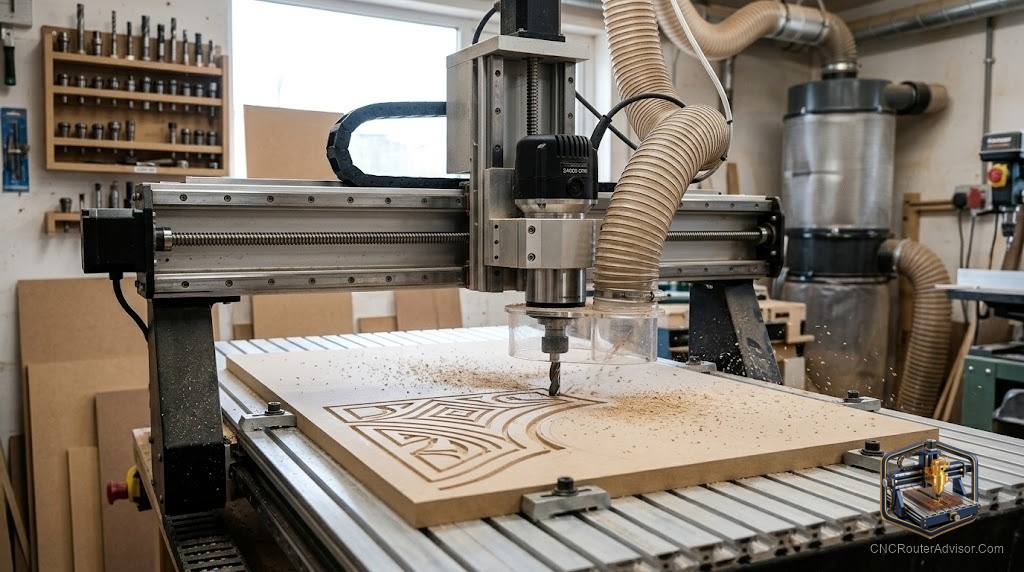
MDF is the material more CNC routers spend more time cutting than anything else. It is flat, consistent, cheap, and predictable, which makes it ideal for cabinet parts, painted furniture, signs, jigs, and spoilboard resurfacing. It also makes a truly impressive volume of very fine, very nasty dust, gums tool edges faster than most materials when settings are off, and blunts cheap bits in a way solid wood does not. Getting MDF right on a CNC router is not complicated, but it does reward doing the basics well.
CNC router MDF work is the process of cutting, pocketing, profiling, and carving medium-density fibreboard on a computer-controlled gantry machine. MDF is a composite wood product made from fine wood fibres pressed with resin, which gives it a consistent density and a smooth, paintable face, but also makes it abrasive to carbide and harmful to breathe as dust.
Short answer for MDF work: use a solid carbide spiral end mill, run dust collection from the first second of the cut, keep the bit sharp and sized to the job, and expect to resurface your spoilboard more regularly than with solid wood. MDF is not hard to cut; it just punishes shortcuts.
Why MDF behaves the way it does
MDF’s consistency is its main advantage and its main machining challenge. The resin binders in MDF make it uniformly dense, which means a bit that cuts cleanly at one point cuts cleanly across the whole sheet. That consistency is why MDF machines so predictably. But those same resins are abrasive, dulling carbide faster than most solid woods, and the fine dust they produce when cut is a respiratory hazard. Both of those are manageable; neither is ignorable.
The other thing MDF does not do well is hold mechanical fasteners, especially screws near an edge. Plan workholding around through-bolts, wedge clamps, or a vacuum table rather than screwing into the edge.
Tooling for MDF
Solid carbide end mills, not high-speed steel, and not carbide-tipped wood bits if you are cutting volume. MDF’s abrasiveness wears HSS quickly enough that you notice it in finish quality within a short run. Solid carbide holds its edge far longer.
For most MDF work, a two-flute solid carbide up-cut spiral is the standard tool: it clears chips well, holds its edge, and produces a clean cut edge and floor on pockets. A down-cut spiral produces a cleaner top surface on through-cuts where the face matters. The IDC Woodcraft 3/8-inch compression end mill is worth having for melamine-coated or veneered MDF where both faces need to be clean in one pass.
For spoilboard resurfacing, a large surfacing bit covers more area per pass and leaves a consistently flat surface. The Whiteside 6210 spoilboard surfacing router bit is a reliable choice: 2-3/4-inch cutting diameter with replaceable inserts, designed specifically for this job.
Feeds and speeds for MDF
MDF cuts best at moderate spindle speed and a genuine feed rate. The combination that produces fine dust is the same as the combination that produces poor finish: too high a spindle speed with too low a feed rate. The bit dwells in the cut, rubbing rather than shearing, generating heat, and creating powder rather than chips. A real chip load, achieved by pushing the feed rate, gives a cleaner cut and a more coarse chip that collects more easily.
A practical starting point for a 6mm two-flute carbide end mill in MDF: 18,000 RPM, feed rate in the range that your machine handles without stalling, 3 to 4mm depth of cut per pass. Adjust from there based on what you hear and see: a steady cutting sound and visible chips mean you are in range; fine powder and heat mean you are rubbing.
Workholding MDF
MDF is heavy and flat, which makes it easy to hold on a spoilboard with standard hold-downs or T-slot clamps. For nested parts, a vacuum table is by far the most practical approach at full-sheet scale. For smaller parts without a vacuum table, double-sided tape and edge clamps work; just confirm the tape is strong enough for the cutting forces because MDF nested parts can be heavy.
Dust collection: not optional
MDF dust is fine, abundant, and harmful to breathe. A dust boot or shoe with a proper vacuum or dust collector running from the first second of the cut is the only acceptable setup. A spoilboard full of MDF swarf with no collection running is both a health issue and a mess. Real collection means real airflow: a small shop vacuum will manage smaller machines; a dedicated dust collector is required for larger tables and longer runs.
The verdict
MDF is a rewarding CNC material when the basics are right: solid carbide tooling, a real feed rate rather than a dwelling slow cut, proper dust collection from the first second, and regular spoilboard maintenance. It is the backbone of cabinet production and painted furniture work because of its consistency, and it rewards the investment in good bits and good dust management more directly than almost any other material.
Three things to remember:
- Use solid carbide end mills, not HSS; MDF’s resin binders dull cheap tooling fast and the quality shows immediately.
- Run at a genuine feed rate, not a slow crawl: MDF cut right makes chips, not powder, and chips are both cleaner and easier to collect.
- Dust collection running from the first second is not optional; MDF dust is fine, abundant, and a genuine health hazard.
FAQ
Is MDF hard to cut on a CNC router? No, MDF is consistently dense and predictable. The main challenges are managing abrasive wear on tooling, handling the volume of fine dust, and keeping the feed rate up to cut cleanly rather than dwelling and rubbing.
What bits work best for MDF? Solid carbide spiral end mills. A two-flute up-cut spiral is the standard for pockets and profiles. A compression bit for coated or veneered MDF where both faces need clean edges. A large surfacing bit for spoilboard maintenance.
Why does my CNC cut MDF look burnt or powder-dusty instead of clean? The feed rate is too low relative to the spindle speed. The bit is dwelling and rubbing rather than shearing. Increase the feed rate so the bit takes a real chip per revolution.
How often do I need to resurface my spoilboard when cutting MDF? More often than with solid wood, because MDF’s abrasiveness wears the spoilboard surface, and the bits cut below the intended depth as the spoilboard loses height. Regular surfacing keeps parts to spec.
Do I need a vacuum table for MDF work? For full-sheet nested parts, a vacuum table is the most practical hold-down. For smaller individual parts, hold-downs and double-sided tape work, but confirm the holding force matches the weight and cutting forces of the part.
Is MDF dust actually dangerous? Yes. MDF dust is very fine and contains resin binders that are respiratory irritants. Proper dust collection and respiratory protection (not just nuisance masks) are required for regular MDF work.
Can I engrave or carve MDF on a CNC router? Yes. MDF carves cleanly with V-bits, ball-nose bits, and straight end mills. The consistent density produces smooth, detailed results in carved lettering and relief work.
References
- Whiteside Machine, 6210 Spoilboard Surfacing Router Bit (product specifications): https://www.whitesiderouterbits.com/products/6210
- CNC Router Info, Best CNC Router Bits (MDF and wood section): https://cncrouterinfo.com/guides/best-cnc-router-bits/
- Amana Tool, Solid Carbide CNC Router Bits for Wood: https://www.amanatool.com/products/cnc-router-bits/