
CNC Router End Mills Guide: Types, Uses, Sizes, and Selection Tips
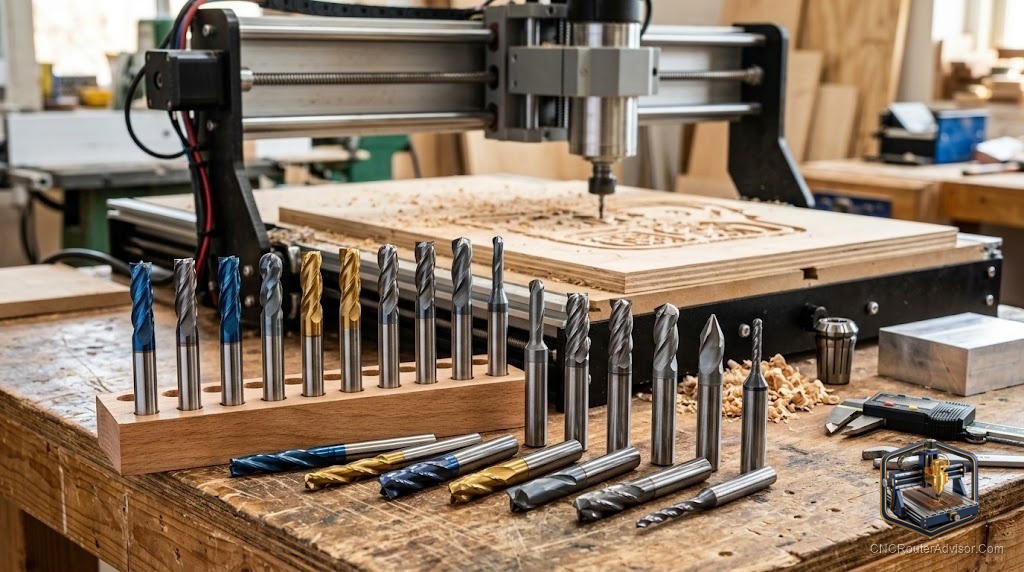
Every clean edge, smooth surface, and precise pocket on a CNC router comes from the end mill. The machine moves the bit; the bit does the cutting. Yet end mills are where many people stop thinking and just buy “a pack of router bits,” which is how you end up with the wrong tool doing a passable job when the right one would have done it better, faster, and with less load on the machine. This guide covers the types of CNC router end mills, what each is actually for, how to choose by job, and specific picks that work.
CNC router end mills are rotating cutting tools that mount in the router’s collet and remove material as they move through it. Unlike drill bits, which cut only on their tip, end mills cut on their sides as well, allowing them to cut profiles, pockets, and contoured surfaces. Each geometry is engineered for a specific type of cut and material, and using the right one is the difference between clean work and wasted stock.
Short answer for selecting end mills: know the job first. Spiral up-cut for clearing material, down-cut for clean top edges, compression for plywood and veneered panels, V-bit for lettering and chamfers, ball-nose for 3D carving, and a surfacing bit for the spoilboard. Those six handle the vast majority of CNC wood work.
Spiral up-cut end mills: the everyday workhorse
The up-cut spiral is the default for most cutting and pocketing. Its flutes pull chips up and out of the cut, keeping the tool clear, running cool, and cutting efficiently. The trade-off: upward chip movement can leave a slightly frayed top edge on plywood, which matters less for painted parts and a lot more for finished visible surfaces.
Down-cut end mills: clean top edges
The down-cut pushes chips downward, leaving the top surface clean and chip-free. Use it for the final pass on surfaces where a clean top edge matters, or for thin materials that would vibrate under an upward pull. Chips pack down rather than clearing, so shallower passes prevent clogging.
Compression end mills: the cabinet maker’s standard
A compression bit is up-cut at the tip and down-cut at the top of the flute, cutting upward at the bottom and downward at the top simultaneously. Result: clean edges on both faces in a single pass, ideal for plywood, veneered MDF, and melamine.
The IDC Woodcraft 3-piece compression end mill set covers the most-used sizes for cabinet shops. The IDC Woodcraft 3/8-inch compression upcut end mill is the individual pick when you know your size and want spares. Honest flaw: small-diameter compression bits can deflect or snap on full-depth cuts, so take a light first pass, then a full-depth finishing pass.
V-groove and V-bits: lettering, chamfers, V-carving
V-bits cut a tapered groove whose width depends on depth, perfect for sign lettering, chamfers, and decorative V-groove work. 60-degree and 90-degree are the most common angles.
Ball-nose end mills: 3D carving
The rounded tip leaves a smooth scalloped surface on 3D relief work, carved panels, and topographic shapes in wood. Finer step-over between passes means smoother result and longer run time.
Surfacing bits: spoilboard and slab work
A wide, flat-cutting geometry designed to skim large flat areas quickly. Use it to resurface a marked-up spoilboard, flatten a live-edge slab, or level material height across a sheet. The Whiteside 6210 spoilboard surfacing router bit is a consistently recommended pick: 2-3/4-inch cutting diameter, replaceable inserts, clean flat floor.
Size and shank selection
Most hobby and prosumer CNC routers use 1/4-inch or 1/8-inch shank end mills. Larger shanks are more rigid for heavier cuts; smaller shanks enable finer detail. Match shank to collet exactly, and buy solid carbide for regular use.
The verdict
Build a targeted set rather than a large variety pack. An up-cut spiral, a compression bit, a V-bit, a ball-nose, and a surfacing bit handle most CNC wood projects, and quality in those five beats a drawer full of mediocre generics.
Three things to remember:
- Choose by job: up-cut for clearing, compression for plywood both faces, V-bit for lettering, ball-nose for 3D, surfacing for the spoilboard.
- Match shank to collet exactly; use solid carbide for all regular work.
- Compression bits need a light roughing pass before a full-depth finishing pass to prevent deflection and snapping.
FAQ
What are CNC router end mills? Rotating cutting tools that mount in the collet and cut on their sides and tip, allowing them to cut profiles, pockets, slots, and contoured surfaces with different geometries optimised for different jobs.
What end mill should I start with for wood? A two-flute solid carbide spiral up-cut is the practical starting point. Add a compression bit for plywood and a V-bit for lettering.
What is a compression end mill for? Clean edges on both faces of plywood, veneered panels, and melamine in a single pass.
When should I use a ball-nose end mill? For 3D carving and relief work where you want a smooth contoured surface.
What size end mill do I need? Check your collet: most hobby routers use 1/4-inch or 1/8-inch shanks. Match shank to collet exactly.
Carbide or high-speed steel? Solid carbide for everything beyond the lightest use. It holds its edge far longer at CNC speeds.
How do I stop plywood from chipping on the top face? Use a compression end mill for full-depth cuts, or take a light down-cut scoring pass first, then cut through with an up-cut.
References
- Amana Tool, Solid Carbide CNC End Mills: https://www.amanatool.com/products/cnc-router-bits/
- Whiteside Machine, 6210 Spoilboard Surfacing Router Bit: https://www.whitesiderouterbits.com/products/6210
- CNC Router Info, Best CNC Router Bits: https://cncrouterinfo.com/guides/best-cnc-router-bits/