
CNC Router Collet Guide: Types, Sizes, Uses, and Selection Tips
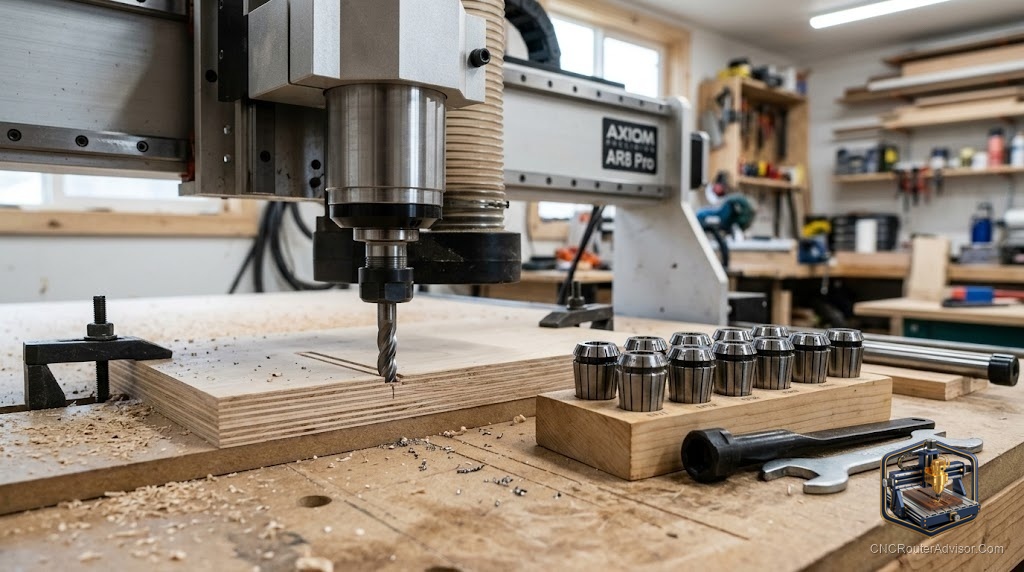
The collet is the small, unglamorous part that holds your bit, and it quietly decides whether your cuts are crisp or ruined. A worn, wrong, or badly seated collet causes runout, the bit wobbling instead of spinning true, which shows up as rough finishes, oversized cuts, broken bits, and mysterious chatter that no change of feeds and speeds will fix. Understanding collets is one of those small pieces of knowledge that solves a surprising number of frustrating problems.
A CNC router collet is the precision sleeve that grips the bit’s shank inside the spindle, and choosing the right type and size, and keeping it in good condition, is essential for accuracy, finish quality, and safety. This guide covers the common collet types, the sizes you will meet, how to use one correctly, and how to select and care for them.
What a collet does and why it matters
The collet clamps the bit shank concentrically so the bit spins exactly on the spindle’s axis. When it works, the bit runs true. When the collet is worn, dirty, mismatched to the shank, or under-tightened, the bit runs with runout, and every problem downstream, poor finish, inaccurate dimensions, premature bit breakage, follows from that. Treat the collet as a precision part, not a throwaway.
Common collet types
- ER collets. The most common system on quality router spindles. ER collets are versatile, accurate, and available in a wide range, held by a nut on the spindle. Common designations include ER11, ER16, ER20, ER25, and ER32, each covering a range of shank sizes.
- Router-style collets. On machines that use a trim router as the spindle, the router’s own collet holds the bit, typically in 1/4 inch and 1/8 inch, or 6mm and 8mm on European routers.
- Fixed-size collets on some spindles accept only one shank diameter.
ER collets dominate because one spindle can accept many sizes just by swapping the collet.
Sizes: matching collet to shank
Each collet holds a small range of shank diameters, roughly a millimetre of clamping window, so you match the collet to the bit shank:
- ER11 suits small shanks up to about 1/4 inch (7mm), common on smaller spindles like 65mm and 80mm units.
- ER16 and ER20 cover larger shanks, with ER20 handling roughly 1 to 13mm across its collet set.
- A collet must match the shank closely. An ER collet rated for 6mm will not properly grip a 1/4 inch (6.35mm) shank, and forcing a near-miss causes runout and slippage.
Confirm both your spindle’s collet system (which ER size it takes) and the shank sizes of your bits, then buy the collets that bridge them.
Using a collet correctly
This step trips up many beginners and is worth getting right:
- Seat the collet into the nut first. On ER systems, the collet clips into the nut before the nut goes onto the spindle. The nut has an eccentric ring that both seats and later extracts the collet. Never thread a loose collet onto the spindle and then push the bit through, as it will not clamp correctly.
- Insert the bit shank into the seated collet, leaving enough shank engaged, not gripping on the cutting flutes.
- Thread the nut on and tighten with the proper wrenches to a firm, secure grip.
- Do not bottom the bit out hard against the spindle. Leave a small gap.
Selection and care tips
- Buy quality collets, since a precision collet has low runout and a cheap one does not, and it is false economy to pair a good spindle with a poor collet.
- Match the ER size to your spindle and buy the individual collet sizes for the shanks you use.
- Keep them clean, because chips and dust in the collet or nut cause runout. Clean the collet, nut, and spindle taper regularly.
- Replace worn collets, as they wear out and lose grip and accuracy over time.
- Never grip on flutes, only on the smooth shank, to protect both the bit and the collet.
The honest verdict
The collet is a precision part disguised as a cheap accessory, and treating it that way solves problems that feeds and speeds cannot. Match the collet to both your spindle’s ER size and your bit shanks, seat ER collets into the nut before threading them on, keep everything clean, and replace collets when they wear. Buy quality, because a wobbling bit from a worn or mismatched collet ruins finish, accuracy, and tools no matter how good the rest of the machine is. Get the collet right and a whole category of frustrating cutting problems simply disappears.
Frequently asked questions
What is a collet on a CNC router? The precision sleeve that grips the bit’s shank inside the spindle, holding it concentric so the bit spins true. It is essential for accuracy, finish, and safety.
What collet types are common on CNC routers? ER collets (ER11, ER16, ER20, ER25, ER32) on quality spindles, and router-style collets on machines that use a trim router, typically in 1/4 inch, 1/8 inch, 6mm, or 8mm.
How do I know what collet size I need? Match your spindle’s ER system to your bit shanks. Each collet holds a small range, so buy the sizes that fit the shanks you use, confirming both spindle and bits.
Will a 6mm collet hold a 1/4 inch bit? No. A 1/4 inch shank is 6.35mm and will not seat properly in a 6mm collet. Forcing a near-miss causes runout and slippage, so match the collet to the shank.
How do I install an ER collet correctly? Clip the collet into the nut first, then thread the nut onto the spindle, insert the bit into the seated collet, and tighten with the proper wrenches. Do not thread a loose collet on alone.
Why is my bit wobbling or my finish rough? Often collet runout from a worn, dirty, or mismatched collet, or one seated incorrectly. Clean it, confirm the size matches the shank, and replace it if worn.
Do collets wear out? Yes. Collets lose grip and accuracy over time and with hard use. Replace worn collets, since a worn one causes runout that ruins finish, accuracy, and bits.